


Last quarter, a mid-size skincare brand sent us their full bill of materials for a 50ml airless bottle line. They were paying three different vendors for injection molding, decoration, and assembly. When we mapped every line item, packaging alone consumed nearly half their production budget. That single audit changed their entire sourcing approach.
Packaging cost optimization is a manufacturing strategy that reduces per-unit packaging expenditure through multi-cavity tooling, lean scheduling, and automated assembly without sacrificing quality or compliance. For cosmetic brands producing at any scale, this is where margin improvement starts. The problem is that most brands treat packaging cost as a purchasing negotiation. It is an engineering problem.
This guide covers the six core strategies that drive real cost reduction on the production floor: tooling economics, automation, lean production, material optimization, in-house decoration, and supplier consolidation.
Where Cosmetic Packaging Costs Actually Go
Raw materials and packaging typically account for 40-50% of overall beauty product production budgets, according to Othila Pak. That makes packaging the single largest controllable cost center for most cosmetic manufacturers and brands alike. On average, manufacturers spend over $150 billion on packaging annually, roughly 7-10 cents per dollar spent on the product itself, according to AMSC and Specright.
The cost breakdown for a typical cosmetic packaging component splits into four buckets: resin and raw materials, mold amortization, labor and machine time, and decoration or finishing. Most brands focus on negotiating resin price. That is the least effective lever.
Mold investment drives per-unit cost more than any other single variable. A single-cavity mold producing one part per cycle ties up the same machine time as a multi-cavity tool producing four or eight parts. The math is straightforward: identical overhead, divided across more units per cycle. When brands ask us why their quoted unit price seems high, the answer is almost always tooling configuration.
Decoration is the cost category that procurement teams consistently underestimate. When silk screening, UV coating, or hot stamping is outsourced to a separate facility, the markup typically adds a significant premium to per-unit cost. That premium covers transport between facilities, quality inspection at receiving, and the decorator’s own margin. Brands paying for outsourced decoration are effectively paying twice for quality control.
Multi-Cavity Tooling and Volume Economics
Multi-cavity injection molding is a tooling strategy that produces multiple identical parts per machine cycle, distributing fixed costs across a larger output per press stroke. According to Nicolet Plastics, for annual production volumes exceeding 100,000 units, multi-cavity molds are generally more cost-effective than single-cavity tooling because machine time, labor, and overhead are divided across multiple parts per cycle.
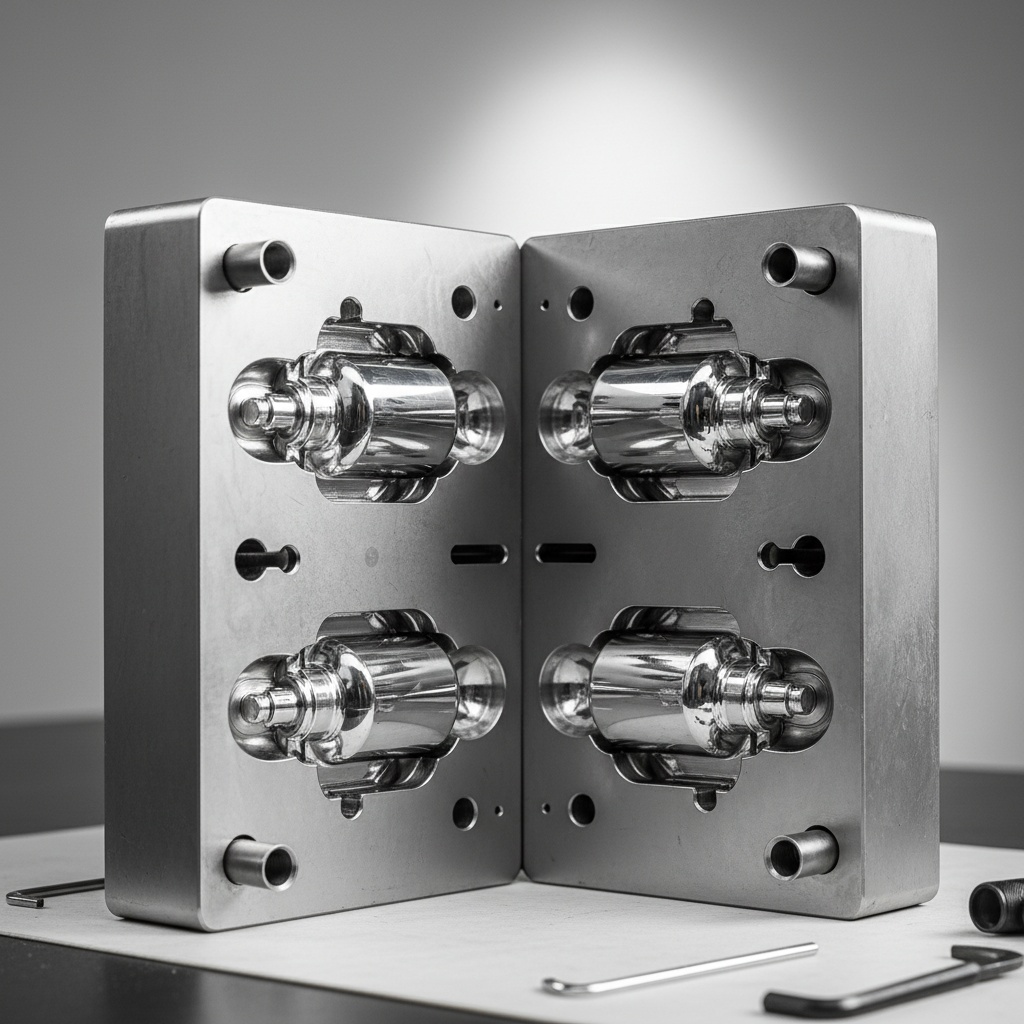
On our production floor, we run 20 injection molding machines with annual capacity exceeding 20 million sets. That fleet allows us to dedicate specific machines to multi-cavity configurations optimized for high-volume SKUs while keeping single-cavity tools available for lower-volume custom runs. The scheduling flexibility matters because not every product justifies the higher upfront tooling cost.
The break-even calculation is straightforward. Multi-cavity mold tooling costs more upfront than a single-cavity equivalent. But cycle time per part drops proportionally with cavity count. A four-cavity mold produces four parts in roughly the same cycle time as a single-cavity mold produces one. Over a production run of several hundred thousand units, the tooling premium is recovered quickly, and per-unit cost drops substantially.
Plastic materials account for 20-40% of total injection molding cost, according to SWCPU. When multi-cavity tooling reduces machine time per part, it also reduces the energy cost per part and the labor allocation per part. The compounding effect is what makes multi-cavity molding the single highest-impact lever in packaging cost optimization.
| Packaging Cost Optimization: Single vs. Multi-Cavity Comparison | Single-Cavity Mold | 4-Cavity Mold | 8-Cavity Mold |
|---|---|---|---|
| Parts per cycle | 1 | 4 | 8 |
| Relative tooling investment | Low | Medium | High |
| Machine time per part | Baseline | ~25% of baseline | ~12.5% of baseline |
| Best suited for annual volume | Low volume | Mid-to-high volume | High volume |
| Per-unit labor allocation | Highest | Moderate | Lowest |
| Breakeven speed | Immediate | Medium-term | Longer-term |
Automated Assembly as a Cost Multiplier
Automated packaging assembly is a downstream process that combines molded components, dispensing mechanisms, and closures into finished units at speeds and consistency levels that manual assembly cannot match. When brands evaluate automated assembly lines, they often think about labor cost reduction alone. The real value is the multiplication effect with upstream tooling gains.
Consider the sequence: multi-cavity molding produces four bottle bodies per cycle. Those bodies move to an automated line that inserts pumps, attaches overcaps, and applies shrink bands. If assembly is manual, the bottleneck shifts from molding to the assembly table. The upstream gains from multi-cavity tooling are partially wasted because manual assembly cannot keep pace with the faster molding output.
When both molding and assembly are optimized together, the throughput of the entire production line increases. On our production floor, we consistently find that the combination of multi-cavity tooling with automated assembly delivers cost reductions that exceed what either strategy achieves independently. The fixed overhead of facility, management, and utilities gets spread across a larger number of finished units per shift.
Automated assembly also reduces defect rates. Manual insertion of pumps into bottles introduces variability in seating depth, alignment, and torque. Each rejected unit carries the full cost of the molded body, the pump mechanism, and the assembly labor. Automated systems apply consistent force and verify assembly quality inline, catching defects before they reach packaging.
Lean Production Scheduling for Packaging Runs
Lean production in cosmetic packaging applies waste elimination principles to mold changeovers, production sequencing, and inventory management. Organizations that implement structured packaging cost reduction strategies achieve material cost savings of 15-30%, reduce damage rates by 25-40%, and improve sustainability scores, according to Specright.
The most impactful lean tool for injection molding operations is SMED (Single-Minute Exchange of Die). Every mold changeover means downtime. On a production floor running multiple SKUs across shared machines, changeover frequency directly impacts cost per unit. Reducing mold swap time from hours to minutes translates into more productive machine hours per day. For brands with multiple packaging SKUs, lean packaging production scheduling determines whether their per-unit cost is competitive or inflated.
Production leveling, known as heijunka in lean methodology, prevents the cost spikes that come from batch-and-queue scheduling. Instead of running all units of SKU A, then changing over to SKU B, a leveled schedule interleaves production in smaller batches matched to actual demand. This reduces finished goods inventory carrying cost and prevents the waste of overproduction.
On our production floor, visual management boards track machine status, changeover schedules, and defect rates in real time. When a machine falls behind schedule or a defect trend emerges, the production team responds within the same shift. This rapid feedback loop is what separates lean manufacturing from traditional batch production. Traditional scheduling hides problems in large inventory buffers. Lean scheduling surfaces problems immediately so they can be corrected before cost accumulates.
Material Selection and the PCR Cost Trade-Off
Material optimization in packaging cost reduction covers three decisions: selecting the right polymer grade for the performance requirement, optimizing wall thickness to reduce material consumption per part, and evaluating recycled content as a cost and market positioning tool.
PCR (Post-Consumer Recycled) plastic is reclaimed resin that has completed at least one consumer use cycle. Oulete processes PCR content in PP, PE, and PET at ratios from 10% to 50%. The cost trade-off with PCR is nuanced. PCR resin can carry a slight price premium over virgin material depending on grade and availability. But brands that specify PCR content gain access to retail distribution channels and buyer programs that require verified sustainability credentials.
According to Towards Packaging, the global packaging market is valued at USD 1,109 billion in 2025 and is projected to grow at 4.21% CAGR through 2034. Within that growth, sustainability-driven procurement is a structural trend, not a temporary preference. Brands that adopt PCR materials now position themselves for tightening regulations and retailer requirements rather than scrambling to reformulate later.
Wall thickness is the material optimization lever that most brands overlook. Reducing wall thickness by even a fraction of a millimeter, when validated by structural testing, reduces resin consumption per part across the entire production volume. On high-volume SKUs, this translates into measurable savings. The constraint is functional: the wall must maintain structural integrity during filling, shipping, and consumer use. Optimizing the runner system in the mold itself also reduces material waste by minimizing the amount of resin that solidifies in the channels between the injection point and the cavities.
Oulete’s capability to compound PCR materials in-house, combined with ISO 9001 quality management and SGS testing certification, means brands can specify sustainability requirements without adding a separate material supplier to the supply chain. That consolidation reduces procurement complexity and lead time variability.
In-House Decoration vs. Outsourced Finishing
Decoration cost is the hidden margin killer in cosmetic packaging. Silk screen printing, UV coating, hot stamping, and metallization are the four primary finishing processes for cosmetic bottles, jars, and tubes. When these processes are outsourced to a third-party decorator, the per-unit cost includes the decorator’s material cost, labor, margin, transportation between facilities, and incoming quality inspection at each handoff point.
Oulete operates full in-house decoration capability covering silk screen, UV coating, hot stamp, and metallization processes. When molded parts move directly from the injection press to the decoration line within the same facility, the transport cost between facilities disappears. The incoming inspection step at the decorator disappears. The decorator’s margin disappears. The lead time added by the round trip to an external facility disappears.
The quality advantage is equally significant. When a decoration defect occurs on an outsourced part, the root cause investigation spans two organizations. Response time is measured in days. When decoration runs in-house, the molding team and the decoration team share the same production floor. A printing alignment issue gets corrected within the same shift, sometimes within the same hour. The defect rate on in-house decorated parts is consistently lower because the feedback loop between molding and finishing is immediate.
For brands evaluating quotes from multiple packaging suppliers, the line item to scrutinize is decoration. Ask whether decoration is performed in-house or outsourced. If outsourced, the supplier’s quoted unit price includes markups at every handoff. A lower base molding price with outsourced decoration can easily exceed the total cost from a manufacturer with integrated finishing capability.
MOQ Planning and Total Cost of Ownership
Packaging cost optimization is expected to increase by 16.9% as a business strategy priority in future industry projections, according to Southern Packaging. That growing emphasis reflects a shift from simple unit price comparison to total cost of ownership analysis. Unit price is one variable. The full cost equation includes tooling amortization, freight, lead time risk, MOQ holding cost, quality inspection overhead, and rework rates.
According to Beauty Plus Packing, airless bottle unit costs in China range from $0.40-$1.20 for AS/PP/PETG materials with typical MOQs of 5,000 pieces per design, and lotion pump bottles run $0.25-$0.50 per unit. Those unit prices are starting points. The total cost of ownership for a packaging sourcing decision includes the cost of quality failures, the cost of holding excess inventory from high MOQ requirements, and the cost of production delays from long or unpredictable lead times.
Oulete’s MOQ of 1,000 units changes the optimization equation for indie and mid-size brands. A 5,000-unit MOQ forces smaller brands to either over-order and carry inventory or compromise on packaging specifications to fit within a stock mold program. A 1,000-unit MOQ allows brands to order closer to actual demand, test market response with smaller batches, and iterate on packaging design without writing off large obsolete inventory.
Supplier consolidation is the TCO lever that procurement teams underuse. When a brand sources bottles from one vendor, pumps from another, and decoration from a third, every interface between vendors creates coordination cost, quality risk, and lead time variability. Consolidating to a cosmetic packaging manufacturer in China that handles injection molding, assembly, and decoration under one roof, with ISO 9001 quality systems and GMP compliance at the source, eliminates interface risk and simplifies the supply chain.
The brands that achieve the lowest total packaging cost are not the ones that negotiate the lowest unit price. They are the ones that minimize the total number of handoffs, quality checkpoints, and logistics steps between raw material and finished packaged product.
Break-Even Calculations for Common Packaging Decisions
Understanding when an investment pays for itself separates strategic cost optimization from guesswork. The three most common break-even decisions in cosmetic packaging are multi-cavity tooling upgrades, in-house versus outsourced decoration, and PCR material adoption.
Multi-cavity tooling break-even depends on annual volume and the cost differential between tool configurations. According to Nicolet Plastics, multi-cavity molds become more cost-effective than single-cavity tooling at annual volumes exceeding 100,000 units. On our production floor, the break-even timeline varies with cavity count, part complexity, and order frequency. Brands with high-velocity SKUs running well above the 100,000-unit threshold typically recover the multi-cavity tooling premium within their first production year, because the per-unit machine time savings compound with every cycle.
In-house decoration break-even is faster than most brands expect. When decoration runs in-house, the elimination of inter-facility transport, incoming inspection at the decorator, and the decorator’s margin creates an immediate per-unit saving on every order. For brands running continuous production, the payback on in-house decoration infrastructure typically occurs within the first few production campaigns. The quality improvement from tighter feedback loops between molding and decoration provides additional value that does not appear in a simple cost calculation but shows up in lower defect rates and fewer customer complaints.
PCR adoption break-even operates on a different logic. The resin cost differential between virgin PP and PCR PP varies by market conditions and grade availability. But brands that specify PCR content gain measurable commercial advantages: access to retailer sustainability programs, qualification for eco-label certifications, and compliance with emerging regulations like the EU PPWR recycled content mandates. According to ISO, ISO 14021 provides guidelines for environmental claims including recycled content, which gives brands a standardized framework for communicating their PCR usage to buyers and retailers. The commercial value of these market access benefits frequently outweighs any material cost premium within the first year of adoption.
Cost Benchmarks by Packaging Category
Brands evaluating packaging costs need reference points. The following benchmarks reflect typical unit cost ranges for cosmetic packaging sourced from established Chinese manufacturers at standard MOQs.
According to Beauty Plus Packing, airless bottle unit costs in China range from $0.40 to $1.20 for AS, PP, and PETG materials, while lotion pump bottles run $0.25 to $0.50 per unit. These ranges assume standard mold configurations and volumes at or above typical 5,000-piece MOQs. At Oulete’s 1,000-unit MOQ, per-unit costs at lower volumes will sit toward the higher end of these ranges, but brands avoid the inventory carrying cost of excess stock.
Decoration adds to the base container cost. Silk screen printing, the most common finishing method for cosmetic bottles, adds a per-unit charge that varies by number of colors, coverage area, and ink type. Hot stamping for metallic finishes and UV coating for gloss or matte effects each carry their own per-unit premiums. When these processes run in-house at the same facility that molds the containers, the combined unit price is lower than the sum of separately sourced molding and decoration quotes.
Total landed cost for U.S.-bound shipments must factor in ocean freight, duties and tariffs, customs brokerage fees, and domestic last-mile logistics. Brands that evaluate only the FOB factory unit price underestimate their actual per-unit packaging expenditure. A complete TCO comparison across suppliers should use landed cost at the U.S. warehouse door as the benchmark, not the factory gate price.
FAQ
What percentage of production cost is packaging in cosmetics manufacturing?
Raw materials and packaging typically account for 40-50% of overall beauty product production budgets. This makes packaging the highest-leverage area for margin improvement because material and component costs represent the largest controllable expense category in most cosmetic manufacturing operations.
How does multi-cavity injection molding reduce per-unit packaging cost?
Multi-cavity molds produce multiple identical parts in a single machine cycle, distributing machine time, energy, and labor costs across all parts simultaneously. A four-cavity mold produces four parts in roughly the same cycle time as a single-cavity mold produces one, reducing per-part machine cost proportionally.
What is the difference between cost optimization and cost cutting in packaging?
Cost optimization is an engineering-driven strategy that reduces per-unit expenditure by improving production efficiency, tooling configuration, and process integration. Cost cutting typically means selecting cheaper materials or removing features. Optimization maintains or improves quality while reducing cost; cutting often degrades quality to reduce price.
How does lean manufacturing apply to cosmetic packaging production?
Lean manufacturing in cosmetic packaging focuses on reducing mold changeover time through SMED methodology, leveling production schedules to match demand, and eliminating the seven forms of manufacturing waste. These practices reduce idle machine time, lower work-in-process inventory, and surface defects faster than traditional batch production.
Can PCR materials reduce cosmetic packaging costs?
PCR resin pricing varies by grade and availability, and it can carry a slight premium over virgin material. The cost benefit comes from market access: retailers and distributors increasingly require verified sustainability credentials, and brands using PCR content qualify for distribution channels that exclude non-sustainable packaging.
What is the total cost of ownership when sourcing cosmetic packaging from China?
Total cost of ownership extends beyond unit price to include tooling amortization, ocean freight costs, lead time buffer inventory, quality inspection overhead, duties and tariffs, and the cost of rework or rejection at receiving. Brands that evaluate only unit price frequently underestimate their actual packaging expenditure.
How do automated assembly lines reduce cosmetic packaging costs?
Automated assembly lines reduce per-unit cost by increasing throughput, reducing manual labor allocation, and lowering defect rates through consistent force application and inline quality verification. The highest cost impact occurs when automated assembly is paired with multi-cavity molding, as the automation prevents assembly from becoming a bottleneck that limits upstream gains.
What packaging cost reduction strategies work without sacrificing quality?
Multi-cavity tooling, lean production scheduling, in-house decoration integration, and supplier consolidation all reduce cost without compromising component quality. These strategies target production efficiency and supply chain structure rather than material specifications. ISO 9001 and GMP-certified manufacturers maintain quality systems that govern cost reduction decisions within documented quality parameters.