


A European skincare brand approached us last year with a straightforward problem: their existing supplier was quoting 90 days lead time on pump caps because the single-cavity tool could only produce one part per cycle. Their order volume was 50,000 units. We moved the project to an 8-cavity mold, and the same press operator produced 8x the output per cycle. The delivery timeline dropped to under three weeks. That single tooling decision changed the economics of their entire product launch.
Multi-cavity molding is an injection molding process that produces multiple identical parts per cycle, cutting per-unit costs by dividing machine time and labor across 4 to 32 simultaneous cavities. For cosmetic packaging buyers sourcing caps, pumps, and airless bottle components, understanding how cavity count shapes cost, quality, and minimum order quantities is the difference between overpaying and building a competitive supply chain. This guide covers the real decisions behind multi-cavity tooling, written from the factory floor of a manufacturer running 20 injection molding machines daily.
What Multi-Cavity Molding Actually Means
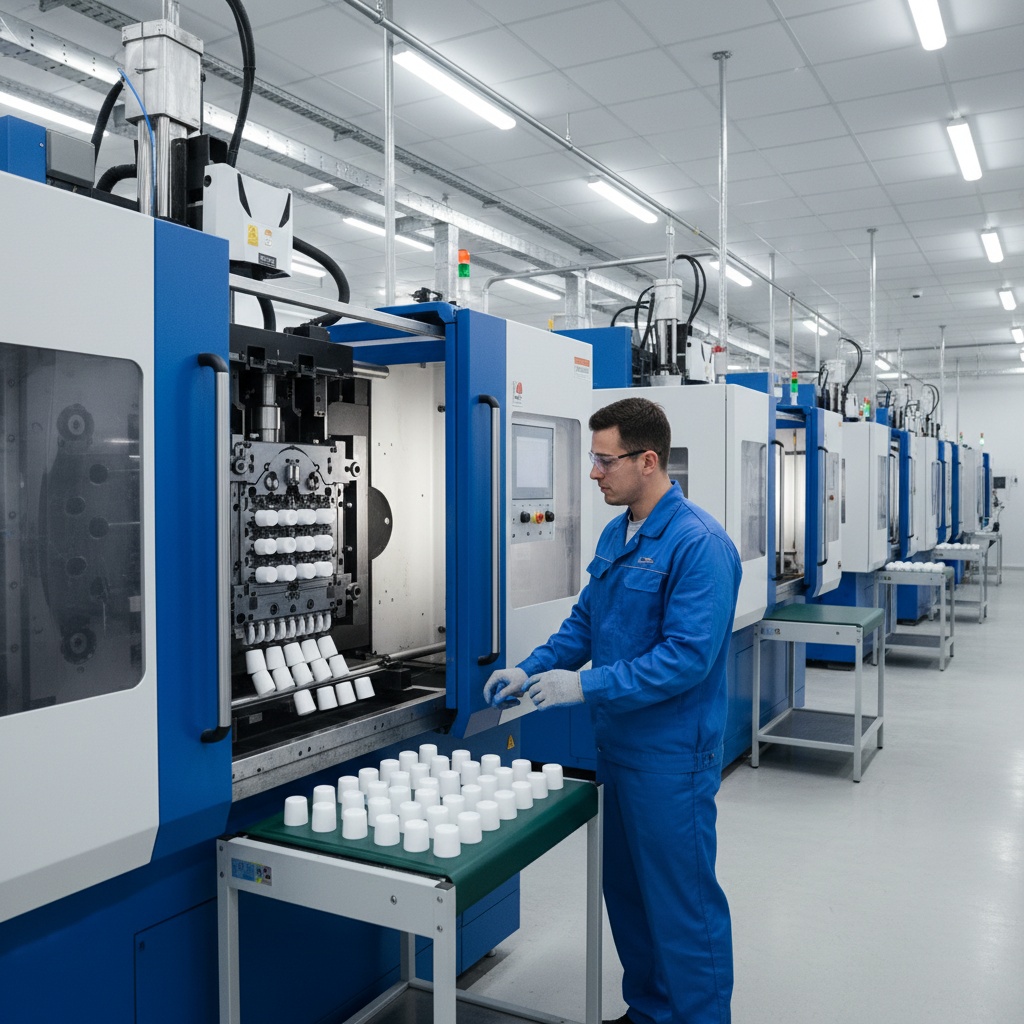
Multi-cavity molding is an injection molding configuration that uses a single mold base containing two or more identical cavities, each producing a finished part during every machine cycle. While single-cavity molds eject one part per shot, an 8-cavity tool ejects eight identical components from the same press in the same cycle time.
The distinction matters because the economics scale directly. According to Nicolet Plastics, a single press operator monitoring an 8-cavity mold produces 8x the output of the same operator running a single-cavity tool. The machine still runs one cycle, consumes one shot of energy, and occupies one operator’s attention. The only variable that changes is the number of finished parts per cycle.
A related concept causes confusion. Family molds contain cavities for different parts in the same tool, such as a bottle body and its matching cap produced together. Multi-cavity molds produce identical parts. For cosmetic packaging, the choice between these two approaches depends on whether your components share similar wall thickness and material requirements.
The global injection molded plastics market reflects how fundamental this technology has become. According to Precedence Research, the market was valued at USD 358.71 billion in 2025 and is projected to reach USD 511.9 billion by 2035. Asia Pacific held 49.5% of total global injection molding production value in 2025, according to Market Data Forecast, making China-based manufacturers the dominant source for multi-cavity tooling.
How Cavity Count and Cost Shape Cosmetic Packaging Orders
On our production floor, cavity count selection follows a practical framework tied to three variables: annual order volume, part geometry, and the buyer’s MOQ expectations.
Volume thresholds drive the initial decision. According to ZetarMold, the break-even point for multi-cavity tooling investment is typically reached after 50,000 to 100,000 units produced, with volumes above 500,000 units per year making multi-cavity tooling economically essential. For cosmetic packaging components like pump caps or closure discs, these volumes are common even for mid-size brands running seasonal collections.
| Factor | 2-Cavity Mold | 4-Cavity Mold | 8-Cavity Mold | 16+ Cavity Mold |
|---|---|---|---|---|
| Ideal Annual Volume | Under 50,000 units | 50,000-200,000 units | 200,000-500,000 units | Above 500,000 units |
| Typical Components | Custom closures, specialty caps | Standard pump bodies | Disc-top caps, overcaps | Simple closures, liners |
| Part Complexity | High (undercuts, threads) | Medium-high | Medium | Low-medium |
| Tooling Investment | Low | Moderate | Moderate-high | High |
| Per-Unit Cost Impact | Baseline | Significant reduction | Major reduction | Highest per-unit savings |
| Best For | Prototyping, niche SKUs | Growing brands | Established product lines | Mass-market packaging |
Part geometry constrains the upper limit. Complex airless bottle components with deep undercuts and tight threading may top out at 4 cavities because the mold steel required for each cavity takes significant space. Simple disc-top caps, by contrast, fit comfortably into 16 or even 32-cavity configurations.
The cost argument for higher cavity counts is strong, but the numbers need context. According to Intel Market Research, multi-cavity systems running 32 to 48 cavities demonstrate approximately 80% higher output efficiency compared to traditional single-cavity methods. However, 64-cavity medical-grade molds can cost $250,000 to $500,000 upfront. Cosmetic packaging molds rarely reach that extreme, but the principle holds: more cavities require more upfront capital.
Only 12% of plants with fewer than 50 employees currently use high-cavitation systems, according to Intel Market Research, despite typical ROI being achievable within 18 to 24 months. This gap represents an opportunity for cosmetic brands. Smaller packaging suppliers may quote single-cavity pricing because they lack the equipment to run multi-cavity tools.
Oulete operates 20 injection molding machines with an annual capacity exceeding 20 million sets. This fleet size means we can assign dedicated machines to multi-cavity tools without disrupting other production lines. When brands ask about our 1,000-unit MOQ, the equipment flexibility is what enables it. A 2-cavity mold running a short batch still produces efficiently on a smaller press, while high-volume repeat orders move to 8 or 16-cavity tools on larger machines. The relationship between cavity count and packaging cost optimization is direct: every component in a cosmetic packaging assembly can potentially move to multi-cavity production, and the cumulative savings across a complete packaging BOM often exceed what buyers expect.
Maintaining Quality Across Every Cavity
Producing eight or sixteen identical parts per cycle creates a specific quality challenge: cavity-to-cavity variation. If cavity number 3 consistently produces parts 0.05mm thicker than cavity number 7, that variation compounds across millions of units.
Runner system design determines whether molten plastic reaches every cavity at the same pressure and temperature. Hot runner systems deliver material directly to each cavity through heated channels, eliminating cold runner waste and improving fill balance. For cosmetic packaging where color consistency matters, hot runners prevent the color shift that occurs when regrind from cold runners re-enters the material stream.
Cold runner systems cost less but introduce variables. The runner itself consumes material, and the distance from the sprue to each cavity creates fill-time differences. For clear PETG or colored PP components where surface appearance is critical, hot runner systems pay for themselves through reduced reject rates.
According to JDI Plastics, ISO 9001 requires documented processes and continuous improvement, directly applicable to multi-cavity mold production records and cavity-to-cavity consistency audits. Oulete maintains ISO 9001, CE, SGS, and GMP certifications, which means every cavity in every tool has documented inspection records.
ISO 20457 specifies injection molding tolerance standards. According to Super Ingenuity, in multi-cavity tools with 16 or more cavities, cavity-to-cavity variation can consume 30 to 50% of the allowable tolerance band. This is why cavity identification plans matter. Every part must be traceable to its specific cavity, allowing quality teams to identify which cavity drifts before the variation reaches customers.
A Cavity Identification Plan is a quality documentation system that tracks dimensional and visual data by individual cavity number, enabling statistical analysis of each cavity’s performance over time. According to ProtoLabs, for multi-cavity tools, all quality reporting must be cavity-specific, showing min, max, and mean per cavity to identify imbalanced gates or premature core wear.
Multi-Cavity Production for Airless Bottles, Pumps, and PCR Materials
Cosmetic packaging introduces requirements that general industrial molding does not face. Surface finish must be flawless because the consumer sees and touches the packaging. Dimensional tolerances on threads, snap-fits, and pump mechanisms must be consistent because these components assemble together. Color matching must hold across production runs because brands demand visual consistency on retail shelves.
Oulete specializes in high-end airless pump bottles, and multi-cavity molding is central to how we produce pump bodies, actuators, and overcaps at scale. An airless pump system contains multiple injection-molded components, each requiring its own tool. The pump body might run in a 4-cavity mold due to its complexity, while the overcap runs in an 8 or 16-cavity tool because of its simpler geometry.
Where ISO 22716 (GMP for Cosmetics) applies, multi-cavity-molded components that contact cosmetic formulations require material traceability, equipment validation, and contamination prevention protocols. According to Registrar Corp, ISO 22716 governs these requirements specifically for cosmetic packaging manufacturing. This standard adds documentation requirements to multi-cavity production but does not change the fundamental molding process.
Running PCR (Post-Consumer Recycled) plastic through multi-cavity molds requires specific adjustments that many general-purpose molders overlook. PCR resin has inherent batch-to-batch variation in melt flow characteristics because the feedstock comes from mixed post-consumer waste streams. This variation directly affects how evenly material fills multiple cavities.
On our production floor, we monitor three parameters more closely when running PCR in multi-cavity tools. First, melt flow index consistency: virgin PP has tighter lot-to-lot consistency, while PCR PP can vary by a wider margin depending on the recycled content percentage. Second, color uniformity: PCR materials can shift color slightly between batches, and in a multi-cavity mold, any flow imbalance amplifies this shift because faster-filling cavities may cool differently than slower ones. Third, warpage tendency: PCR resins sometimes exhibit different shrinkage behavior, and in an 8 or 16-cavity mold, uneven shrinkage creates dimensional inconsistency across the batch.
The practical solution involves tighter incoming material inspection, more frequent process parameter checks during production, and sometimes reducing cavity count for PCR runs compared to virgin material runs. A tool designed for 16-cavity production with virgin PP might run best at 8 cavities when processing high-percentage PCR material. The per-part cost increases slightly, but the reject rate drops, and the overall economics remain favorable.
Oulete manufactures cosmetic packaging with in-house PCR compounding capability for PP, PE, and PET at 10% to 50% recycled content. This vertical integration eliminates the uncertainty that comes from purchasing pre-compounded PCR from third parties, where batch variation is outside the molder’s control.
How to Evaluate a Supplier’s Multi-Cavity Capability
Not every injection molder can run multi-cavity tools effectively. The equipment, quality systems, and engineering expertise required go beyond what a basic molding shop offers. When evaluating suppliers for multi-cavity cosmetic packaging production, these questions reveal actual capability versus marketing claims.
Ask about machine tonnage range and platen size. Multi-cavity molds are physically larger and require higher clamp force. A supplier with only small-tonnage presses cannot run 16-cavity tools for standard cosmetic caps. Oulete’s fleet of 20 injection molding machines spans the tonnage range needed for both small-cavity specialty tools and high-cavity standard production.
Ask for cavity-specific quality data from a current production run. A capable supplier can show you SPC charts broken down by cavity number. If they only provide batch-level averages, their quality system may not track individual cavity performance, which means they cannot catch cavity-specific drift before it becomes a batch-level problem.
Ask about automated assembly lines downstream from the molding press. Multi-cavity production generates high volumes of parts quickly. Without automated handling, sorting, and assembly capability, those parts stack up at the press and create bottlenecks. The molding speed advantage disappears if downstream processes cannot keep pace.
Ask how they handle lean packaging production principles in their multi-cavity operations. Changeover time between different molds, setup procedures, and scrap reduction during startup all affect the true cost of multi-cavity production. A supplier practicing lean principles will have documented changeover procedures and track first-article inspection pass rates.
Frequently Asked Questions
What is the difference between a single-cavity mold and a multi-cavity mold?
A single-cavity mold produces one finished part per injection cycle, while a multi-cavity mold produces two or more identical parts simultaneously from the same machine cycle. The core difference is output multiplication without proportional increases in cycle time, energy, or operator labor. Multi-cavity molds cost more to build but reduce per-unit production costs at sufficient volumes.
How many cavities should I request for my cosmetic packaging order?
Cavity count depends on your annual volume, part complexity, and budget for tooling. Orders below 50,000 units per year typically suit 2 to 4-cavity molds. Volumes between 50,000 and 500,000 units work well with 4 to 8-cavity tools. Above 500,000 annual units, 8 to 16 or more cavities become economically necessary. Your supplier should recommend cavity count based on your specific part geometry and volume forecast.
Does a multi-cavity mold increase cycle time?
Multi-cavity molds add minimal cycle time compared to single-cavity versions. The injection phase takes slightly longer to fill more cavities, and cooling time may increase marginally. The net effect is dramatically positive because output per cycle multiplies by the cavity count while total cycle time increases only slightly.
What is the difference between multi-cavity molds and family molds?
Multi-cavity molds produce identical parts in every cavity. Family molds produce different parts in the same tool, such as a bottle cap and its matching liner. Family molds work when the different parts have similar wall thickness and material requirements. When part geometries differ significantly, separate multi-cavity tools for each component produce better quality.
At what production volume does multi-cavity molding become cost-effective?
The break-even point for multi-cavity tooling investment is typically reached after 50,000 to 100,000 units produced. Above 500,000 units per year, multi-cavity tooling becomes economically essential because the per-unit savings far exceed the additional tooling cost.
How does cavity count affect part quality consistency in cosmetic packaging?
Higher cavity counts require more sophisticated runner balancing, cooling design, and process monitoring. Each cavity must fill at the same rate and temperature to produce consistent parts. Quality systems must track data by individual cavity number. Well-designed and well-maintained multi-cavity molds produce consistent parts, but the engineering effort increases with cavity count.
Can multi-cavity molds be used for airless pump bottle components?
Airless pump systems contain multiple injection-molded parts with varying complexity. Simple components like overcaps and actuator covers run well in 8 to 16-cavity tools. Complex pump bodies with internal mechanisms typically use 2 to 4-cavity molds due to the intricate steel work required. Each component in the assembly gets its own optimized cavity count.
What is a Cavity Identification Plan and why does it matter for quality?
A Cavity Identification Plan is a quality documentation system that assigns a unique identifier to each cavity in a multi-cavity mold and tracks dimensional, visual, and performance data by cavity number over time. This system catches cavity-specific problems such as worn cores, blocked cooling channels, or gate imbalance before they affect batch-level quality. For cosmetic packaging where visual consistency is critical, cavity-level tracking is essential.