


Last year, a French skincare brand sent us their full formulation list and asked a question we hear regularly: “Can you confirm your airless bottles contain no SVHCs above the threshold?” They had been working with a supplier who could not produce a single test report. Two months before their EU market launch, they had no documentation proving their packaging was REACH-compliant. That situation is more common than it should be.
EU REACH packaging requirements mandate that cosmetic packaging sold in Europe must be free of Substances of Very High Concern above 0.1% by weight, with full supplier disclosure and ECHA notification obligations. Brands sourcing packaging from Asia need to understand not just what REACH requires, but what documentation their manufacturer should provide before any container ships to Europe.
For brands navigating both EU and US regulatory frameworks, the compliance logic differs substantially. Our guide to FDA cosmetic packaging compliance covers the American side of that equation.
What EU REACH Means for Cosmetic Packaging
REACH (Registration, Evaluation, Authorisation, and Restriction of Chemicals) is the European Union’s foundational chemical safety regulation, established under Regulation (EC) No. 1907/2006. It requires manufacturers and importers to register chemical substances produced or imported above one tonne per year and to disclose the presence of hazardous chemicals in articles, including packaging components, according to ECHA.
A critical point that many brands miss: under REACH, each packaging component counts as a separate “article.” The bottle body, the pump mechanism, the overcap, and the dip tube are each individually assessed against SVHC thresholds. A PP airless bottle with five distinct components means five separate evaluations.
The EU Cosmetics Regulation 1223/2009 adds another layer. According to ComplianceGate, Article 10 requires a Safety Assessor to evaluate the migration of substances from packaging materials into the cosmetic product itself. This means the packaging is not assessed in isolation. The interaction between your formula and your container matters for regulatory clearance.
SVHCs and the 0.1% Threshold
A Substance of Very High Concern (SVHC) is a chemical classified as carcinogenic, mutagenic, reprotoxic, persistent, bioaccumulative, or endocrine-disrupting. According to QIMA, the ECHA Candidate List contained 250 SVHCs as of June 2025, and this number grows with each regulatory update cycle.
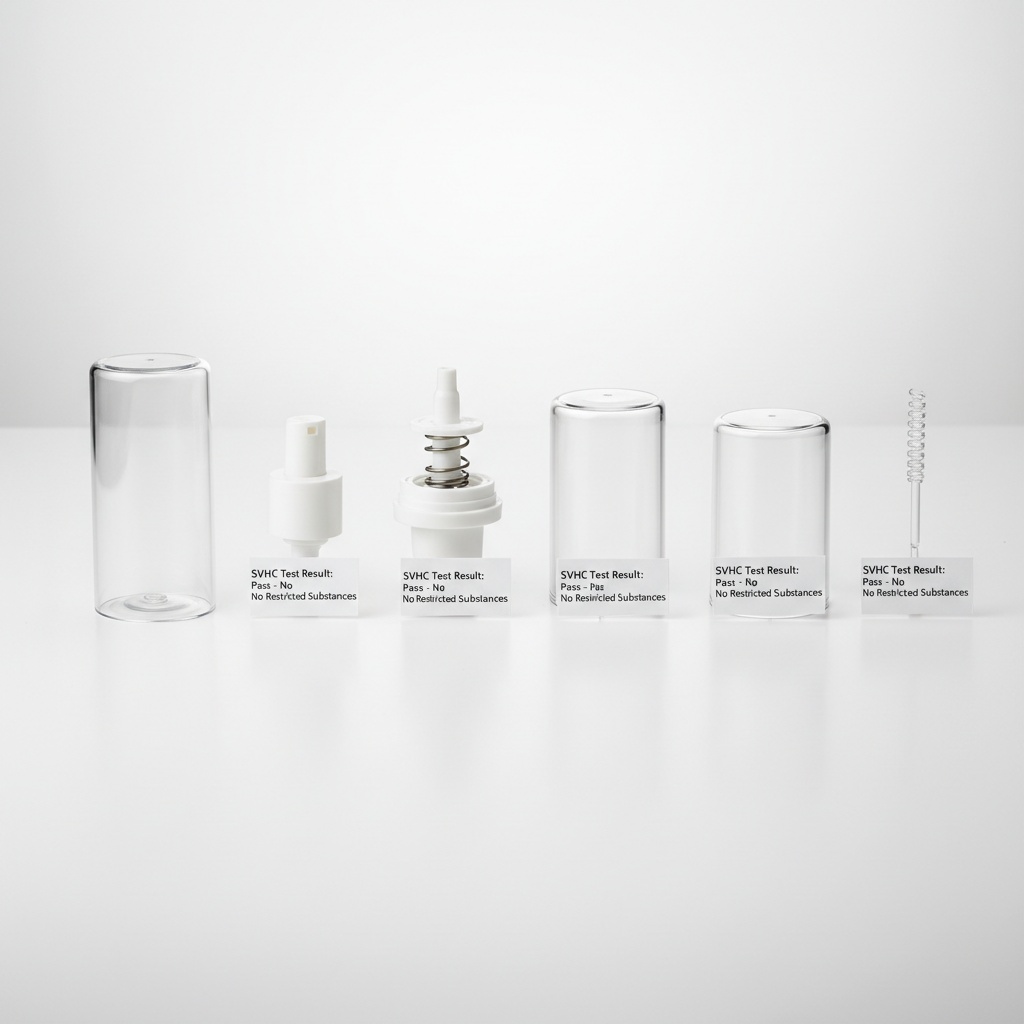
The 0.1% weight-by-weight threshold applies per article, not per finished product. When brands ask us about this threshold, we walk them through what it means in practice. If one component of a multi-part airless bottle assembly contains an SVHC, the 0.1% threshold applies to that individual component’s weight, not the full assembly weight. This per-article calculation means lighter components like pump mechanisms face a stricter absolute limit than heavier bottle bodies.
When a packaging article contains any SVHC above 0.1% w/w, two obligations trigger. First, the supplier must disclose the substance identity and provide safe-use instructions to the buyer. Second, if the article is placed on the EU market, the manufacturer or importer must submit a notification to ECHA’s SCIP database (Substances of Concern In articles as such or in complex objects/Products). This database is publicly accessible, meaning consumers and regulators can query it.
On our production floor, we run SVHC screening tests on every resin batch before it enters the injection molding line. PP and PE resins used in airless bottles are inherently low-risk for SVHCs, but additives like UV stabilizers, plasticizers, and colorants are where problems surface. Testing reveals that masterbatch colorants from uncertified suppliers are the most common source of SVHC contamination in cosmetic packaging.
PPWR 2026: New Chemical and Recyclability Rules
The Packaging and Packaging Waste Regulation (PPWR), Regulation (EU) 2025/40, entered into force on February 11, 2025, with core obligations applying from August 12, 2026, according to EUR-Lex. PPWR does not replace REACH. It stacks on top of it, adding recyclability grades, recycled content mandates, chemical restrictions, and Extended Producer Responsibility (EPR) obligations.
For cosmetic packaging specifically, PPWR introduces PFAS limits that take effect August 12, 2026. According to GV Pak, the thresholds are: 25 ppb for any single non-polymeric PFAS, 250 ppb for the sum of non-polymeric PFAS, and 50 ppm for all PFAS including polymeric forms. These limits apply to food-contact packaging directly and signal the regulatory direction for cosmetic containers as well.
PPWR also mandates minimum recycled content in plastic packaging. According to Berlin Packaging, contact-sensitive non-PET plastic packaging (which covers most cosmetic airless bottles made from PP or PE) must contain a minimum 10% recycled content by 2030, rising to 25% by 2040. Oulete already produces PCR-grade packaging with PP, PE, and PET at 10% to 50% recycled content, which positions brands to meet these upcoming mandates without switching suppliers.
According to EUR-Lex, PPWR will also ban single-use plastic cosmetic and toiletry packaging in the accommodation sector (hotel mini-bottles, single-use amenity containers) from January 1, 2030. Brands selling to the hospitality channel need to plan refillable or bulk-dispensing alternatives now.
Material-Specific Compliance for PP, PE, and PETG
Different plastics carry different compliance risk profiles. Brands sourcing PETG bottles for cosmetics or PP airless systems need material-specific guidance rather than generic regulatory overviews.
According to Taobe Consulting, the combined total of lead, cadmium, mercury, and hexavalent chromium in packaging materials must not exceed 100 ppm under the Packaging Waste Directive. This heavy metal limit applies regardless of the polymer type. On our production line, we maintain heavy metal concentrations well below this threshold through controlled resin sourcing and masterbatch certification.
| EU REACH Packaging Requirements by Material Type | PP/PE Airless Bottles | PETG Blow-Molded Bottles | Glass with Plastic Closure |
|---|---|---|---|
| Primary SVHC risk areas | UV stabilizers, colorant masterbatch | Glycol-modified additives, coatings | Closure gasket materials, coatings |
| Heavy metal limit (Pb+Cd+Hg+CrVI) | 100 ppm combined | 100 ppm combined | 100 ppm combined |
| PPWR recycled content (2030) | 10% minimum (non-PET contact-sensitive) | 10% minimum (non-PET contact-sensitive) | Not applicable to glass body |
| PPWR recycled content (2040) | 25% minimum | 25% minimum | Not applicable to glass body |
| Migration testing standard | Per FCM Regulation (EC) No. 10/2011 guidelines | Per FCM Regulation (EC) No. 10/2011 guidelines | Closure and liner only |
| Microplastics restriction (EU 2023/2055) | Decorative coatings, labeling inks | Decorative coatings, labeling inks | Decorative coatings only |
According to Cosmetics & Toiletries, REACH Regulation (EU) 2023/2055 restricts intentionally added microplastics in cosmetics products, including decorative coatings and labeling inks on packaging, with phased implementation through 2035. Brands using glitter finishes or textured coatings on their containers should verify that these decorative elements comply with the microplastics restriction.
Many cosmetic packaging assessments follow the food-contact migration testing methodology. According to Taobe Consulting, the Overall Migration Limit (OML) is 60 mg/kg and Specific Migration Limits (SML) apply per listed substance under FCM Regulation (EC) No. 10/2011. While cosmetic packaging is not legally classified as food-contact material, these testing standards are the accepted benchmark for demonstrating safety.
What Documentation to Request from Your Packaging Supplier
When brands ask us what paperwork they need for EU compliance, the answer is straightforward: five core documents. Without these, no responsible importer should clear cosmetic packaging through EU customs.
SVHC Declaration of Non-Presence: A signed statement from the manufacturer confirming that each packaging component has been tested and contains no Candidate List SVHCs above 0.1% w/w. This declaration should reference the specific Candidate List version date, since ECHA updates the list regularly.
Third-Party SVHC Screening Test Report: Laboratory analysis (typically XRF screening plus targeted GC-MS testing) performed by an accredited lab such as SGS, Bureau Veritas, or TUV. Oulete maintains ISO 9001, CE, SGS, and GMP certifications, and we provide SGS test reports as standard documentation for EU-bound shipments.
Heavy Metal Compliance Certificate: Test results confirming the combined Pb, Cd, Hg, and CrVI concentration is below 100 ppm per the Packaging Waste Directive requirements.
Recycled Content Certificate of Conformity: For orders specifying PCR content, a certificate from the resin supplier or an independent auditor verifying the post-consumer recycled percentage. Oulete provides chain-of-custody documentation for all PCR-grade orders (PP/PE/PET at 10% to 50% recycled content) to support PPWR 2030 compliance claims.
Material Safety Data Sheets (SDS): Standard REACH-format SDS for each polymer and additive used in the packaging components, listing all registered substances and their classifications under CLP Regulation 1272/2008.
Brands that also need to comply with halal or organic standards should review our guides to halal cosmetic packaging and organic certification packaging, as these certifications introduce additional material restrictions that overlap with REACH.
PPWR Compliance Timeline for Cosmetic Brands
| Deadline | Requirement | Impact on Cosmetic Packaging |
|---|---|---|
| August 12, 2026 | PPWR core obligations apply; PFAS limits enforced | All packaging on the EU market must meet chemical restriction thresholds |
| 2028-2029 (pending implementing acts) | Harmonized labeling with pictograms and QR codes, per Circularise | Plan for updated label artwork and digital product passports once implementing acts are confirmed |
| January 1, 2030 | 10% recycled content for contact-sensitive non-PET plastics; hotel amenity single-use plastic ban | PP/PE airless bottles must contain minimum 10% PCR; hospitality brands need refillable solutions |
| January 1, 2030 | All packaging must achieve recyclability Grade A, B, or C | Non-recyclable multi-material packaging designs may need redesign |
| January 1, 2035 | Microplastics restriction fully phased in | All decorative packaging coatings must be microplastic-free |
| January 1, 2040 | 25% recycled content for contact-sensitive non-PET plastics | PP/PE airless bottles must contain minimum 25% PCR |
According to Circularise, PPWR also introduces EPR (Extended Producer Responsibility) registration requirements, meaning brands placing packaging on the EU market must register with national EPR schemes and contribute financially to packaging waste collection and recycling systems. This obligation applies to the brand or importer, not the packaging manufacturer, but Oulete provides the recyclability documentation that brands need for their EPR filings.
The regulatory trajectory is clear. Brands that build REACH and PPWR compliance into their packaging specifications now will avoid reformulation costs and supply chain disruptions when each deadline arrives. The specifications matter, and the supplier you choose determines whether compliance documentation is a standard deliverable or an afterthought you scramble to assemble before a shipment clears customs.
FAQ
What is EU REACH and does it apply to cosmetic packaging?
EU REACH is the European Union’s chemical safety regulation under Regulation (EC) No. 1907/2006, and it applies to all articles placed on the EU market, including every component of cosmetic packaging. Each packaging component (bottle, pump, cap, dip tube) is assessed individually for SVHC content against the 0.1% w/w threshold.
What is an SVHC and how does the 0.1% threshold work?
A Substance of Very High Concern is a chemical with carcinogenic, mutagenic, reprotoxic, persistent, bioaccumulative, or endocrine-disrupting properties listed on ECHA’s Candidate List. The 0.1% threshold is calculated per individual article by weight, not per the total assembled product, so each packaging component must be evaluated separately.
Do Chinese packaging manufacturers need to comply with EU REACH?
Chinese manufacturers are not directly regulated by REACH, but the EU importer or Only Representative bears legal responsibility for compliance. This means Chinese suppliers must provide the testing data and documentation that their EU customers need to demonstrate compliance, or those customers cannot legally place the packaging on the EU market.
What is the SCIP database and when must packaging be notified?
The SCIP database is ECHA’s public registry of articles containing SVHCs above 0.1% w/w. Any packaging article placed on the EU market that contains a Candidate List SVHC at or above 0.1% must be notified to the SCIP database by the EU supplier or importer before it enters the supply chain.
How does PPWR differ from REACH for cosmetic packaging?
REACH focuses on chemical substance registration, restriction, and authorization, while PPWR addresses packaging design and lifecycle requirements including recyclability grades, minimum recycled content, PFAS chemical limits, labeling standards, and EPR obligations. Both regulations apply simultaneously, and compliance with one does not satisfy the other.
What are the PFAS limits for packaging under PPWR 2026?
PPWR sets three PFAS thresholds for packaging effective August 12, 2026: 25 ppb for any single non-polymeric PFAS, 250 ppb for the sum of all non-polymeric PFAS, and 50 ppm for all PFAS including polymeric forms.
What testing should a brand request to verify REACH compliance?
Brands should request third-party SVHC screening (XRF plus GC-MS), heavy metal analysis for Pb/Cd/Hg/CrVI against the 100 ppm combined limit, and migration testing following FCM Regulation (EC) No. 10/2011 methodology. All testing should be performed by accredited laboratories with reports referencing the current ECHA Candidate List version.