


Last quarter, a French skincare brand sent us samples of their serum line packaged in standard PET bottles. Within eight weeks of shelf testing, the bottles had developed visible stress crazing along the shoulder. Their formulation contained 12% alcohol and a cocktail of essential oils. The fix was straightforward: switch to PETG.
That switch resolved every issue they had, and it is the same recommendation we make to roughly half the brands that come through our Shaoxing facility. PETG is not always the right call. But when your formulation demands it, nothing else in the plastics family performs the same way at the same price point. Here is what fifteen years of blow molding cosmetic packaging has taught us about this material.
What PETG Actually Is and Why It Matters for Cosmetics
PETG is a glycol-modified copolymer of polyethylene terephthalate (PET) in which the standard ethylene glycol monomer is partially replaced with cyclohexanedimethanol (CHDM). According to Impact Plastics, this creates a thermoplastic polyester with fundamentally different processing and performance characteristics than its PET parent material. The CHDM substitution disrupts the crystalline structure of PET, which is why PETG stays amorphous and transparent even at thicker wall sections.
For cosmetics, that amorphous structure has practical consequences. Standard PET crystallizes when you slow-cool it or blow it with thicker walls, turning hazy or white. PETG stays optically clear regardless of wall thickness. This is why brands that want heavier, more luxurious bottles gravitate toward PETG. According to Laird Plastics, PETG delivers exceptional transparency and clarity comparable to glass, making it ideal for cosmetic packaging where product visibility drives consumer appeal.
The density of PETG sits at approximately 1.27 g/cm3, which makes finished bottles about 50% lighter than glass equivalents. That weight difference compounds across a production run: lower freight costs, reduced breakage during shipping, and easier handling on filling lines. PETG bottles are available in capacities ranging from 5 ml to 350 ml, covering everything from sample vials to full-size body care, according to Jarsking.
PET vs. PETG: A Side-by-Side Comparison for Cosmetic Bottles
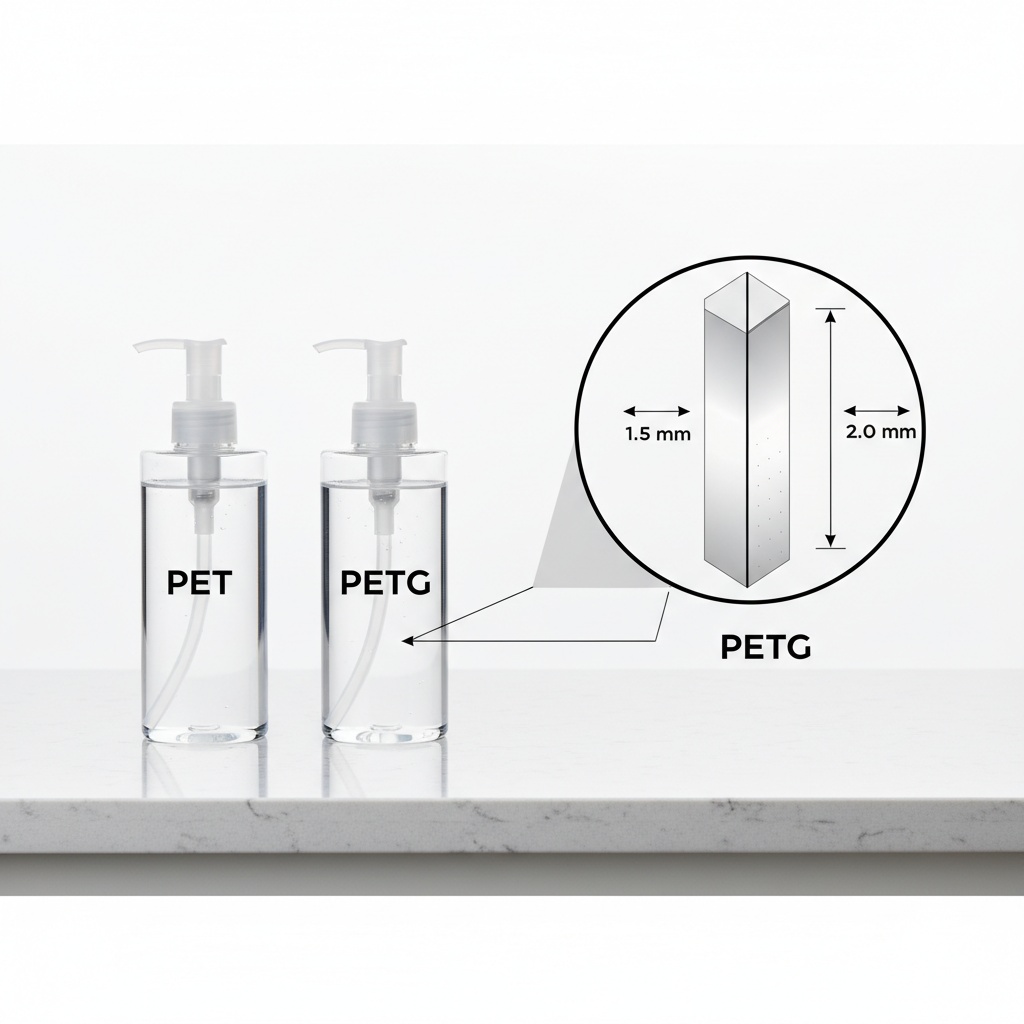
The PET-versus-PETG question comes up in nearly every project kickoff meeting. Both materials share a polyester backbone, but their behavior in cosmetic applications diverges significantly. We have written about this comparison in detail on our blog covering PET vs. PETG for cosmetic containers, but here is the manufacturing-focused breakdown.
| Property | PET | PETG |
|---|---|---|
| Transparency | High (thin walls only) | Glass-like at any wall thickness |
| Impact Strength | Moderate | 3-5x stronger than glass |
| Chemical Resistance (Alcohols) | Limited | Good (retains ~94% tensile strength in ethanol) |
| Blow Molding Temperature | Higher | Lower processing temperature |
| Wall Thickness Flexibility | Constrained by crystallization | Thick walls without haze |
| Recyclability | Widely accepted | Recyclable, but narrower collection streams |
| Cost per Unit | Lower | Moderate premium over PET |
| UV Protection | Minimal | Balanced UV blocking capability |
The practical decision comes down to formulation chemistry. If your product is a water-based cleanser with no active ingredients and no alcohol, PET works fine and saves cost. The moment your formula includes ethanol, essential oils, or aggressive actives like salicylic acid, PETG becomes the safer choice.
According to PMC research, PETG exposed to 99.5% ethanol retains approximately 94% of its tensile strength and roughly 90% of its impact resistance. With 99% isopropyl alcohol, those numbers drop to about 85% tensile and 64% impact. Standard PET degrades faster under the same conditions. For toners and setting sprays that rely on alcohol as a carrier, PETG provides the margin of safety that prevents field failures.
Blow Molding PETG: What Happens on the Production Floor
Most articles about PETG stop at the material datasheet. They do not tell you what happens when you actually put PETG preforms into a blow molding machine. We run 20+ blow molding and injection molding machines at our Shaoxing facility, and PETG behaves differently than PET at every stage of the process.
PETG blow molding involves heating preforms until malleable, then inflating them with high-pressure air into precision molds. Typical wall thickness for extrusion blow molded PETG bottles lands around 0.5 mm. The material’s wider processing window compared to PET is both an advantage and a trap. PETG tolerates temperature variation better, but operators who treat it identically to PET produce bottles with dimensional inconsistencies.
The key difference is that PETG does not strain-harden the way PET does during stretching. PET naturally self-levels during blow molding: thin spots resist further stretching, creating uniform wall distribution. PETG lacks this behavior. On our production line, we compensate by adjusting preform design and blow timing to achieve consistent wall thickness across the entire bottle geometry.
Oulete produces PETG blow-molded bottles with in-house quality control spanning incoming material inspection through final dimensional verification. We catch the three most common PETG defects before they reach the packing line: stress whitening at high-stretch points, gate marks from injection that affect downstream decoration, and warping from uneven cooling. Each defect has a specific root cause in the molding parameters, and our quality team tracks these metrics across every production batch.
Chemical Compatibility: Matching PETG to Your Formulation
Chemical compatibility testing is where we spend the most time with new clients. A bottle that looks perfect on day one can fail catastrophically at month six if the formulation attacks the polymer. PETG offers improved chemical resistance over standard PET, particularly against the oils and alcohols found in most cosmetic formulations, according to Topfeelpack.
For alcohol-based products like toners, micellar waters, and setting sprays, PETG handles typical cosmetic alcohol concentrations well. For formulations with higher alcohol content, we recommend compatibility testing with the specific formula. PETG also performs well with glycerin-heavy serums, hyaluronic acid solutions, and most water-in-oil emulsions.
Where PETG has limitations: concentrated essential oils (particularly citrus terpenes at high percentages), acetone-based nail care products, and some aggressive fragrance compounds. Prolonged exposure to high concentrations of these chemicals may cause surface swelling or environmental stress cracking. We always recommend brands ship us their actual formulation for a accelerated shelf-life compatibility test before committing to production tooling.
PETG is completely non-toxic and does not contain harmful compounds such as bisphenol A (BPA), making it safe for direct contact with cosmetic formulations, according to Jarsking. For brands selling into the U.S. market, PETG bottles comply with FDA regulations that set specific limits for migration of substances from packaging material into the product, according to WEIWO Cosmetic.
PETG also delivers balanced UV protection capabilities that benefit light-sensitive formulations. For products like vitamin C serums or retinol treatments where UV exposure degrades active ingredients, PETG provides a baseline level of UV filtering, according to Topfeelpack. Brands requiring maximum UV protection can combine PETG with opaque overcoats or UV-blocking additives during compounding.
Decoration and Branding on PETG Bottles
A bottle is packaging. A decorated bottle is brand identity. PETG accepts every major decoration method used in cosmetics, but each technique requires parameter adjustments specific to the material.
Screen printing on PETG uses UV-curable inks rather than the solvent-based systems common on PP or HDPE. Solvent inks attack the PETG surface and cause crazing. UV inks cure through photopolymerization without chemical interaction with the substrate. According to UK Pack China, screen printing is cost-effective for brands with multiple SKUs, while hot stamping adds metallic accents for premium positioning.
Oulete operates full decoration capabilities in-house, including screen printing, hot stamping, and frosted finish application, all calibrated for PETG substrates. Running decoration in the same facility as blow molding eliminates a logistics step and reduces lead time. When a bottle moves from the molding machine to the decoration line within the same building, we control every variable that affects print adhesion and finish quality.
Frosted PETG bottles deserve special mention. The frosting process on PETG produces a more uniform, consistent matte finish than on PET because the amorphous structure of PETG responds more predictably to surface treatment. The result is that soft, diffused look that prestige skincare brands favor for their hero products.
Sustainability: PCR Content and Recyclability
The sustainability conversation around PETG requires honest answers, not marketing slogans. PETG is fully recyclable. However, according to Beauty Plus, PETG is not accepted as widely as PET in municipal recycling systems and may require special sorting facilities. This is the material’s primary environmental limitation.
The practical path forward is PCR integration. Post-consumer recycled content reduces the virgin resin demand and the carbon footprint of each bottle. According to HCP Packaging, PCR content reduces energy consumption by at least 79% and GHG emissions by at least 67% compared to virgin resin production. Oulete offers PCR sustainable packaging with post-consumer recycled content ranging from 10% to 50% across PP, PE, and PET resins.
According to Research and Markets, the eco-friendly cosmetic packaging market will grow from $5.3 billion in 2025 to $5.78 billion in 2026, driven by consumer demand for sustainable packaging. Brands that integrate PCR content now position themselves ahead of tightening regulations in the EU and increasingly in North America.
Oulete’s PCR integration capability extends to PETG applications, enabling brands to specify recycled content percentages that meet their sustainability commitments without compromising bottle clarity or mechanical performance. The key is sourcing PCR resin from certified suppliers with consistent quality metrics, which is where a manufacturer’s supply chain relationships matter as much as their molding expertise.
Choosing a PETG Bottle Manufacturer: What to Evaluate
According to Towards Packaging, the U.S. cosmetic packaging market is projected to grow from $2.1 billion in 2025 to $3.27 billion by 2034, with bottles holding the dominant market share. That growth is attracting new suppliers at every price point. Separating capable manufacturers from catalog resellers requires asking the right questions.
Start with certifications. ISO 9001 covers quality management systems. GMP certification confirms the facility meets manufacturing practice standards relevant to cosmetics. SGS testing verifies material claims independently. Oulete maintains ISO 9001, CE, SGS, and GMP certifications across its Shaoxing manufacturing operations, with an annual capacity exceeding 20 million sets.
Ask about minimum order quantities. Many brands, especially indie and DTC brands launching new SKUs, need flexibility. Oulete’s MOQ starts at 1,000 units, which lets brands test market response before committing to large production runs. Compare that to manufacturers requiring 10,000 or 50,000 unit minimums.
Request samples with your actual formulation, not water. Any PETG bottle looks good filled with water. The real test is 12 weeks of contact with your specific product at accelerated aging conditions. A manufacturer that pushes back on compatibility testing is a manufacturer that does not want you to discover problems before you have paid for tooling.
Finally, evaluate whether the manufacturer handles decoration in-house or subcontracts it. Subcontracted decoration means your bottles leave the controlled factory environment, get transported, handled by a third party, and returned. Every handoff is a risk point for contamination, damage, and delay. Oulete’s integrated blow molding and decoration facility in Shaoxing eliminates these handoff risks by keeping the entire process, from resin to finished decorated bottle, under one roof. For spray pump and airless pump bottle applications, this integration is particularly valuable because pump assembly adds another precision step to the production sequence.
Frequently Asked Questions
Q: Is PETG safe for cosmetic packaging? PETG is non-toxic and BPA-free, making it safe for direct contact with cosmetic formulations. PETG bottles intended for cosmetics comply with FDA regulations that set specific limits for migration of substances from packaging material into the product. The material has a long track record in skincare, haircare, and color cosmetics packaging.
Q: What is the difference between PET and PETG bottles? PETG replaces part of PET’s ethylene glycol with cyclohexanedimethanol, creating a material that stays transparent at thick wall sections, resists chemicals better, and processes at lower temperatures. PET costs less and recycles more easily. PETG is the better choice when formulations contain alcohol or active ingredients that degrade PET.
Q: Can PETG bottles be recycled? PETG is fully recyclable as a thermoplastic polyester. However, municipal recycling programs do not accept PETG as widely as standard PET, and special sorting facilities may be required. Brands can offset this limitation by specifying PCR content in their PETG bottles, reducing virgin resin consumption by up to 50%.
Q: Is PETG compatible with alcohol-based cosmetics? PETG handles alcohol-based formulations significantly better than standard PET. At 99.5% ethanol concentration, PETG retains approximately 94% of tensile strength and 90% of impact resistance. For typical cosmetic alcohol concentrations below 30%, PETG shows no measurable degradation over standard shelf-life periods.
Q: Does PETG provide UV protection for cosmetics? PETG offers balanced UV protection capabilities that benefit UV-sensitive formulations such as vitamin C serums and retinol treatments. For products requiring maximum light protection, PETG can be combined with opaque coatings or UV-blocking additives compounded directly into the resin during manufacturing.
Q: What is the minimum order quantity for custom PETG bottles? MOQ varies widely by manufacturer. Some require 10,000 to 50,000 units. Oulete offers a 1,000-unit MOQ for custom PETG bottles, allowing brands to test market response with smaller initial runs before scaling production.
Q: Can PETG bottles be screen printed and hot stamped? PETG accepts screen printing, hot stamping, frosted finishes, and silkscreen decoration. Screen printing on PETG requires UV-curable inks rather than solvent-based inks, which would damage the PETG surface. Hot stamping adds metallic foil accents. The best results come from manufacturers that handle decoration in-house with equipment calibrated for PETG.
Q: How do PETG bottles compare to glass in cost and weight? PETG bottles weigh approximately 50% less than glass equivalents, reducing shipping costs substantially across large production volumes. The material cost of PETG runs higher than standard PET but significantly lower than glass. When factoring in reduced breakage, lower freight, and faster filling-line speeds, PETG often delivers a lower total cost of ownership than glass.
The specifications of your formulation should drive your packaging material decision. Request samples, run compatibility testing with your actual product, and evaluate total cost of ownership across the full supply chain. The brands that get packaging right are the ones that test before they commit.