


Last year, a European prestige skincare brand shipped a large consignment of vitamin C serum to Southeast Asia. Within six weeks, customer complaints spiked. The product had oxidized during transit, but no one knew until consumers opened the bottles. The brand had no visibility into what happened between the factory and the shelf. That problem is exactly what smart packaging sensors solve, and it is why we started integrating NFC label overlays onto our airless bottles at our Shaoxing facility.
Smart packaging sensors are embedded electronic components, including NFC chips, RFID tags, and temperature indicators, that monitor product condition, verify authenticity, and enable direct consumer interaction through cosmetic packaging.
According to GlobeNewswire, the global smart packaging market reached approximately $26.15 billion in 2025, driven by e-commerce growth and supply-chain traceability demands. For cosmetic packaging specifically, the stakes are even clearer. According to Research Intelo, the smart cosmetic packaging segment was valued at $2.4 billion in 2024 and is projected to reach $8.1 billion by 2033, reflecting a CAGR of approximately 14.2%.
What Are Smart Packaging Sensors?
Smart packaging sensors are electronic or chemical devices integrated into or onto product packaging that collect, transmit, or display information about the product’s condition, origin, or usage. They fall into two broad categories: active and intelligent.
Active packaging is a packaging system that directly interacts with the product contents to extend shelf life or maintain quality. Examples include oxygen scavengers, moisture absorbers, and antimicrobial coatings. According to Precedence Research, active packaging formats account for approximately 68.2% of the global smart packaging market as of 2025, making them the dominant category by a wide margin.
Intelligent packaging is a packaging system that monitors and communicates information about the product or its environment without altering the product itself. NFC chips, RFID tags, temperature indicators, and QR codes all fall into this category. Intelligent packaging tells you what happened to the product. Active packaging prevents it from happening in the first place.
For cosmetic brands, the distinction matters at the sourcing stage. Active packaging often requires changes to the container’s inner wall materials or coatings. Intelligent packaging, by contrast, can frequently be added as a post-molding step, making it far easier to adopt without redesigning your entire packaging architecture. On our production floor, we see most cosmetic brands starting with intelligent packaging, specifically NFC labels, because the integration cost and complexity are significantly lower.
6 Sensor Technologies Used in Cosmetic Packaging
The sensor category you choose depends on what you need the packaging to do. Some sensors communicate with smartphones. Others change color. A few generate their own therapeutic outputs. The following breakdown covers the six most relevant technologies for beauty and skincare brands.
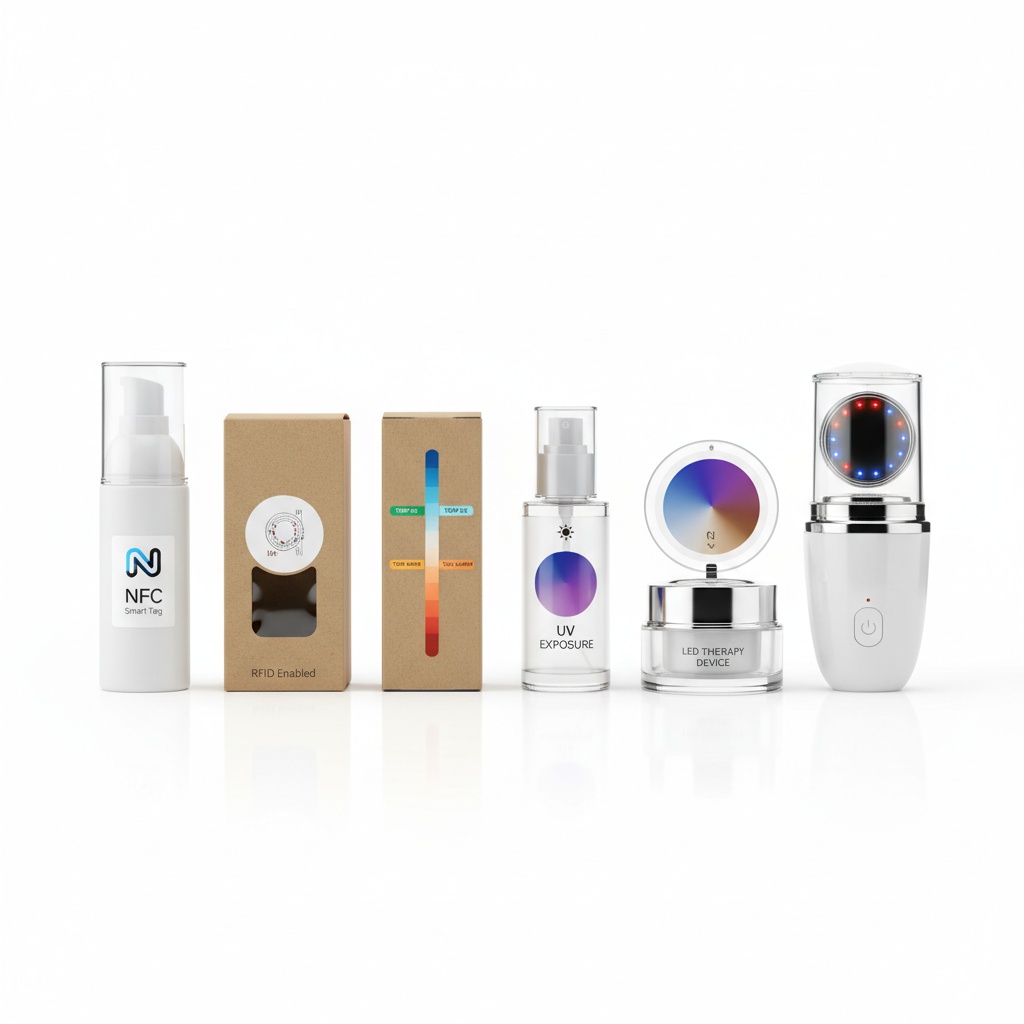
NFC (Near Field Communication) chips are short-range wireless sensors operating at 13.56 MHz that enable tap-to-read interactions between a cosmetic container and any NFC-enabled smartphone. According to TJ NFC Tag, NFC-based smart packaging enables tap-to-authenticate and tap-to-reorder interactions, with cosmetics brands using NFC to link physical packaging to tutorials, loyalty rewards, and refill services.
RFID (Radio-Frequency Identification) tags are wireless identification devices that use radio waves to transmit product data across distances ranging from centimeters to several meters, depending on frequency. According to Packaging Europe, RFID enables full-link traceability from raw-material warehousing through distributor processes to the consumer’s shelf, making it critical for anti-counterfeiting in luxury and prestige cosmetics.
Time-Temperature Indicators (TTIs) are chemical or biological sensors applied to packaging that produce a visible, irreversible color change when a product has been exposed to temperatures outside its specified range. For heat-sensitive formulations like retinoids and probiotics, TTIs provide a simple visual signal that the cold chain was broken. Brands interested in this category should also consider thermochromic packaging technologies, which use similar principles for consumer engagement rather than cold-chain monitoring.
UV Exposure Sensors are photochromic indicators that detect and display cumulative ultraviolet light exposure on the packaging surface. Certain active ingredients, particularly vitamin C derivatives and retinol, degrade rapidly under UV exposure. UV sensors on the outer packaging can alert consumers and retailers when a product has received excessive light exposure during storage or display.
Freshness and Oxidation Indicators are colorimetric sensors embedded in packaging that react to changes in oxygen levels, pH, or volatile organic compounds inside the container. These sensors shift color when the internal atmosphere changes, signaling that the product may have been compromised. For airless pump bottles, oxidation indicators can serve as a secondary verification that the vacuum seal is intact.
Active Therapy Devices are electronic modules integrated directly into cosmetic packaging that deliver therapeutic energy, such as LED light or microcurrent, to the skin during product application. According to Premium Beauty News, Nuon Medical, a smart packaging pioneer holding 70% of the U.S. home light-therapy market, has designed over 600 smart devices and produces more than 100,000 LED therapy units monthly.
| Smart Packaging Sensors: Technology Comparison for Cosmetics | ||||
|---|---|---|---|---|
| Technology | Communication Range | Primary Function | Best Packaging Fit | Integration Method |
| NFC Chip | 1-4 cm (tap required) | Authentication, reorder, tutorials | Bottles, jars, tubes | Adhesive label overlay |
| RFID Tag | Up to several meters | Supply-chain tracking, inventory | Cartons, shipping boxes | Embedded label or hang tag |
| TTI Sensor | Visual only (no wireless) | Temperature excursion detection | Cold-chain cosmetics | Adhesive indicator strip |
| UV Sensor | Visual only (no wireless) | Light exposure monitoring | Light-sensitive serums | Printed on outer carton |
| Oxidation Indicator | Visual only (no wireless) | Seal integrity verification | Airless bottles, ampoules | Inner packaging insert |
| Active Therapy Device | Direct skin contact | LED, microcurrent delivery | Premium treatment packaging | Molded-in electronic module |
How Cosmetic Packaging Manufacturers Integrate Sensors
Most articles about smart packaging focus on what brands can do with it. Very few explain how a packaging factory actually integrates sensor components during production. This section covers the manufacturing side, because that is what determines whether sensor-enabled packaging is feasible at your volumes and budget.
Adhesive Label Overlay is the most common integration method for NFC and RFID in cosmetic packaging. The sensor chip and antenna are manufactured as a thin, flexible label by a specialized electronics supplier. The packaging factory applies this label to the finished container after molding, decoration, and quality inspection are complete. On our production line, we apply NFC labels to cosmetic airless bottles as the final step before carton packing, which means the sensor never contacts the product formula and does not interfere with the molding or decoration process.
Insert Molding is a manufacturing process where the sensor component is placed inside the injection mold cavity before the plastic is injected, permanently encapsulating the electronics within the container wall. This method creates a seamless, tamper-proof integration, but it requires mold modifications, tighter process control, and significantly higher per-unit costs. We generally recommend insert molding only for premium lines at higher order volumes, where the per-unit cost of mold modification is diluted across a larger production run.
Conductive Ink Printing is an emerging technique where sensor circuits are printed directly onto packaging surfaces using electrically conductive inks. This approach eliminates the need for separate chip components entirely, but the technology is still maturing for cosmetic applications. Printed sensors currently lack the data storage capacity and read range of traditional NFC chips.
The substrate material of your packaging directly affects which integration methods are viable. PP and PETG, the two materials we work with most frequently, both accept adhesive NFC labels well because their surface energy supports strong adhesion after corona treatment. Acrylic and glass containers can also receive adhesive labels, but curved surfaces require flexible antenna designs. Metallic finishes and heavy metallization can interfere with NFC signal transmission, so if your bottle design includes full-coverage metallic decoration, the NFC label needs to be placed on an unmetallized zone.
Oulete’s production infrastructure, with 20 injection molding machines and capacity exceeding 20 million sets annually, allows us to handle sensor-enabled packaging across different volume tiers without dedicated production lines. When brands ask about NFC integration, our QC team validates three parameters before approving the production run: NFC read range (must be consistent at the specified distance), label adhesion strength after decoration, and signal clarity through the specific wall thickness of the container.
Smart Packaging Sensors and Sustainability
The intersection of electronic components and recyclable packaging creates real engineering challenges. Adding a battery, PCB, or adhesive-backed chip to a plastic bottle complicates the recycling stream. Most municipal recycling programs cannot process electronics-contaminated plastics, which means sensor-enabled packaging risks being downcycled or landfilled.

Several emerging solutions address this tension. Printed conductive ink sensors avoid metal chip components entirely, making the packaging easier to recycle through standard plastic streams. Biodegradable substrate sensors, still in early development, use organic semiconductors that break down during composting. Removable NFC labels with peelable adhesives allow consumers to separate the electronic component before recycling the container.
For brands using PCR (Post-Consumer Recycled) materials, sensor compatibility adds another layer of consideration. PCR plastic surfaces can have inconsistent surface energy due to the mixed feedstock in recycled resins. This variability affects adhesive label adhesion strength. Oulete produces airless pump bottles with PCR content ranging from 10% to 50% in PP, PE, and PET. When we apply NFC labels to PCR bottles, we run additional adhesion pull tests compared to virgin material runs, because the surface characteristics vary batch to batch.
The most practical approach for brands that want both smart features and sustainability credentials is to use removable adhesive NFC labels on containers made from mono-material recyclable plastics. This combination allows the consumer to peel off the sensor before disposal, preserving the recyclability of the primary container. Refillable skincare packaging paired with a permanent NFC chip on the outer shell is another viable path, where the reusable container retains the sensor while only the inner refill cartridge enters the recycling stream.
Brand Examples and Real-World Applications
Smart packaging is not a theoretical concept. Major beauty brands have already deployed sensor-enabled packaging in commercial products, and the use cases range from anti-counterfeiting to skin diagnostics.
YSL’s Rouge Sur Mesure device uses an integrated sensor and motor system to dispense custom lip color blends from interchangeable cartridges. The device communicates with a smartphone app to store color preferences and suggest new shades. L’Oreal’s Brow Magic uses sensor-guided precision to apply micro-lines of brow color, reading the user’s facial geometry in real time. Both products represent the high end of smart packaging, where the packaging itself becomes an active beauty tool rather than a passive container.
Shiseido has deployed RFID tags across its prestige product lines for supply-chain traceability, enabling the company to track individual units from factory to retail shelf and detect parallel-market diversion. Dior’s Skin Analyzer uses built-in sensors to evaluate skin hydration, pore size, and texture before recommending products from its skincare line.
Nu Skin’s ageLOC Me is a connected device that uses sensor-driven algorithms to mix personalized serum and moisturizer doses based on the user’s skin assessment data. The packaging dispenses precisely calibrated amounts, reducing product waste while delivering a customized routine.
These examples share a common thread: the sensor adds measurable value that could not be delivered through packaging design alone. For brands considering magnetic closure systems or other premium packaging features, adding an NFC chip creates a digital layer on top of the physical experience, enabling authentication, loyalty programs, and usage tracking without changing the structural design.
What Buyers Should Ask Their Packaging Factory
If you are sourcing cosmetic packaging and considering sensor integration, the questions you ask your packaging supplier will determine whether the project succeeds or stalls. Most packaging factories do not manufacture sensors. They source them from electronics suppliers and integrate them during or after the packaging production process. Understanding this supply chain is critical.
Ask about integration method compatibility. Not every factory has experience applying NFC labels to curved cosmetic containers. Request samples with your specific bottle geometry and decoration finish to verify that the label sits flat, adheres properly, and does not interfere with the visual design.
Ask about signal testing protocols. NFC read range varies depending on wall thickness, material composition, and proximity to metallic components. Your factory should be able to demonstrate consistent read-range performance across a sample batch, not just a single prototype.
Ask about regulatory compliance for electronic components. If your products ship to the EU, any electronic sensor components added to your packaging may need to comply with RoHS (Restriction of Hazardous Substances) requirements. According to PackMojo, the EU Cosmetics Regulation EC No 1223/2009 requires that packaging materials, including electronic components, must not adversely affect consumer safety. Your factory should provide component compliance documentation.
Ask about MOQ implications. Sensor integration typically adds a per-unit cost for the NFC label or RFID tag itself, plus a setup charge for the application process. At lower volumes, this cost premium is proportionally higher. At lower order volumes, we are transparent that the per-unit sensor cost will be noticeable. At higher quantities, the cost per unit drops significantly and the economics become more favorable.
Ask about GMP compatibility. According to Intertek, ISO 22716 provides Good Manufacturing Practice guidelines for cosmetics production, and any embedded sensors used during production or logistics must be compatible with GMP hygiene and contamination-control requirements. Your factory should explain at which production stage the sensor is applied and how contamination risk is managed.
Oulete holds ISO 9001, CE, SGS, and GMP certifications, and our sensor integration process is designed to maintain compliance throughout. We apply NFC labels in our finishing area after all product-contact surfaces have been sealed, which eliminates the risk of electronic component contact with cosmetic formulations.
The technology is moving fast. AI-powered skin diagnostics, where imaging sensors combined with machine learning algorithms assess skin conditions and adjust product recommendations automatically, represent the most significant near-term opportunity. Personalized dosing systems that track consumption and trigger NFC-based refill ordering are moving from concept to commercial deployment.
Regulatory frameworks have not yet caught up. As of 2026, no specific regulation governs sensors embedded in cosmetic packaging. Compliance is enforced indirectly through existing cosmetic safety standards (ISO 22715 for labeling, ISO 22716 for GMP), electronics safety standards (RoHS), and regional cosmetic regulations (EU EC 1223/2009). Brands should expect dedicated regulations to emerge as adoption accelerates, likely addressing data privacy, battery disposal, and electronic waste classification.
The specifications matter. But the factory’s ability to source reliable sensor components, integrate them without compromising packaging quality, and validate performance at production scale matters more. Start by requesting samples with NFC labels applied to your specific bottle format and test them with your actual formulation, decoration, and supply-chain conditions before committing to a full production run.
Frequently Asked Questions
What are smart packaging sensors and how do they work in cosmetic packaging?
Smart packaging sensors are electronic or chemical devices integrated into cosmetic containers that monitor product condition, verify authenticity, or enable consumer interaction. NFC chips transmit data when tapped by a smartphone, RFID tags broadcast identification codes over longer distances for supply-chain tracking, and chemical indicators change color in response to temperature, UV exposure, or oxygen levels inside the container.
What types of sensors are most commonly used in beauty packaging?
NFC chips and RFID tags are the most widely adopted sensor types in cosmetic packaging because they can be added as adhesive label overlays without modifying the container design. Temperature indicators and UV sensors are used for formulations that degrade under specific environmental conditions. Active therapy devices with LED or microcurrent capability represent the premium end of the technology spectrum.
How much does smart packaging cost compared to standard cosmetic packaging?
The cost premium depends on the sensor technology and order volume. Adhesive NFC labels typically add a modest per-unit cost that becomes more economical at higher order quantities. Active therapy devices with electronic modules carry significantly higher costs due to component sourcing, assembly complexity, and testing requirements. The integration method, whether adhesive overlay or insert molding, also affects total project cost.
Can smart packaging sensors detect when a skincare product has expired?
Chemical indicator sensors can detect changes in oxygen levels, pH, or temperature that correlate with product degradation, providing a visual signal that the product may be compromised. These sensors do not measure expiration dates directly but instead monitor environmental conditions that cause formulation breakdown. Time-temperature indicators are particularly useful for products shipped through cold chains.
Are smart packaging sensors recyclable?
Most NFC and RFID sensors contain metal antennas and adhesives that complicate plastic recycling streams. Removable adhesive labels that consumers can peel off before disposal represent the most practical solution today. Emerging technologies like printed conductive ink sensors and biodegradable organic semiconductors aim to eliminate recyclability conflicts entirely, but these remain in early-stage development.
Which cosmetic packaging formats work best with sensor integration?
Airless pump bottles and PETG blow-molded containers are particularly well-suited for NFC label integration because their sealed architecture protects electronic components from product contamination. Flat or gently curved surfaces provide the best adhesion for sensor labels. Containers with heavy metallic decoration may require unmetallized zones to ensure reliable NFC signal transmission.
How do cosmetic brands use RFID for anti-counterfeiting?
RFID tags assigned unique identification codes at the point of manufacture create a digital chain of custody that can be verified at every stage of distribution. Each tag carries a code linked to the product’s manufacturing batch, production date, and authorized distribution channel. When a unit appears outside its authorized channel or with a duplicate code, the system flags it as a potential counterfeit.
How do I source smart-enabled cosmetic packaging from a manufacturer in China?
Start by confirming that your packaging supplier has experience integrating NFC or RFID labels onto cosmetic containers, including signal testing and adhesion validation. Request samples with sensors applied to your specific bottle format and decoration finish. Verify that electronic components comply with RoHS requirements if shipping to the EU. Ensure the factory holds relevant quality certifications such as ISO 9001 and GMP to confirm that sensor integration does not compromise packaging hygiene standards.