


When considering the price of custom cosmetic packaging, you need to think about many factors, including material choice, design complexity, order quantity, production process, customization, logistics, and global influences. Each of these elements can affect the overall cost of cosmetic packaging and the unit cost you pay for each item. For instance, the material can account for up to 60% of the packaging costs. Additionally, decoration or custom molds can further increase the price. By aligning your order size with your cosmetic sales rate, you can avoid extra storage fees and maintain a lower unit cost. Purchasing in larger quantities often reduces the unit cost, but it’s essential to verify minimum order quantities to avoid unexpected expenses.
| Cost Factor | Percentage Impact | Description |
|---|---|---|
| Material | 40–60% | The material you choose significantly impacts the cost. |
| Decoration | 10–20% | Design details can increase the packaging cost. |
| Molds & Setup | 5–15% | Initial setup costs apply for custom designs. |
| Shipping & Duties | 10–20% | Shipping and import fees can vary widely. |
| Storage & Handling | 5–10% | Costs are also incurred for storing and handling products. |
Understanding these factors enables you to make informed decisions about the price of your custom cosmetic packaging and helps you keep the unit cost manageable.
Key Takeaways
- The material you pick affects how much each item costs. Using cheaper materials like plastic can help you spend less money.
- Buying more items at once makes each item cost less. You can save 15-30% when you buy in bulk.
- Simple designs are cheaper to make. Pick easy packaging to keep costs low.
- Think about shipping and moving items early. Look at size and weight so you do not get surprise shipping costs.
- Using eco-friendly packaging makes your brand look good. It can cost more, so try to balance being green with your budget.
Material Choice and Unit Cost
Material Types
There are many materials for cosmetic packaging. Each material changes how much you pay per item. Plastic is used a lot because it is light and cheap. Glass looks fancy but costs more to ship and handle. Paperboard is good for eco-friendly brands and prints well. Metal parts make packaging feel special but cost more. The packaging you pick depends on your product and your brand.
| Material Type | Average Cost Range (per unit) | Considerations |
|---|---|---|
| Basic Plastic | $0.15 – $1.50 | Lightweight, cost-effective for large runs |
| Glass | $0.50 – $3.00 | Premium feel, more expensive to ship |
| Custom Design | $5.00+ | Branding cost with unique shapes and finishes |
Plastic packaging costs between $0.30 and $1.20 for each item. Glass packaging costs from $0.80 to $3.50 for each item. Custom designs and luxury packaging can cost $5.00 or more for each item. These prices show how your material choice changes the unit cost.
Sourcing and Supply Chain
You need to think about sourcing and supply chain when planning packaging. Prices for raw materials like Virgin PET and PCR PET can change fast. Virgin PET prices can go up because of oil changes and plastic taxes. PCR PET prices may go down as recycling gets better. Supply chain problems, tariffs, and shipping also change the price. Getting packaging from China can add tariff costs. Flat shipping saves money, but pre-assembled packaging costs more.
- Raw material prices go up from energy costs and global demand
- Supply chain problems happen because of world events
- Eco-friendly materials can cost more because of sustainability needs
- Shipping costs are higher than before 2020
Sustainability Impact
Sustainable packaging matters for cosmetics brands. Eco-friendly materials cost more, but help your brand look good. Compostable materials like PLA cost 1.5 to 2 times more than regular plastics. PCR-based plastics cost a bit more but are easier to use. You need to balance sustainability, performance, and cost when picking packaging.
| Material Type | Typical Price (USD/kg) | Notes |
|---|---|---|
| Traditional PE film | $1.16 – $1.7 | Stable supply, widely recyclable |
| PLA compostable film | $2.29 – $2.85 | Needs special composting, not as strong |
| PCR-based PE film | $1.2 – $1.5 | Costs a bit more, widely recyclable |
Sustainable packaging usually costs more, but it shows your brand cares about the planet. Picking the right materials helps you control unit cost and price while reaching your goals.
formatted text
Design Complexity
How complex your design is affects the cost of each cosmetic package. More detailed designs usually cost more per item. Let’s see how structure, branding, and how easy it is to make affect the price.
Structure and Craftsmanship
There are many types of cosmetic packaging like bottles, jars, tubes, and compacts. Adding more parts or layers makes the price higher. Each extra piece means more materials and work to put it together. For example, a simple tube costs less than a compact with a mirror and hinge. The number of parts in packaging directly raises the unit cost because more parts need more design and assembly.
- Complex packaging costs more because:
- Extra materials are needed.
- Special production steps are used.
- Unique finishes can add to the price.
- Custom shapes or containers increase tooling costs a lot. Custom molds for cosmetic packaging can cost from $8,000 to $18,000.
| Brand Type | Quantity | Unit Cost | Total Cost |
|---|---|---|---|
| Startup | 1,000 pcs | $3.00 | $3,000 |
| Established | 10,000 pcs | $1.50 | $15,000 |
Artwork and Branding
Artwork and branding help your packaging stand out on shelves. You can pick many decoration types like printing, embossing, or foil stamping. These advanced branding methods need special machines and materials. Embossing and foil stamping add to the cost per item, especially for small orders. The cost per item goes down if you order more, but the first setup is always costly. Even though these features cost more, they can help you sell more and build a strong brand.
Manufacturability
Manufacturability means how easy it is to make your packaging. Hard-to-make designs cost more. You must think about materials, cosmetic rules, and how packaging affects the planet. Some materials are easy to shape and recycle, others are not. You also must follow safety rules for cosmetics, which can change your design and cost.
| Aspect | Explanation |
|---|---|
| Design Choices | Manufacturability helps pick designs that are easy and cheap to make. |
| Material Selection | Some materials cost more or are harder to recycle. |
| Regulatory Compliance | Safety rules for cosmetics can change your design and material choices. |
| Sustainability Considerations | Thinking about the planet early helps you make smart choices for cost and design. |
When planning your cosmetic packaging, remember simple designs cost less and are easier to make. You can save money by choosing fewer parts, simple artwork, and materials that fit your needs.
Order Quantity and Unit Cost
Order quantity plays a big role in how much you pay for each cosmetic package. When you buy more, you often pay less per item. This happens because of economies of scale, minimum order requirements, and how you manage your inventory.
Economies of Scale
You can lower your packaging costs by ordering in larger quantities. When you increase your order, the fixed cost for things like setup and tooling gets spread out over more units. For example:
- If you order 100 cosmetic packages, the fixed cost per unit is $1 ($100 ÷ 100 units).
- If you order 1,000 units, the fixed cost drops to $0.10 ($100 ÷ 1,000 units).
- This shows that higher order volumes make each package cheaper.
Bulk purchasing can save you 15-30% when you order 1,000 or more units. A jar that costs $1.50 at 100 units may drop to $0.85–$1.00 at higher volumes.
| Cost Savings per Unit | Order Quantity Increase |
|---|---|
| Up to 15% | Bulk Purchasing |
Minimum Order Quantity (MOQ)
Most cosmetic packaging suppliers set a minimum order quantity. This helps them keep production efficient and control price. For standard packaging, MOQs usually range from 500 to 5,000 units. Custom packaging often needs 10,000 to 20,000 units because of tooling costs. If you order less than the MOQ, you pay more per unit. For example:
- A startup ordering 1,000 pieces may pay $3.00 per unit, for a total price of $3,000.
- An established brand ordering 10,000 pieces pays $1.50 per unit, for a total price of $15,000.
Higher MOQs let manufacturers use machines better and lower the unit cost. Lower MOQs mean higher price per package.
Inventory Balance
You need to balance how much packaging you order with how much you can store and sell. Small cosmetics brands often use pre-order models to reduce risk and avoid unsold inventory. Lean inventory methods, like just-in-time production, help you lower storage costs and waste. This makes your business more flexible and keeps your price and cost under control.
Tip: Order only what you need for your sales rate. This helps you avoid extra storage fees and keeps your packaging costs low.
Production Process
The way you make cosmetic packaging changes the final price you pay. Each step in the production process can affect your cost and the look of your packaging.
Manufacturing Methods
You can choose from several manufacturing methods for cosmetic packaging. Each method has its own cost and works best for certain types of cosmetics.
| Manufacturing Method | Cost Implications |
|---|---|
| Multiple Components | Higher material and production expenses due to extra parts like lids and trays. |
| CMYK Printing | Good for complex designs, lower per-unit cost for large orders. |
| Pantone Printing | Higher cost for each color, but gives better color accuracy. |
| Digital Printing | Higher per-unit cost for big orders, best for small batches. |
| Offset Printing | Lower per-unit cost at scale, but higher setup cost. |
| Finishing Techniques | Extra cost for lamination, varnish, foil stamping, and embossing. |
| Economies of Scale | Lower per-unit cost with bigger orders. |
- Injection molding costs more at first, between $10,000 and $30,000 for the mold. The per-unit cost drops as you make more packaging.
- Blow molding has lower setup cost but can have a higher price per unit for small runs.
- Glass molding and metal work raise the cost but give your packaging a luxury feel.
Tip: If you want a special look for your cosmetic packaging, be ready to pay more for advanced methods.
Tooling and Setup
Tooling and setup fees are important for new cosmetic packaging designs. These costs include making dies, printing plates, and special tools for embossing or foil stamping.
| Component | Description |
|---|---|
| Die-Cutting Dies | One-time charge for custom shapes or windows. Complex dies cost more. |
| Printing Plates | Needed for each color in offset printing. More colors mean higher cost. |
| Foil Stamping/Embossing | Special dies for unique finishes add to the price. |
| Artwork Preparation | Extra charges if artwork is not print-ready. |
| Impact on Small Runs | Fixed costs spread over fewer units, raising the per-unit price. |
If you order a small number of cosmetic packages, the setup cost makes each item more expensive. Larger orders help spread out these costs and lower your unit price.
Lead Time
Lead time means how long it takes to make your cosmetic packaging. Most orders take 3 to 8 weeks. The time depends on how complex your packaging is and how busy the supplier is.
- If you rush your order, you may pay more for overtime or faster shipping.
- Planning ahead helps you avoid extra cost and keeps your price steady.
- Complex packaging or special finishes can make the lead time longer.
Note: Always ask your supplier about lead times before you place your order. This helps you plan your cosmetics launch and control your cost.
You can manage your price and cost by understanding each step in the production process. Smart choices here help you get the best value for your cosmetic packaging.
Customization Level
Special Finishes
Special finishes help your packaging look different. These finishes make your product stand out. Some popular choices are metallic foil stamping, spot UV, embossing, and debossing. Each finish gives your packaging a special style. Adding these features makes each package cost more.
- Metallic foil stamping makes packaging shiny and fancy.
- Spot UV adds glossy spots that catch the eye.
- Embossing and debossing add texture you can feel.
- Custom inserts make your brand stronger and can get more people interested, which can make the extra cost worth it.
If you want your packaging to look high-end, special finishes are a good idea. But remember, every finish will raise your total cost.
Unique Shapes and Sizes
Picking unique shapes and sizes helps your brand get noticed. You might want a bottle with a cool curve or a box with a window. These shapes often need new molds or extra work. This makes each package cost more.
- Unique shapes need special tools and take more time.
- Odd sizes might not fit in normal shipping boxes, so shipping costs can go up.
- Custom designs help your product look different from others.
Choosing a unique shape shows your brand’s style. You also need to be ready for higher costs and longer wait times.
Prototyping
Prototyping lets you try your packaging before you order a lot. You can see how it looks and works. Prototyping costs more, but it helps you avoid mistakes later. Here is a table with some common costs:
| Cost Factor | Description | Additional Cost Impact |
|---|---|---|
| Color Matching | Makes sure colors match your brand and printing. | Adds 5 to 10% to costs |
| Review and Testing | Checks design and function before making a big order. | Costs more because of extra work |
You should always plan for prototyping when making custom cosmetic packaging. This step helps you make sure your packaging is right for your needs and your brand.
Logistics and Shipping
Size and Weight
You should think about the size and weight of your packaging. These things change how much you pay for shipping. Small and light packaging saves money. Big or heavy packaging costs more to move and store.
Shipping materials and finished products can change your total packaging cost a lot.
The design of packaging matters for shipping price. Folding boxes can ship flat, so they use less space and cost less. Rigid boxes ship already made, so they take up more space and cost more to ship.
Shipping costs depend on weight, size, distance, and shipping method.
Shipping Costs
Shipping costs depend on how far your packaging goes and how you ship it. Air shipping is fast but costs more. Sea shipping is slower but cheaper. You also need to pay storage and handling fees. Eco-friendly packaging can cost more because it may weigh more or need special care. You can save money by picking packaging that fits well in shipping boxes and does not waste space.
Tariffs and Trade Policies
Global rules like tariffs and trade policies change your unit cost. When you import packaging, you pay extra fees called tariffs. These fees depend on where your packaging comes from.
- Tariffs make importing goods cost more, so your packaging price goes up.
- Other costs are shipping, storage, and following rules, which brands must think about.
- Brands must decide if they will pay these costs or charge customers more.
Trade rules can change fast. You need to watch for new taxes and rules. Changes in world politics and trade rules make packaging costs harder to predict.
| Origin Country/Region | Estimated U.S. Import Tariff (2026) |
|---|---|
| China | 34% |
| European Union | 20% |
| Vietnam | 46% |
| South Korea / India | 25% – 26% |
| Global Baseline | 10% |
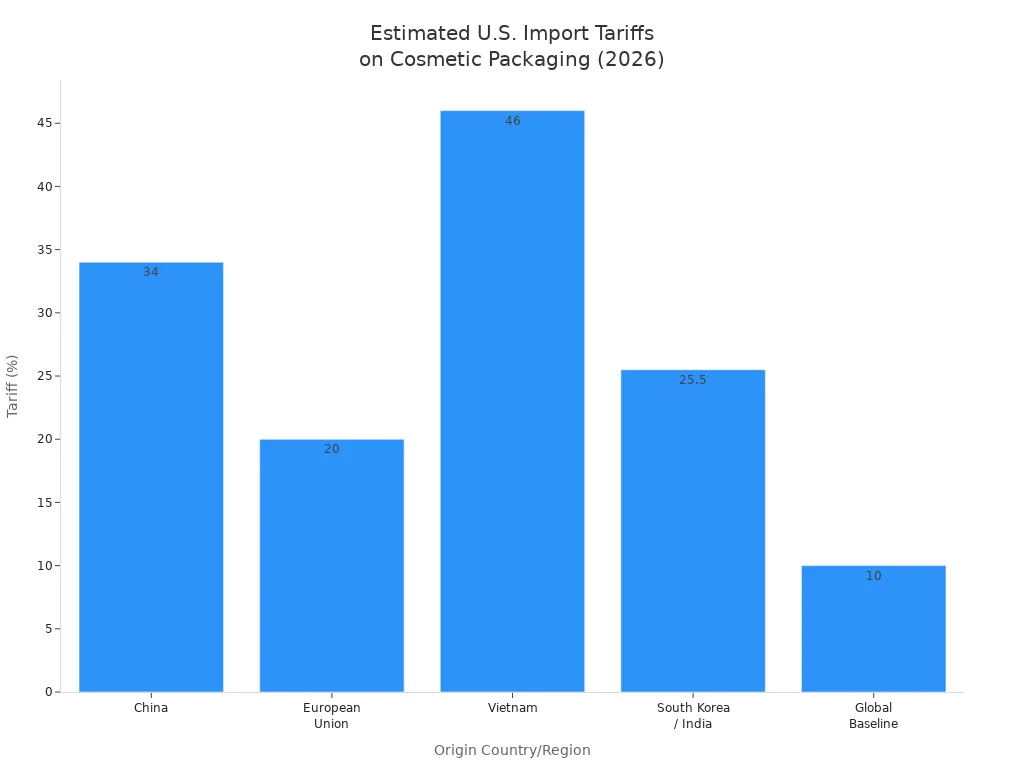
You must plan for these extra costs when you pick packaging. If you want eco-friendly packaging, you may pay higher tariffs and fees. Watching logistics, shipping, and global rules helps you keep your packaging costs low and reach your sustainability goals.
Interdependence of Cost Factors
How Factors Interact
Every choice you make for cosmetic packaging changes other costs. If you pick a material like premium cardboard, your unit cost goes up. Premium materials make your product look fancy. Standard GC1 or GC2 cardboard costs less and saves money. Simple designs are cheaper because machines can make them fast. If your design needs a lot of hand work, the price goes up. When you order more packages, setup costs get spread out. This makes each package cost less. The supplier you choose and how you plan production also matter. They change quality and how fast you get your packaging. Adding special features like hot stamping or eco-friendly parts costs more. But these features help your brand look good and show you care about the planet. All these things work together. You should think about everything when planning your packaging.
Tip: Always ask your supplier for a full cost breakdown. This helps you see how each part changes your total cost.
Cost Optimization Examples
Many brands use smart ways to lower packaging costs and help the planet. Here are some real examples:
- Lush sells “naked” products and uses only recycled plastics. Their “5 Pot Program” lets customers recycle old pots.
- REN Clean Skincare uses packaging made from ocean plastic. Their packaging is always recycled, recyclable, and reusable.
- Dove made a refillable deodorant system. This system uses over 50% less plastic.
- L’Occitane has “Eco-Refills” that use up to 90% less material than normal bottles.
Luxury brands pay more for packaging because they use fancy materials and hard designs. If you want to save money, pick simple designs and order more at once. Work with suppliers who offer green packaging. This helps you balance cost, quality, and caring for the planet.
You can spend less on cosmetic packaging by making designs simple. Picking cheaper materials also helps you save money. Using machines to make packaging lowers costs too. If you plan for shipping and world rules early, you can keep prices down. Eco-friendly packaging makes your brand look good and lasts well. It also helps the planet. Talking to suppliers gives you ideas that fit your needs. They help you find ways to pay less for each item. Custom cosmetic packaging works best when you think about everything together. You should match how you make packaging with what your business needs.
| Advantage | Description |
|---|---|
| Lower cost per unit | Helps you pay less for packaging overall. |
| Flexible customization | Lets you change packaging to fit your needs. |
FAQ
What is the biggest factor in cosmetic packaging unit cost?
Material choice is the most important factor. Glass and metal cost more than plastic. Design, order size, and special finishes also change the price.
How can you lower your custom packaging cost?
You can save money by picking simple designs. Ordering more items at once lowers the price. Standard shapes cost less. Ask your supplier for tips that fit your budget.
Why do custom packaging orders have minimum quantities?
Suppliers set minimums to cover setup costs. Custom molds and printing plates cost money to make. Bigger orders spread these costs over more items.
Does eco-friendly packaging always cost more?
Eco-friendly materials usually cost more than regular ones. Compostable films and recycled plastics cost extra. Prices may go down as more brands use green packaging.
How long does it take to get custom cosmetic packaging?
Production takes about 3 to 8 weeks. Complex designs or special finishes can add time. Ask your supplier for a timeline before you order.