


UV coating helps protect your skin care products. It blocks harmful uv rays. Clean beauty and sustainable cosmetics use gentle formulas. These formulas can break down in sunlight. UV coating keeps your cosmetics safe and working well. You can notice the difference:
- The shelf life of photosensitive skin care products goes from 12 months to 24 months with uv-coated packaging.
UV coating helps your skin stay healthy. It also makes your cosmetics last longer.
Key Takeaways
- UV coating helps skin care products last longer, from 12 to 24 months. This means they stay good and work well for more time.
- Picking skin care products with UV-coated packaging gives better protection from bad UV rays. This helps keep your skin safe and healthy.
- UV-coated packaging keeps the active ingredients in cosmetics stable. This makes sure you get all the benefits each time you use them.
UV Coating and Photosensitivity in Skin Care
What Is Photosensitivity in Skin Care?
Sometimes your skin reacts badly to sunlight. Photosensitivity means your skin is very sensitive to ultraviolet rays. These rays come from the sun or other lights. People with sun sensitivity can get rashes or burns quickly. This reaction is not the same as a normal sunburn. Your skin might turn red, swell, or get blisters. Some ingredients in skin care products make sun sensitivity worse. These ingredients absorb uv rays and become active. They make free radicals that hurt skin cells. You might see redness or dark spots. Sometimes your immune system changes an ingredient after uv exposure. This can cause rashes or eczema-like symptoms later.
Photosensitivity affects how well skin care products work over time. Active ingredients can make your skin more sensitive to uv rays. You might notice:
- Phototoxicity: Ingredients absorb uv rays and make free radicals. These can hurt skin cells and cause redness or dark spots.
- Photoallergy: Your immune system reacts to uv rays and causes rashes or eczema-like symptoms.
- Ingredients that exfoliate or help skin cell turnover can make sun sensitivity worse. Chemical exfoliants like AHAs and BHAs, and brightening agents like hydroquinone, lower your skin’s natural protection against uv rays.
Photosensitivity can cause skin damage, skin cancer, and early aging. You need photoprotection to keep your skin safe. Good photoprotection stops these problems and keeps your skin care products safe.
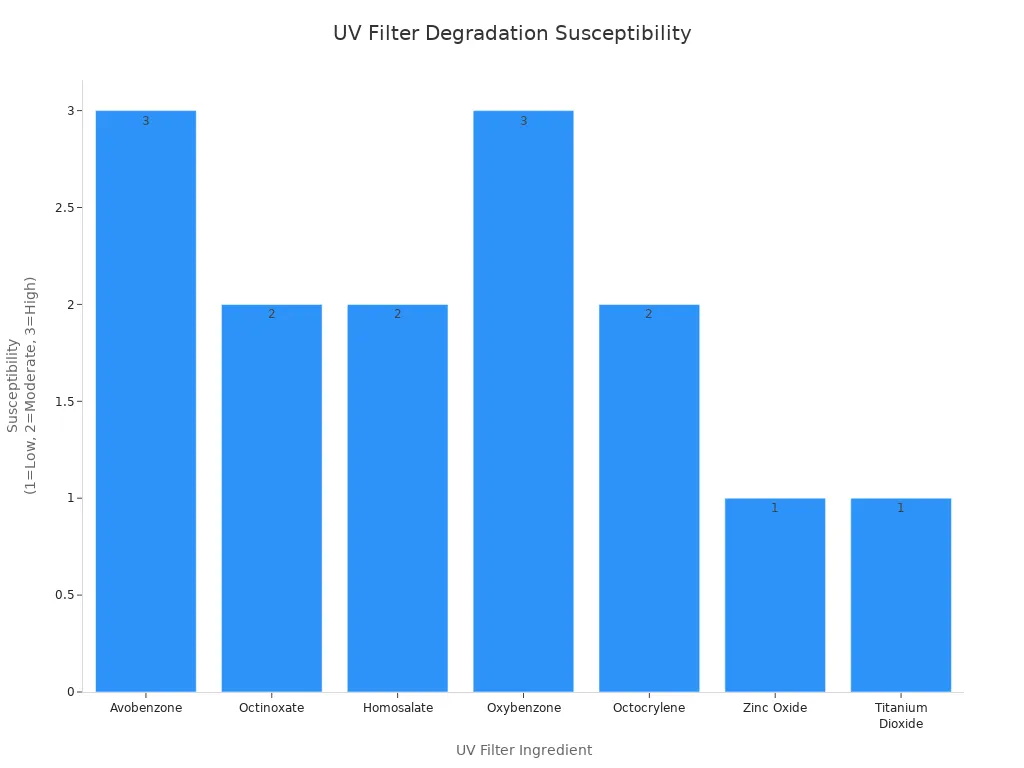
Some skin care ingredients break down faster in uv light. You can see the differences in the table below:
| UV Filter | Susceptibility to Degradation | Notes |
|---|---|---|
| Avobenzone | High | UVA filter, known for instability |
| Octinoxate | Moderate | Commonly used, prone to degradation |
| Homosalate | Moderate | Often used in formulations |
| Oxybenzone | High | Improves UVA protection but unstable alone |
| Octocrylene | Moderate | Stabilizer but can undergo photocycling |
| Zinc Oxide | Low | Inorganic, more stable |
| Titanium Dioxide | Low | Inorganic, more stable |
Why UV Coating Matters for Sensitive Formulas
You want your skin care products to protect your skin well. UV coating acts as a shield against damage from the environment. This is important for clean and sustainable cosmetics. Many formulas use natural ingredients. These ingredients often break down fast in sunlight. UV coating protects by blocking harmful rays. You get products that last longer and work better.
UV coating helps manage sun sensitivity. It protects sensitive formulas from uv rays. You can trust your sunscreen and spf products to stay strong. UV coating keeps active ingredients safe. You avoid fast breakdown and keep photoprotection.
You get good photoprotection in many ways:
- UV coating protects clean and sustainable skin care products from damage.
- Mineral-based UV shields match what people want in clean beauty.
- Natural ingredients give both protection and treatment for your skin.
You need photoprotection for your skin. UV coating makes sure your cosmetics give the best defense against sun sensitivity. You can count on your products to keep your skin safe from uv rays. Good photoprotection makes products last longer and keeps them working well. You get more value and better protection for your skin.
Tip: Always pick skin care products with UV-coated packaging. You get better photoprotection and keep your skin safe from sun sensitivity.
How UV Coating Works to Protect Skin Products
UV Absorbers and Filters in Packaging
You want your skin care products to work well and last long. UV coating uses special ingredients called absorbers and filters. These filters give strong photoprotection. They block, soak up, or scatter ultraviolet rays. This stops the rays from reaching the sensitive formulas inside. Your products get a shield that helps them stay fresh.
There are different filters for creams, sprays, and balms. Each one gives photoprotection in its own way:
- Creams and Lotions:
- Octinoxate soaks up UVB rays and feels light.
- Avobenzone protects from UVA rays but needs help to stay stable.
- Homosalate is a UVB filter and feels smooth.
- Zinc Oxide gives broad photoprotection and is gentle.
- Sprays:
- Octocrylene soaks up UVB rays and helps other filters.
- Tinosorb S gives broad photoprotection and does not break down fast.
- Uvinul A Plus is a stable UVA filter for oil-based products.
- Sticks and Balms:
- Titanium Dioxide and Zinc Oxide give broad photoprotection with less white marks.
- Oil-soluble chemical filters or pre-blended UV dispersions work well in solid products.
Filters do more than just block rays. They use three main actions for photoprotection: Absorption means filters soak up UV rays and turn them into harmless energy. Reflection means some filters bounce UV rays away. Scattering means filters spread out the rays so they cannot hurt the product.
Some filters like zinc oxide and titanium dioxide can make free radicals in light. Coatings on these filters stop this, so your skin stays safe. You get photoprotection without extra risk.
Tip: Check packaging for UV absorbers and filters. This gives better photoprotection for your skin care products.
Benefits for Product Longevity and Efficacy
You want your cosmetics to last long and work well. UV-coated packaging helps by giving strong photoprotection. UV filters in packaging stop harmful rays from breaking down active ingredients. This means your skin gets the full effect every time you use the product.
UV filters in packaging do more than protect your products. They also lower UV radiation inside the package. They stop oxidation and keep vitamins, oils, and other sensitive parts safe. They help your cosmetics keep their color, smell, and texture.
Studies show UV filters can make products last much longer. For example, UV-coated packaging can make oils last up to 200% longer. This means your cosmetics stay fresh and work well for more time. You get more value and better photoprotection.
Here is a table that shows how UV-coated packaging helps your products:
| Benefit Type | Description | Impact on Product Efficacy |
|---|---|---|
| Oxidation Effects | UV rays can cause oxidation, which weakens packaging materials. | Lower strength can lead to faster spoilage |
| Barrier Properties | UV filters reduce oxygen getting inside the package. | Keeps products fresh and slows breakdown |
| Mechanical Strength | Some treatments make packaging stronger and more durable. | Protects against leaks and damage |
You get photoprotection that keeps your skin care products safe from light and air. This means your sunscreen filters and other active ingredients stay strong. You do not have to worry about your cosmetics losing power before you finish the bottle.
Photoprotection is important for every step of your skin care routine. You want your products to work from the first use to the last. UV-coated packaging gives you the photoprotection you need. You can trust your sunscreen filters, creams, and serums to keep your skin healthy and protected.
Note: Always pick cosmetics with UV-coated packaging for the best photoprotection. Your skin will be safer with this extra care.
Sunscreen, SPF, and UV Protection in Packaging
Role of Packaging in Enhancing SPF Stability
You want sunscreen to work every time you use it. The packaging helps keep the sun protection factor strong. UV-coated packaging blocks harmful rays from getting inside. This keeps the SPF stable and stops the active ingredients from breaking down. When you use sunscreen moisturizers, you need the SPF to stay strong. UV coating keeps light from changing the formula. You get sun protection you can trust.
Many studies show UV-coated packaging keeps UV filters safe. The packaging stops light from hurting the sunscreen. Your sunscreen moisturizers stay fresh for a longer time. You do not need to worry about losing SPF before you finish the bottle.
- UV-coated packaging stops sunscreen filters from breaking down.
- It keeps sunscreen moisturizers from losing their sun protection factor.
- You get SPF that lasts longer in your sunscreen and moisturizers.
Choosing the Right UV Coating for Skin Care
You want to pick the best packaging for your sunscreen moisturizers. Look for UV coatings that fit your product’s needs. Spot UV coating makes packaging stronger and helps it look nice. You can trust your sunscreen to stay safe when you carry it or use it.
Manufacturers use UV coating to make packaging tough and pretty. You see bright colors and clear labels. Custom thickness and shine help your sunscreen stand out. UV coating also keeps your moisturizers safe from harm.
When you pick UV-coated packaging, check these things:
| Factor | What to Verify | Red Flags |
|---|---|---|
| Curing Compatibility | Product lists the right lamp and wavelength | Vague words or missing info |
| Solvent Profile | Lists all solvents and skips bad chemicals | “Fragrance” or “proprietary blend” |
| Cure Depth & Time | Shows thickness test and cure time | No thickness or unclear timing |
| Adhesion Testing | Passes standard stick tests | No data or only sticky claims |
| Stability & Shelf Life | Has tested shelf life and dark packaging | Clear bottles or short shelf life |
You want your sunscreen moisturizers to last a long time. UV coating gives you strong and cost-saving packaging. It also helps meet safety and green rules. Spot UV coating makes labels pop and feel cool. You get packaging that protects your sunscreen and looks great.
Tip: Always look for UV-coated packaging when you buy sunscreen moisturizers. You get better protection and SPF that lasts longer.
When you pick UV-coated packaging, you help your skin care products and the planet. UV coatings keep the important ingredients safe. They also make your products better and help the earth.
- UV-coated packaging stops light from getting in. This keeps ingredients from breaking down.
- Many UV coatings can be recycled or break down in nature. They also help cut down on pollution.
| Region | UV Packaging Standard Description |
|---|---|
| FDA (USA) | Needs broad-spectrum protection for anti-aging claims. |
| EU & ASEAN | SPF under 6 is not allowed. SPF over 50 is called SPF 50+. |
FAQ
What makes UV-coated packaging important for sensitive skin and sunscreen-containing cosmetics?
UV-coated packaging gives more protection for sensitive skin. It helps sunscreen ingredients stay strong and not break down. This lowers the chance of skin cancer. It also helps stop early aging in sunscreen-containing cosmetics.
How do ultraviolet light filtering agents reduce photosensitivity risk in multifunctional cosmetic products?
Ultraviolet light filtering agents stop harmful rays from getting in. This lowers the risk of photosensitivity and stops bad skin reactions. Multifunctional cosmetic products give water-resistant photoprotection. They also help slow down early aging from the sun.
Can multifunctional spf rated cosmetics, like sunscreen-containing facial foundations, protect against photoaging?
When you use multifunctional spf rated cosmetics, you get more sun protection. Sunscreen-containing facial foundations help keep your skin safe from sun damage. These products also help slow down early aging.