


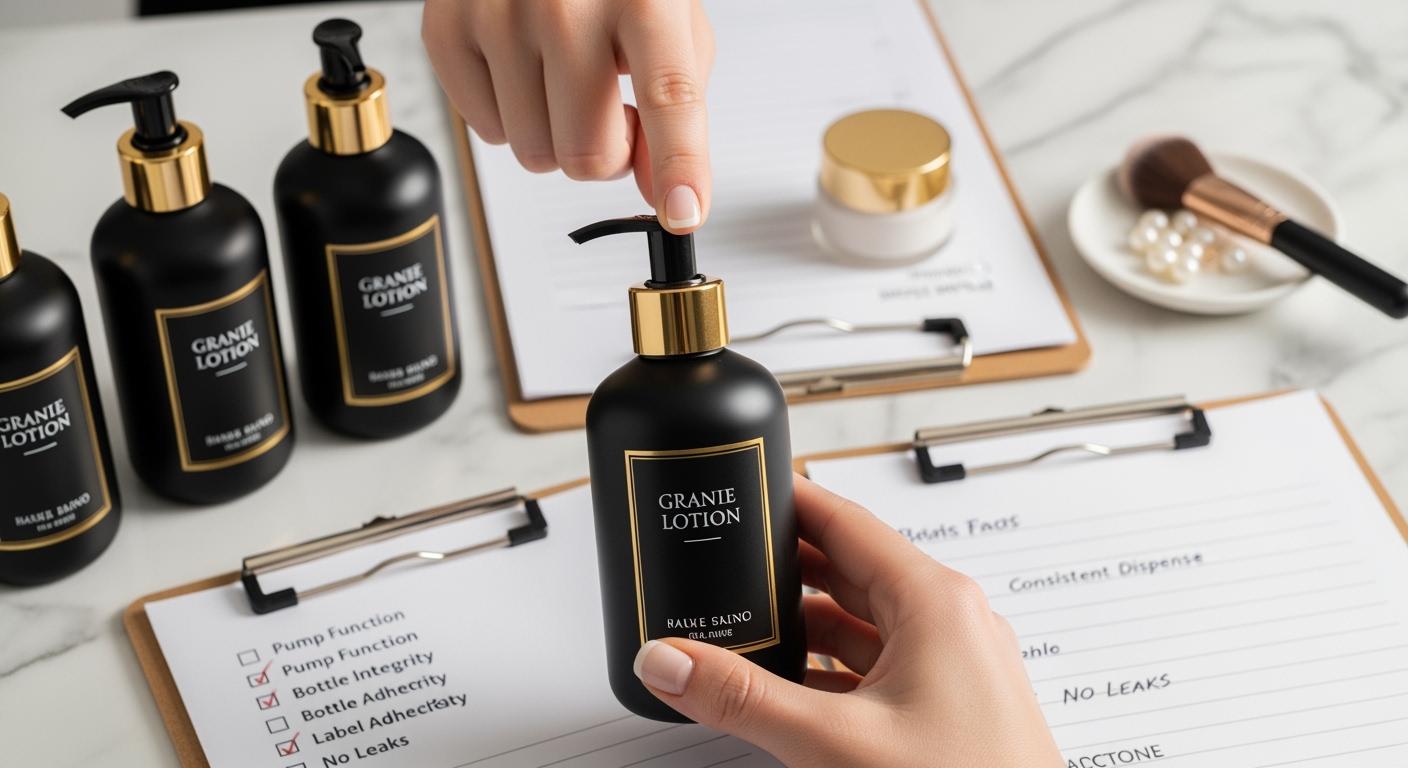
When you choose lotion bottle pump packaging, you must check several essential factors to protect your brand’s image. Poor packaging can harm convenience, practicality, hygiene, and durability, which consumers rate as highly important.
Aspect of Packaging | Importance Level |
|---|---|
Convenience | High |
Practicality | High |
Hygiene | Moderate |
Visual Appeal | Moderate |
Durability | High |
You should also know that most buyers look for easy-to-use, portable, and durable bottles. To avoid costly mistakes, use a checklist. Focus on compatibility, material, customization, supplier reliability, and logistics.
Key Takeaways
Check pump compatibility with your product’s viscosity to ensure smooth dispensing and avoid waste.
Always test samples with your actual formula before placing a bulk order to catch potential issues early.
Look for reliable suppliers with certifications to ensure quality and safety standards are met.
Consider customization options like color and design to enhance brand recognition and appeal.
Plan for lead times and shipping methods to protect your products during transit and ensure timely delivery.
Part1: Pump Functionality And Compatibility
When you select lotion bottle pump packaging, you must ensure the pump works well with your product. The right pump keeps your lotion, cream, or gel easy to use and prevents waste. This section helps you understand how pump design, product viscosity, and safety features affect your packaging choice.
1.1 Product Viscosity Match
Not all pumps work with every product. Lotions, creams, and gels have different thickness levels. If you use a pump that does not match your product’s viscosity, you may face problems like slow dispensing, inconsistent output, or even pump failure. You should always test the pump with your actual formula before placing a bulk order.
Compatibility Issue | Description |
|---|---|
Product viscosity mismatch | Can lead to slow dispensing, inconsistent output, or pump failure. |
Air leakage | May cause the pump to fail or dispense improperly. |
Internal piston problems | Can hinder the pump’s ability to function correctly. |
Poor sealing between pump and bottle | Results in product leakage or ineffective dispensing. |
Incorrect neck size | Can prevent proper attachment of the pump to the bottle. |
Damaged gaskets | May lead to air leaks and product wastage. |
Pumps not locked during transport | Can cause damage to the pump mechanism. |
Dip tube length | If too short, it may not reach the product, especially if thick. |
Bottle shape | An unsuitable shape can affect the ability to dispense all product. |
Testing with actual formula | Recommended to ensure compatibility before mass production. |
The dip tube and suction mechanism also play a key role. The pump head pulls the product up through the dip tube and out the nozzle. If the dip tube is too short, it will not reach the bottom of the bottle, leaving product behind. The pump must create enough suction to draw thicker products like creams and gels.
Tip: Always request a sample and test it with your actual product to avoid costly mistakes.
1.2 Dispensing Accuracy
You want your lotion bottle pump packaging to deliver the right amount of product every time. Accurate dispensing prevents waste and gives your customers a consistent experience. Pumps use a spring and actuator system. When you press the pump, the spring compresses and creates air pressure. This pressure pulls the product into the dip tube and out through the nozzle. The first few pumps, called “priming,” get the product ready for use.
Manufacturers use several tests to check dispensing accuracy:
Test Type | Purpose | Key Elements |
|---|---|---|
Material Inspection | Ensures high-quality materials | Plastic, springs, gaskets |
Functional Testing | Verifies smooth operation and no leaks | Operation, dispensing, leak detection |
Performance Testing | Confirms compliance and accuracy | Accurate dispensing, clog prevention |
Tightness testing checks for leaks at the thread, pump core, and nozzle.
Number of sprays test measures how many pumps it takes to dispense the product.
Pump output test determines the amount dispensed per pump.
You should ask your supplier about these tests and request test results before you commit to a large order.
1.3 Leak-Proof And Locking
A secure pump protects your product during shipping and storage. Industry standards include several locking and leak-proof features:
Twist-to-Lock Mechanism: Rotate the pump clockwise to lock it for transport.
Twist-to-Open Mechanism: Rotate counterclockwise to unlock and use.
Airless Technology: Reduces air exposure, which helps preserve active ingredients.
Controlled Dispensing: Gives you precise control over how much product comes out, reducing waste.
Child-Safe Options: Some pumps require adult strength to unlock, adding safety.
Note: Pumps that do not lock can get damaged during shipping, leading to leaks and product loss.
When you choose lotion bottle pump packaging, always check for these features. Reliable pumps keep your product safe and your customers happy.
Part2: Material Quality And Safety
2.1 Material Options
You need to choose the right material for your lotion bottle pump packaging. Each material offers unique benefits and challenges. The table below compares the most common options:
Material | Advantages | Disadvantages |
|---|---|---|
Plastic | – Some types are recyclable (PE or PP). | – Contributes to plastic waste if not recycled. |
Aluminum | – Fully recyclable and eco-friendly if made from recycled aluminum. | – More energy-intensive production. |
– Chemically inert, preserving product quality. | – Fragile and requires careful handling. |
You can also consider PCR (post-consumer recycled) plastics for a more eco-friendly solution. PCR options help reduce your environmental impact and appeal to sustainability-focused buyers.
2.2 Regulatory Compliance
You must ensure your packaging meets all safety regulations. The following table lists key standards for lotion bottle pump packaging:
Regulation | Description |
|---|---|
EU Regulation (EC) No 1223/2009 | Governs material safety and labeling requirements in the European Union. |
FDA 21 CFR Part 700 | Regulates cosmetic packaging and labeling in the United States. |
GB/T 29680-2013 (China) | Standard for cosmetic container performance and compatibility. |
You should look for packaging that is BPA-free and phthalate-free. This protects your customers from harmful chemicals. Over 72% of consumers worry about chemical leaching in personal care products. BPA-free certification builds trust and shows your commitment to safety. You also need to check for non-reactivity with ingredients like essential oils, acids, or alcohol. Migration testing ensures no harmful substances move from the packaging into your product.
Tip: Full material disclosure increases consumer trust. Transparency matters more than just a BPA-free label.
2.3 Durability And Resistance
Durability keeps your product safe from damage during shipping and use. Good packaging resists cracks, leaks, and chemical reactions. Sealing integrity is vital for shelf life and product stability. Strong seals prevent oxidation, evaporation, and contamination. You should always test your packaging with your actual formula to confirm chemical resistance and long-term performance.
Part3: Lotion Bottle Pump Packaging Customization
3.1 Color And Finish Choices
You can shape consumer perception with your choice of color and finish. Warm, cool, and neutral tones create different emotions. For example, red signals energy, while blue suggests stability and cleanliness. Brands like Clinique use red to stand out, and Nivea uses blue for trust. Over 85% of buyers say color and customization influence their purchasing decisions. You can select matte or glossy finishes to match your brand’s personality. Custom color matching helps your product become instantly recognizable on the shelf.
Tip: Choose colors and finishes that reflect your brand values and target audience.
3.2 Branding And Labeling
You have many options to make your packaging unique. Logo printing, labeling, and hot stamping add a professional touch. These features help your product stand out and build brand loyalty. You can also select cap designs and bottle shapes that align with your brand identity. Customization enhances user experience and product appeal.
Customization Option | Description |
|---|---|
Design Aesthetics | Choose from various sizes, colors, and cap designs to align with your brand. |
Functionality | Customization improves user experience and product appeal. |
Sustainability | Eco-friendly materials and designs reflect your brand’s values. |
Logo printing
Labeling
Hot stamping
Matte finish
Glossy finish
Custom color matching
Note: Beauty brands often become recognizable by their branding and color palettes.
3.3 Custom Order Minimums
You need to know the minimum order quantities before placing a custom order. Most suppliers require a certain number of units for custom designs. The table below shows typical minimums:
Source | Minimum Order Quantity |
|---|---|
JCCosmopack | 12,000 pcs |
Boyu Packaging | 5,000 – 10,000 pcs per size (Standard), 10,000 pcs and above (Custom mold) |
HCC Packaging | 10,000 pcs / SKU |
You should plan your order based on your sales forecast and storage capacity. Custom orders help you create unique Lotion Bottle Pump Packaging that fits your brand, but you must meet supplier requirements.
Part4: Supplier Reliability And Quality Control
4.1 Certifications
You need to check supplier certifications before you place a bulk order. Certifications show that a supplier follows strict quality and safety standards. Reliable suppliers often hold these certifications:
ISO9001: Ensures quality management systems.
Sedex: Focuses on ethical supply chain practices.
FDA: Confirms compliance with food and drug safety standards.
LFGB: Certifies food-grade safety for materials.
BRCGS: Guarantees high standards for packaging safety and quality.
BRCGS Packaging Materials certification: Confirms rigorous safety and quality benchmarks for cosmetic packaging.
These certifications help you avoid legal risks and protect your brand reputation. You should ask suppliers for proof of certification and verify their validity.
4.2 Sample Testing
Sample testing gives you confidence in your Lotion Bottle Pump Packaging. You can spot potential issues early and ensure the pump works with your product. Testing samples lets you collect data, fix problems, and improve processes. Regular sample testing builds customer trust and satisfaction. You know your product will work as intended every time.
Tip: Always request samples and test them with your actual formula before confirming a bulk order.
Quality control processes play a key role during production. Suppliers use injection molding for bottles and pump heads. Automated machinery assembles components to reduce human error and maintain consistency.
Component | Production Method | Quality Control Importance |
|---|---|---|
Bottle | Injection Molding | Ensures precise dimensions and material quality |
Pump Head | Injection Molding | Critical for functionality and reliability |
Assembly | Automated Machinery | Reduces human error and maintains consistency |
Reliable suppliers integrate quality control into every step. The choice of materials impacts the overall quality of your packaging.
4.3 Lead Times
You must plan for lead times when ordering bulk packaging. Lead time is the period from placing your order to receiving your products. Major suppliers offer these average lead times:
Supplier | Average Lead Time |
|---|---|
HCC Packaging | 20–25 days |
Feemio | 15–30 days |
STDPAK | 3 weeks (21 days) |
You should confirm lead times with your supplier and factor them into your production schedule. Reliable suppliers communicate clearly about timelines and keep you updated on progress.
Part5: Logistics And Cost Considerations
5.1 Pricing And Discounts
You need to understand what drives the cost of lotion bottle pump packaging. Several factors influence pricing when you place bulk orders. Tooling and mold costs can increase your initial investment, especially if you request unique sizes or dispenser types. Supply chain and logistics also affect pricing. Smaller bottles require more packaging per product, while larger bottles need reinforced packaging. Customization options, such as special shapes or finishes, can boost brand recognition but may complicate recyclability. Regulatory labeling requirements can impact bottle size and design.
Factor | Description |
|---|---|
Tooling and Mold Costs | Unique molds are required for each size or dispenser type, impacting initial investment and MOQ. |
Supply Chain and Logistics | Smaller bottles have a higher packaging-to-product ratio, affecting shipping efficiency. Large bottles require reinforced packaging. |
Customization Options | Custom shapes and finishes enhance brand recognition but can complicate recyclability. |
Regulatory Labeling | Must include mandatory information without overcrowding the design, influencing bottle size choices. |
Bulk orders often qualify for discounts. You can save 5-15% with extra savings offers. Packaging subscription orders, combo kit deals, and full pallet volume discounts may provide additional savings.
Discount Type | Percentage Savings |
|---|---|
Extra Savings | 5-15% |
Packaging Subscription Orders | Varies |
Combo Kit Deals | Varies |
Full Pallet Volume Discounts | Varies |
Tip: Ask your supplier about available discounts before finalizing your order.
5.2 Shipping And Packaging
Safe shipping protects your lotion bottle pump packaging from damage. You should secure pump bottles to prevent leaks. Locking mechanisms help maintain product freshness and safety. Tamper-evident features assure your customers that the product is safe.
Effective packaging methods include:
Bubble wrap absorbs shocks and prevents exposure. Use multiple layers for heavy items.
Packing paper or foam wraps items before boxing and prevents scratches.
Air pillows fill space around products to prevent movement during transit.
Molded inserts cradle items and prevent movement and damage.
Sealed poly bags contain leaks and use absorbent pads inside.
Strong corrugated boxes protect contents and survive drops.
H-taping method securely seals boxes to prevent opening during transit.
Note: Proper packaging reduces the risk of leaks, breakage, and tampering.
5.3 Returns And Support
You should expect strong after-sales support from your supplier. Most suppliers offer a 100% quality guarantee. If products do not meet agreed specifications, they will remake the product at no cost or provide a full refund. Customer satisfaction is a top priority.
Service Type | Description |
|---|---|
Strong quality control | Ensures every lotion bottle meets international safety and cosmetic-grade requirements. |
Customization capabilities | Offers tailored packaging solutions including unique shapes, colors, logos, and printing finishes. |
Excellent customer service | Provides smooth communication, timely samples, and dependable after-sales services. |
Tip: Choose suppliers who offer clear return policies and responsive support. This protects your investment and ensures your packaging meets your standards.
You protect your brand and avoid costly mistakes when you use a checklist before bulk ordering Lotion Bottle Pump Packaging. Focus on these key steps:
Check compatibility with your formula’s viscosity.
Test pump dosage and dispensing accuracy.
Confirm air-tightness and sealing.
Match design with your brand identity.
Review sustainability and minimum order requirements.
Sample testing helps you spot leaks or dispensing issues early. Work closely with your supplier to meet industry quality benchmarks and build trust.
FAQ
What types of lotion bottle pumps work best for thick creams?
You should choose pumps with a wider dip tube and strong suction for thick creams. Airless pumps also work well.
How do you test pump compatibility with your product?
You should request samples from your supplier. Fill them with your actual formula. Test for smooth dispensing, leaks, and accurate dosage. This step helps you avoid costly mistakes.
Can you customize the color and finish of lotion bottle pumps?
Yes, you can select custom colors, finishes, and even add your logo. Suppliers offer matte, glossy, and metallic options. Looking for custom lotion bottle pumps or complete packaging solutions? Contact Oulete to discuss your project and request free samples.
What certifications should you check before ordering?
You should look for ISO9001, FDA, and BRCGS certifications. These prove the supplier meets quality and safety standards. Always ask for proof before you order. Oulete provides certified cosmetic packaging solutions and supports OEM/ODM customization for global beauty brands. Contact our team for more information.
How do you prevent leaks during shipping?
You should use pumps with locking features and tamper-evident seals. Ask your supplier about secure packaging methods like bubble wrap and molded inserts. This protects your products in transit.