


What actually determines how a mascara performs on the lash – the formula, or the tube it comes in? Ask any cosmetic chemist and they will say formula. Ask any packaging engineer and they will point to the wiper. The truth sits between those two answers, and understanding that intersection is how brands avoid the most common mascara development mistakes.
Oulete engineers mascara tube systems at our Shaoxing facility, where 20 injection molding machines produce components for cosmetic brands across Europe, North America, and Asia-Pacific. This guide covers the engineering that matters at the design and production stage: materials, wiper specification, wand selection, tube geometry, quality testing, and the sustainability options that are production-ready today.
The Four Core Components of a Mascara Tube
A mascara tube is a dispensing package that combines a sealed formula reservoir, a metering wiper, and an integrated wand applicator to deliver controlled doses of mascara formula to the eyelashes. Unlike a squeeze tube or pump bottle where the user controls dispensing force, a mascara tube meters formula passively through the mechanical interaction between wiper and wand. That passive metering is what makes mascara packaging more engineering-intensive than most cosmetic containers.
Tube body. The outer shell houses the formula reservoir. Standard inner volumes range from 8 mL to 15 mL, with 10 mL and 12 mL being the most common for retail mascara. The tube body is injection-molded from PP (polypropylene) for standard lines or ABS (acrylonitrile butadiene styrene) for premium surface finish. Wall thickness and dimensional consistency matter because the wiper seats into the tube neck, and any deviation at that interface compromises seal integrity.
Wand and brush assembly. This is the applicator that contacts the lashes. The wand consists of a stem (typically PP or nylon rod) and a brush head (fiber bristles, molded nylon, or silicone). Wand stem length must match tube body height with appropriate clearance for wiper engagement. The brush head geometry is the primary variable that determines lash look: volume, length, separation, or definition.
Wiper. The most functionally critical and least understood component. Located at the tube neck orifice, the wiper strips excess formula from the brush as the wand is pulled out. Wiper material is typically LDPE (low-density polyethylene) or SEBS (styrene-ethylene-butylene-styrene) rubber. The wiper inner diameter controls formula deposit weight per stroke, making it the single component with the greatest influence on application experience.
Cap and closure. Seals the wand into the tube body and maintains air-tight closure to prevent formula drying. Cap materials follow the same PP/ABS hierarchy as tube bodies. Cap torque specification directly affects seal integrity: too loose allows air ingress that dries the formula; too tight creates an ergonomic problem for the end-user. The cap exterior is also primary branding real estate for hot stamping, screen printing, or metallization.
A mascara tube system consists of four engineered components – tube body, wiper, wand/brush assembly, and cap – where the wiper inner diameter and wand geometry together determine how much formula is deposited per application stroke. Changing any single component without re-evaluating the others introduces performance risk.
Mascara Tube Materials: From Tube Body to Bristle
Material selection for mascara tubes involves trade-offs between cost, surface finish, chemical compatibility, and increasingly, recycled content availability. Each component has a dominant material choice and at least one premium alternative.
PP (polypropylene) for tube bodies and wand stems. PP is the default material for mascara tube bodies across the industry. It offers good chemical resistance against wax-based mascara formulas, processes efficiently on injection molding lines, and accepts PCR (post-consumer recycled) content at 10% to 50% without significant impact on molding parameters. The surface finish of PP is naturally slightly waxy, which means direct printing requires an adhesion promoter or primer layer.
According to the Personal Care Products Council, polypropylene (PP) is the most common mascara tube body material due to its chemical resistance against wax-based formulas, compatibility with post-consumer recycled content, and cost efficiency in injection molding, making it the default choice for both standard and sustainable mascara packaging.
ABS (acrylonitrile butadiene styrene) for premium lines. ABS delivers superior surface gloss and dimensional stability compared to PP. It also provides higher impact resistance, which matters for cold-temperature markets in Northern Europe and North America where PP can become brittle during winter logistics. ABS requires higher tooling temperatures during injection molding, and its PCR supply chain is less mature than PP.
PBT nylon bristles for fiber brushes. PBT (polybutylene terephthalate) is the industry standard for fiber mascara brush bristles. Its semi-crystalline structure provides excellent chemical resistance to mascara formula solvents while maintaining bristle shape under formula load across hundreds of open-close cycles. The alternative is PA6/PA6.6 nylon, which produces softer bristles suited for gentle, natural lash looks.
Silicone for molded wands. Silicone wands are molded as a single piece with no separate bristles. Silicone hardness is specified in Shore A: 20 to 50A is the typical range, where softer durometers pick up more formula and harder durometers deliver better lash separation. The hygiene advantage of silicone is significant – its non-porous surface prevents bacterial colonization at the bristle base, a factor that preservative-free mascara brands increasingly prioritize.
LDPE and SEBS for wipers. LDPE wipers are flexible and food-grade compatible but can harden in cold climates, increasing pull force beyond ergonomic limits. SEBS wipers maintain elasticity from -20 degrees C to +60 degrees C, making them the preferred choice for brands distributing to markets with extreme temperature swings.
Wiper Design: The Most Under-Appreciated Component in Mascara Packaging
A mascara wiper is a metering gasket seated at the tube neck orifice that controls formula dispensing by stripping excess product from the wand during extraction. Most brand managers focus on brush shape and tube aesthetics. Experienced formulators know that the wiper is where application quality is won or lost.
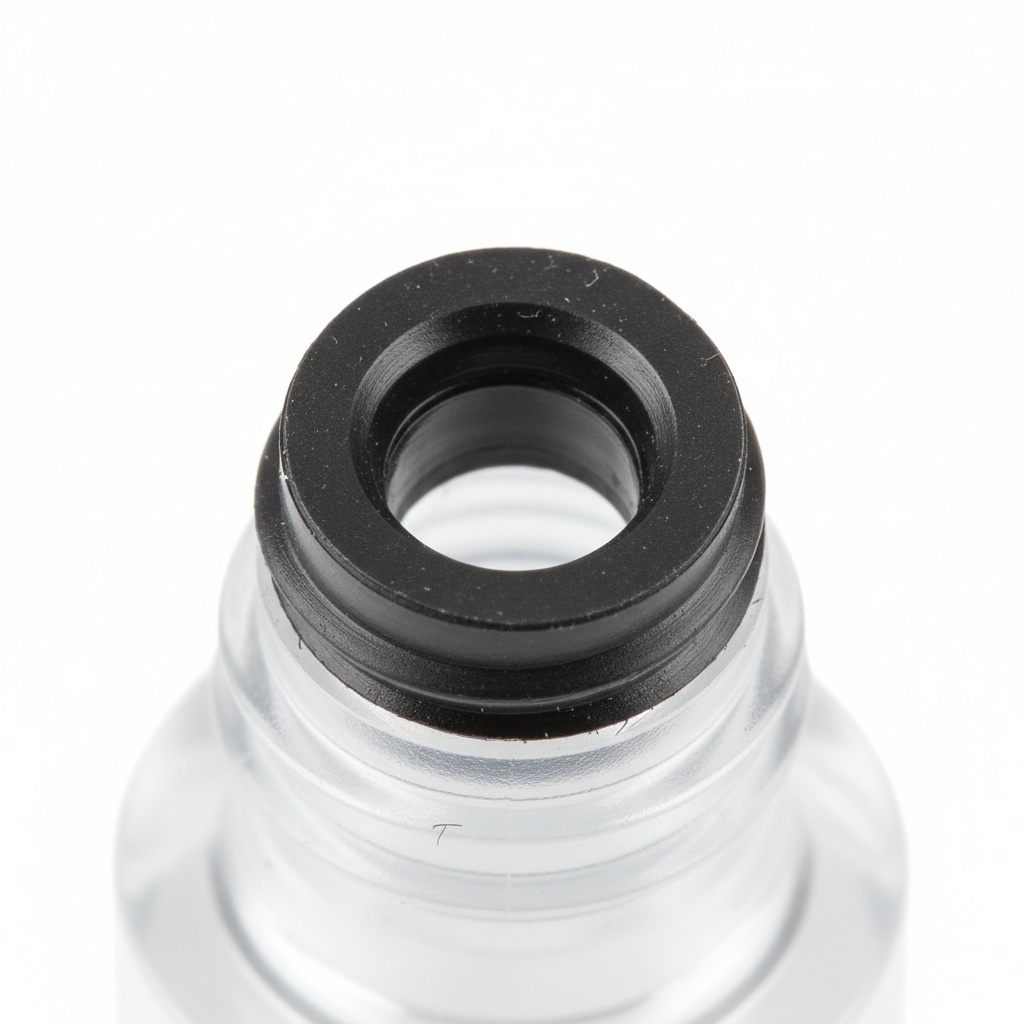
Inner diameter (ID) control. The wiper’s inner diameter is typically set 0.5 to 2.0 mm smaller than the wand stem outer diameter (OD). This interference fit creates a squeegee effect: formula is metered off the wand as it passes through the wiper orifice. Standard wiper ID options include 4.5 mm, 5.0 mm, 5.5 mm, and 6.0 mm, matched to wand OD for the desired formula load. A 0.5 mm reduction in wiper ID can noticeably decrease formula load per stroke, making wiper specification as critical as formula viscosity in determining the final application experience.
Material hardness and formula matching. Wiper hardness is measured on the Shore A scale. Softer wipers (Shore A 30 to 40) yield heavier formula deposits but carry a risk of drips on high-fluidity formulas. Harder wipers (Shore A 50 to 65) strip more formula from the wand and are preferred for thin mascaras to prevent bleeding onto the eyelid. Matching wiper hardness to formula viscosity is a calibration exercise that requires testing, not guesswork.
| Wiper ID | Formula Load | Best For | Recommended Formula Viscosity |
|---|---|---|---|
| 4.5 mm (tight) | Light deposit | Lengthening, defining mascaras | Low to medium viscosity |
| 5.0 mm (standard) | Medium deposit | All-purpose, everyday mascaras | Medium viscosity |
| 5.5 mm (moderate) | Medium-heavy deposit | Volumizing, buildable mascaras | Medium to high viscosity |
| 6.0 mm (wide) | Heavy deposit | Maximum volume, dramatic mascaras | High viscosity (wax-heavy) |
Pull force. Pull force is the force required to extract the wand from the tube through the wiper, measured in Newtons. The standard ergonomic range is 3 to 8 N. Pull force below 3 N risks accidental cap removal and formula spillage. Pull force above 8 N creates an ergonomic failure, particularly for elderly or arthritic consumers. Pull force is affected by wiper ID/OD interference, wiper material hardness, formula viscosity, and ambient temperature.
Dead volume. Dead volume is the percentage of formula that remains trapped in the tube below the wiper at end of life and cannot be dispensed. Industry best practice targets dead volume below 5% of total fill weight. Wiper geometry and tube bottom profile both influence dead volume, and reducing it is becoming a sustainability metric that brands and retailers track.
Wand and Brush Types: Matching Applicator to Formula
The wand is where packaging engineering meets consumer experience. Five major brush types dominate the market, each optimized for a different lash look and formula viscosity range.
Dense fiber brush (volumizing). High bristle count (200 to 400 bristles) picks up maximum formula per stroke, creating a full, voluminous lash look. This brush type requires a wider wiper ID to allow sufficient formula loading without clogging. Best matched with medium to high viscosity mascaras that contain wax or fiber-fortifying ingredients.
Tapered fiber brush (lengthening). A tapered tip allows precision application to bottom lashes and inner corners. Bristle density graduates from high at the base to low at the tip, creating variable formula loading across the brush. Pairs well with lower-viscosity, flexible polymer mascaras that form films rather than building volume.
Spoolie/comb brush (separating). Widely spaced, stiff bristles or comb teeth define and separate individual lashes with minimal formula loading. Compatible with low-viscosity, thin mascaras. Using a spoolie brush with a thick, wax-heavy formula causes clumping because the wide bristle spacing cannot meter dense product evenly.
Silicone mascara wands offer a hygienic advantage over fiber brushes because their non-porous surface prevents bacterial colonization at the bristle base, a factor increasingly cited by preservative-free and natural mascara formulators when selecting applicator components.
Silicone molded wand (precision). Molded as a single piece from silicone with tip geometry variations including ball-tip, hourglass, and comb-spike hybrid. Formula compatibility is best with medium-viscosity mascaras; low-viscosity formula slides off the non-porous silicone surface too easily. The hygienic benefit makes silicone wands the top choice for clean beauty and natural mascara brands.
Dual-fiber brush (lash extension effect). Combines long natural fibers for reach with short synthetic fibers for formula loading. This is the most premium brush type and requires careful wiper calibration because the dual-density brush loads unevenly across fiber lengths. Wiper ID must be tuned to prevent over-stripping the short fibers while allowing adequate formula on the long fibers.
| Lash Look | Brush Type | Formula Viscosity | Wiper ID Range |
|---|---|---|---|
| Maximum volume | Dense fiber | Medium-high | 5.5-6.0 mm |
| Lengthening | Tapered fiber | Low-medium | 4.5-5.0 mm |
| Separation/definition | Spoolie/comb | Low | 4.5-5.0 mm |
| Precision/hygienic | Silicone molded | Medium | 5.0-5.5 mm |
| Lash extension effect | Dual-fiber | Medium-high | 5.0-5.5 mm (calibrated) |
Tube Shapes, Sizes, and Customization Options
Tube geometry affects shelf presence, application ergonomics, and decoration feasibility. Four standard form factors cover the majority of the market.
Standard cylindrical. Outer diameter of 10 to 15 mm and height of 110 to 140 mm. This is the most common form factor because it is the easiest to decorate (flat cylindrical surface suits hot stamping, screen printing, and label application), has the lowest tooling cost, and offers the widest compatibility with automated filling lines.
Slim and tapered. Outer diameter of 8 to 10 mm, appealing for travel-size and everyday positioning. The narrower wiper orifice used in slim tubes naturally favors lengthening mascaras over volumizing formulas. This shape is particularly popular with Korean beauty brands, and the K-beauty influence has driven global demand for slim mascara tubes.
Curved mascara tube bodies improve application angle alignment with the natural eye socket geometry but introduce a decoration constraint: direct screen printing is impractical on curved surfaces, requiring brands to choose between shrink sleeve labels or accept a plain-finish curved tube with cap-only decoration.
Curved and ergonomic. A 5 to 15 degree bend in the tube body follows the natural eye socket anatomy, improving application angle without extreme wrist rotation. The tooling cost premium is real: curved injection molds are more complex than straight, and decoration requires shrink sleeve labels rather than direct printing.
Oversized and jumbo. Outer diameter of 18 to 22 mm with formula capacity of 15 to 20 mL. Designed for shelf standout and paired with oversized brush heads for volumizing positioning. The larger decoration surface provides maximum branding real estate.
Customization options. Oulete offers several decoration processes for mascara tubes: hot stamping (metallic logo, foil accents, up to 2 colors with standard tooling), screen printing (1 to 4 colors, requires primer on PP substrate), matte and soft-touch coating for premium tactile feel, metallic vacuum metallization for mirror-chrome cap finishes, and shrink sleeve labels for full-wrap 360-degree design on curved tubes. Stock tube shapes are available for decoration-only customization at lower MOQ (3,000 to 5,000 units per color run), while custom tube shapes require new injection mold tooling with a lead time of 30 to 45 days for standard cylindrical variants and 45 to 60 days for curved or faceted designs.
Manufacturing, Quality Testing, and Sustainability
Filling and Sealing
Mascara formulas contain waxes (carnauba, beeswax, synthetic wax blends) that require hot filling at 70 to 85 degrees C to remain molten during the fill process. Tube body material must be thermally stable at fill temperature: PP and ABS both handle this range without deformation. Piston filling is the standard method for viscous mascara, providing precise volume control for 5 to 20 mL fill weights. Rotary filling lines process 60 to 120 tubes per minute and require pre-heated formula reservoirs. For natural or preservative-free mascaras, nitrogen blanketing during filling prevents oxidation.
After filling, the wand and cap assembly is inserted through the wiper. Threading (cap threads onto tube body) is the most common closure method and provides a more reliable seal under supply chain vibration than crimping. Torque specification for threaded closures sits at 0.4 to 0.8 Nm, measured and controlled to maintain seal integrity without stripping the threads.
Quality Testing Protocols
According to ASTM D775 and related packaging test standards, mascara tube quality testing covers four primary dimensions: pull force (3 to 8 N ergonomic target), seal integrity (inverted storage at 40 degrees C for 48 hours), drop resistance (1.2 m onto concrete), and formula-material compatibility (90-day soak test at 40 degrees C), each of which directly impacts shelf life and consumer experience in the market.
Pull force testing. Measured on a tensile tester at 100 to 200 mm/min extraction speed. The 3 to 8 N target range ensures consumers can open the mascara without difficulty while preventing accidental cap removal. Extended drop testing uses a 1.5 m drop height for U.S. retail standards.
Seal integrity. Inverted storage at 40 degrees C for 48 to 72 hours confirms no formula seepage through the wiper or cap thread. Pressure differential testing applies internal air pressure to detect any deformation or cap blow-off. Transportation vibration simulation follows ISTA 2A protocol to verify cap retention during shipping.
Formula-material compatibility. Tube body and wiper components are immersed in the actual mascara formula at 40 degrees C for 90 days. Testing checks for dimensional change (swelling), color migration (tube pigment leaching into formula), and delamination. This test is critical for pigmented tube bodies where color contamination can ruin the formula.
Wiper durability. Simulated consumer use of 300 to 500 open-close cycles confirms that wiper ID does not increase beyond acceptable limits, maintaining consistent formula metering throughout the product life cycle.
Oulete holds ISO 9001, CE, SGS, and GMP certifications that cover quality management for cosmetic packaging manufacturing, including mascara tube production at our Shaoxing facility with an annual capacity exceeding 20 million sets.
Sustainability Options
According to the Association of Plastic Recyclers, PCR (post-consumer recycled) PP can be incorporated into mascara tube bodies at 10% to 50% content with minimal impact on visual appearance or mechanical performance. The challenge is that mascara tube wipers require tight-tolerance fitment, and PCR PP has slightly higher dimensional variability than virgin PP, so wipers are typically produced from virgin material even when the tube body uses PCR.
PCR PP tube bodies can incorporate 10% to 50% post-consumer recycled content with minimal visual or functional impact, making recycled polypropylene the most accessible sustainability upgrade for mascara packaging today.
Mono-material design is the industry direction: engineering the entire assembly (tube body, cap, and wiper) from a single polymer family (all PP) so the package can be recycled without disassembly. The engineering challenge is that wipers traditionally use SEBS or LDPE for elasticity, and achieving sufficient flexibility in a PP wiper requires specialized design.
Refillable mascara systems represent an emerging category where the wand and brush pod are sold separately, and consumers refill the formula pod without replacing the outer tube. Commercial launches from brands including L’Oreal, ILIA, and Elate Cosmetics have validated the concept. For cosmetic tube suppliers, refillable systems shift the business model toward higher-value, longer-lifecycle outer tube components. For a comprehensive overview of tube formats and applicator types, see our lip gloss tubes sourcing guide.
Bio-PP from sugarcane feedstock (produced by Braskem) offers a drop-in replacement for fossil PP with identical processing parameters. PHA and PLA bio-plastics are not yet practical for injection-molded mascara tubes due to brittleness and moisture sensitivity.
The mascara tube is an integrated dispensing system where tube body, wiper, wand, and cap must be specified together rather than selected independently. The two variables that most brand managers underestimate are wiper inner diameter and wand geometry, both of which directly control formula delivery and application experience.
For brands evaluating sustainable cosmetic packaging options, PCR PP tube bodies are production-ready today and represent the most accessible sustainability upgrade for mascara packaging. The near-term industry target is a full mono-material mascara tube that can be recycled as a single unit.
Oulete provides mascara tube samples and specification consultation for brands developing new mascara SKUs. With cosmetic spray pump, PETG bottle, and cosmetic tube packaging capabilities alongside mascara tube production, we support brands across their full packaging portfolio from a single cosmetic packaging manufacturer in China. Contact our engineering team with your formula specifications to receive wiper and wand recommendations matched to your target lash look and formula viscosity.
Frequently Asked Questions
Q: What materials are used to make mascara tubes? Mascara tube bodies are typically injection-molded from PP (polypropylene) for standard products or ABS (acrylonitrile butadiene styrene) for premium lines. Brush bristles use PBT nylon or PA6 nylon for fiber brushes, or molded silicone for non-porous wands. Wipers are made from LDPE or SEBS thermoplastic elastomer. Caps follow the same PP/ABS material options as tube bodies, with aluminum sleeves available for luxury positioning.
Q: How does a mascara wiper work? The wiper sits at the tube neck orifice and creates an interference fit with the wand stem. When the consumer pulls the wand out, the wiper’s inner diameter strips excess formula from the brush in a squeegee action. The wiper ID is set 0.5 to 2.0 mm smaller than the wand OD, and this interference determines how much formula remains on the brush for application.
Q: What is the difference between silicone and fiber mascara brushes? Fiber brushes use PBT nylon bristles that load more formula per stroke and produce volumizing effects with high bristle counts. Silicone wands are molded as a single non-porous piece that loads less formula but offers better lash separation and a hygienic advantage because bacteria cannot colonize the smooth surface. Fiber brushes suit volumizing mascaras; silicone wands suit lengthening and defining formulas.
Q: How are mascara tubes filled and sealed during manufacturing? Mascara is hot-filled at 70 to 85 degrees C to keep wax-based formulas molten. Piston fillers dispense precise volumes into the tube body. After filling, the wand and cap assembly is inserted through the wiper, and the cap is threaded onto the tube at a controlled torque of 0.4 to 0.8 Nm. Seal integrity is verified through inverted storage testing and vacuum leak checks.
Q: Can mascara tubes be made with recycled plastic? PP mascara tube bodies can incorporate 10% to 50% post-consumer recycled (PCR) content with minimal impact on appearance or performance. PCR PP has slightly higher dimensional variability than virgin PP, so precision components like wipers are typically produced from virgin resin. Mono-material all-PP designs are the industry direction for improving end-of-life recyclability of the complete tube assembly.
Q: What is the minimum order quantity for custom mascara tubes? MOQ depends on the level of customization. Stock tube shapes with decoration-only customization (screen print, hot stamping) typically start at 3,000 to 5,000 units per color run. Custom tube shapes requiring new injection mold tooling start at higher volumes. Oulete offers an MOQ starting at 1,000 units, allowing brands to test market response with smaller initial production runs.
Q: What quality tests are performed on mascara tubes? Standard quality testing includes pull force measurement (3 to 8 N ergonomic range), seal integrity testing (inverted storage at 40 degrees C for 48 hours), drop testing (1.2 m onto concrete with no cracking or cap separation), and formula-material compatibility testing (90-day soak at 40 degrees C checking for swelling, color migration, and delamination). Wiper durability testing simulates 300 to 500 open-close cycles to confirm consistent metering performance.
Q: What mascara tube shapes are available? Four standard form factors dominate: straight cylindrical (10 to 15 mm OD, most common), slim/tapered (8 to 10 mm OD, popular in K-beauty), curved/ergonomic (5 to 15 degree bend for improved application angle), and oversized/jumbo (18 to 22 mm OD for shelf standout). Stock shapes offer the fastest lead time; custom shapes require 30 to 60 days for tooling.