


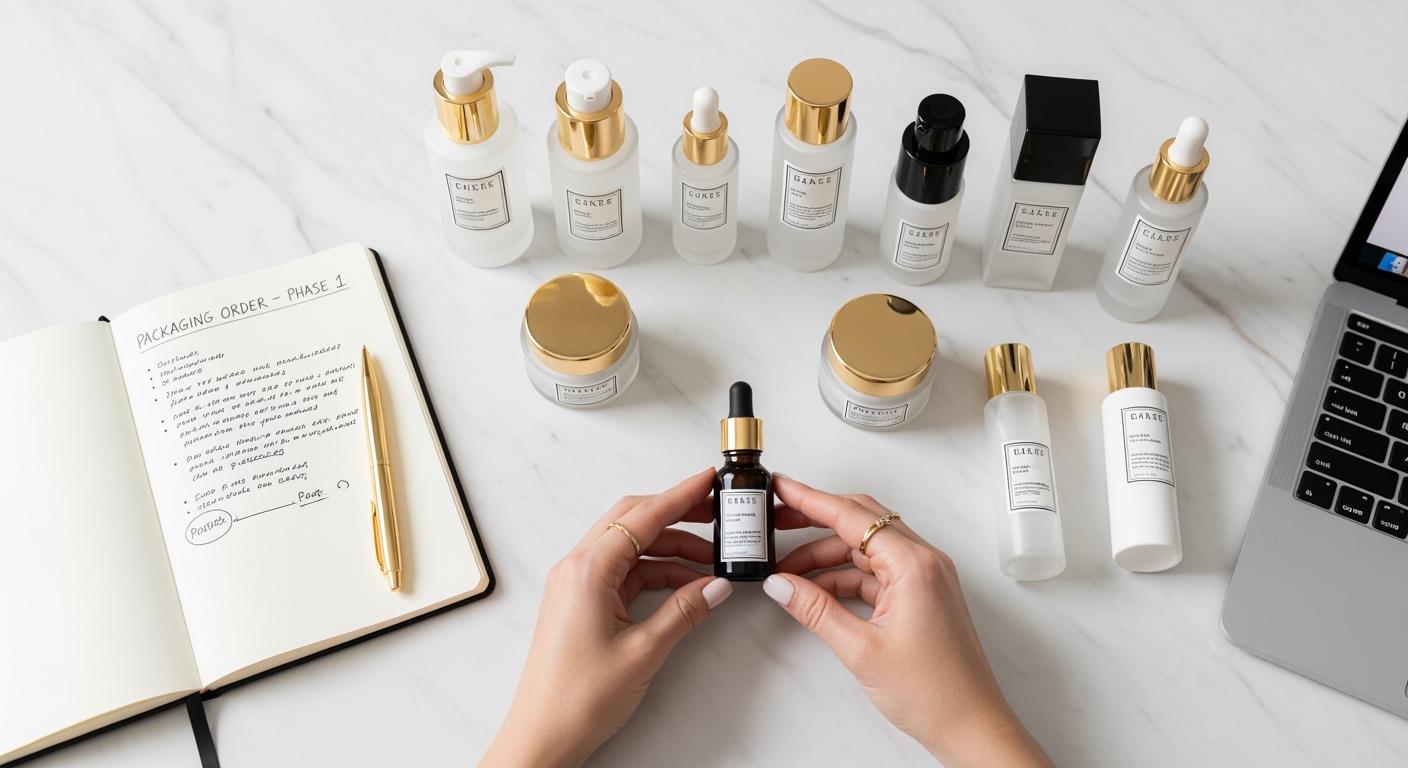
You want to launch your cosmetic line, but high order requirements can seem overwhelming. Low MOQ cosmetic packaging changes the game for small businesses. You gain the freedom to start with smaller bottle orders and keep your financial risk low.
Low MOQ cosmetic packaging allows small brands to minimize financial risk by investing in smaller quantities, which is more manageable for their cash flow. This flexibility enables them to test market reactions without the burden of large upfront investments, making market entry more accessible.
Small businesses can now test products, adjust quickly, and build their brand with confidence.
Key Takeaways
Low MOQ packaging allows small brands to start with smaller orders, reducing financial risk and improving cash flow.
Testing market demand with low MOQ options helps avoid unsold inventory and allows for quick adjustments based on customer feedback.
Choosing uniform containers simplifies inventory management and helps meet supplier minimums, making reordering easier.
Researching reliable suppliers and requesting samples ensures you receive quality packaging that aligns with your brand image.
Planning for growth from the start helps you scale effectively, allowing for future reorders without delays.
Part 1: What Is Low MOQ Cosmetic Packaging
1.1 Definition and Key Benefits
You may wonder what low moq cosmetic packaging means for your business. In the industry, minimum order quantity refers to the smallest number of units a supplier will produce in a single run. Low moq cosmetic packaging allows you to order smaller batches of bottles, jars, or tubes, which is ideal for small businesses and indie beauty brands entering the market.
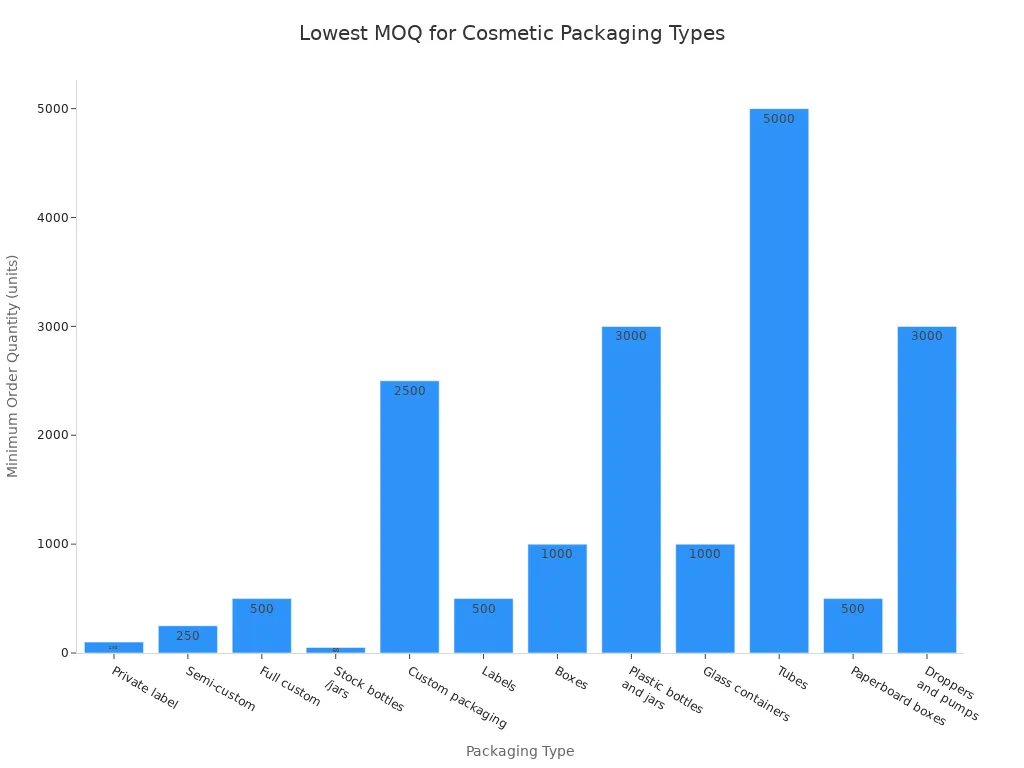
Here is a quick reference table showing typical minimum order quantities for different types of cosmetic packaging, with a focus on bottles:
Type of Packaging | Minimum Order Quantity (MOQ) |
|---|---|
Private label | 100-500 units |
Semi-custom | 250-1,000 units |
Full custom | 500-2,500 units |
Stock bottles/jars | 50-500 units |
Custom packaging | 2,500-10,000 units |
Labels | 500-3,000 units |
Boxes | 1,000-5,000 units |
Plastic bottles and jars | 3,000–10,000 pcs |
Glass containers | 1,000–5,000 pcs |
Tubes | 5,000–20,000 pcs |
Paperboard boxes | 500–3,000 pcs |
Droppers and pumps | 3,000–5,000 pcs |
Low moq options offer several advantages for your company:
You can enter the market with less capital.
You reduce inventory risk and avoid overstocking.
You gain flexibility to test new products and adapt to market changes.
You manage storage costs more efficiently.
You receive supplier support tailored to startups, including guidance on packaging and regulations.
1.2 Why Small Brands Choose Low MOQ
You choose low moq cosmetic packaging because it helps you launch new products with smaller batches. This approach reduces financial risk and keeps your investment manageable. Traditional bulk orders often create inventory pressure and tie up cash flow, which can slow your growth.
With low moq cosmetic packaging, you can:
Test market demand without committing to large quantities.
Avoid the burden of unsold inventory.
Scale production based on real feedback from your customers.
Keep the formulation process simple and manageable.
Many small businesses and indie beauty brands prefer this model because it supports flexible product launches and helps maintain a lower level of SKUs. You can access high-quality cosmetic packaging without the need for massive orders, making it easier to compete and grow in the industry.
Part 2: Planning Your First Order
2.1 Identifying Packaging Needs
You need a clear understanding of your product and target market before placing your first order for cosmetic packaging. Start by gathering detailed information about your product line. Consider the type of cosmetic you plan to launch, such as serums, lotions, or oils, and determine the most suitable bottle type for each. Analyze your target market’s preferences and expectations. This step helps you select packaging that aligns with both product function and customer appeal.
Follow these steps to accurately identify your packaging needs:
Gather information about your product and target market.
Select appropriate packaging types based on the product’s purpose.
Choose materials that align with your brand values and product requirements.
Work with designers to create packaging that is both functional and visually appealing.
Ensure compliance with legal and regulatory requirements for cosmetic packaging.
Pay close attention to legal and practical details. Your packaging must comply with FDA labeling guidelines and any regulations in your target market. Highlight your brand logo and messaging prominently. Make sure the packaging answers common questions about the product. Create mock-ups to visualize the consumer experience and refine your design before committing to production.
2.2 Custom vs. Standard Options
When planning your first order, you face a key decision: custom or standard packaging. Custom bottles allow you to create a unique look that sets your brand apart. You can choose minimalistic and elegant designs, high-quality printing, and custom embellishments to enhance your packaging’s appeal. However, custom options often come with higher minimum order quantities and longer lead times.
Standard bottles offer a practical solution for small businesses and indie beauty brands. These options typically have lower MOQs and faster turnaround times. Standard packaging also helps you control costs and streamline your supply chain. When choosing between custom and standard options, consider the following factors:
Product type: Different products may require different packaging solutions.
Material: The choice of material affects durability and brand perception.
Brand image: Packaging should reflect your brand’s personality and target audience.
Functionality: Packaging must protect the product and be user-friendly.
Visual appeal: Attractive packaging can enhance customer attraction.
Environmental impact: Eco-friendly options can appeal to environmentally conscious buyers.
Budget: Cost considerations are crucial for maintaining profitability.
Packaging materials serve as both protection and a marketing tool. Luxurious and eco-friendly materials can elevate your brand image and demonstrate your commitment to sustainability. If you want to explore standard bottle options, visit our glass dropper bottles page or plastic cosmetic bottles page for more details.
2.3 Using Uniform Containers and Labels
Using uniform containers and labels can help you keep MOQs low and costs manageable. By selecting one or two bottle sizes for your product line, you can purchase larger quantities of each size. This approach helps you meet supplier minimums and reduces the cost per SKU. Uniform packaging also simplifies inventory management and makes reordering easier.
Uniform sizes and containers allow you to buy larger quantities of one size, which helps meet suppliers’ minimum order quantities and reduces costs per SKU.
Consistent labeling streamlines your branding and ensures a cohesive look across your product range.
Standardizing your packaging can make your supply chain more efficient and reduce the risk of errors during production.
Small-batch packaging becomes more affordable when you use uniform containers. This strategy works especially well for small businesses that want to test the market or launch multiple products without overextending their budget. Indie beauty brands often use this method to maintain flexibility and scale up as demand grows.
Tip: Start with a single bottle style and label design for your initial launch. You can always expand your packaging options as your business grows.
By planning your first order with these strategies, you set a strong foundation for your brand’s success in the competitive cosmetic packaging market.
Part 3: Finding Affordable Cosmetic Packaging Suppliers
3.1 Researching Reliable Partners
You need to find reliable partners who offer affordable cosmetic packaging with low moq suppliers. Start by using these effective methods:
Search online directories that list cosmetic packaging manufacturers.
Attend industry trade shows to meet suppliers in person and see their products.
Ask for referrals from other small businesses in the beauty industry.
Review each supplier’s experience, capabilities, and pricing.
Check if they offer the bottle types you need, such as glass or plastic bottles, and ask about customization, lead times, and minimum order quantities.
Look for certifications like ISO 9001 and read customer reviews to judge reliability.
You can also visit our glass dropper bottles and plastic cosmetic bottles pages to explore more options for your product line.
When you evaluate suppliers, use this table to compare important criteria:
Criteria | Description | Importance |
|---|---|---|
Certifications and Compliance | Look for ISO 9001 and GMP certifications. | Ensures quality assurance and regulatory adherence. |
Experience and Track Record | Prefer suppliers with over 5 years of experience. | Indicates reliability and expertise. |
Quality Control and Customization | Check for QC protocols and design capabilities. | Ensures product reliability and matches brand needs. |
3.2 Requesting Samples and Quotes
You should always request samples and quotes from several suppliers before making a decision. This step helps you compare affordable cosmetic packaging options and ensures you get high-quality cosmetic packaging for your brand. By examining samples, you can check the durability and appearance of different bottles. Comparing quotes lets you find budget-friendly options that fit your needs.
Requesting samples and quotes also helps you confirm that suppliers meet regulatory standards. You can test how the bottles look with your labels and see if the packaging matches your brand image. This process gives you confidence before placing your first order.
3.3 Evaluating Supplier Flexibility
Supplier flexibility can make a big difference for small businesses. You want a partner who can adjust to your needs, offer low moq suppliers, and support your growth. Flexible suppliers help you launch new products quickly, reduce inventory risk, and adapt to market changes. They also make it easier to create seasonal collections or test new ideas.
Early collaboration with your supplier is important. You should discuss your equipment, design needs, and production schedule. This teamwork helps avoid costly mistakes and ensures a smooth process for your first order of cosmetic packaging bottles.
Tip: Choose suppliers who communicate clearly and respond quickly to your questions. This shows they value your business and can support you as you grow.
Part 4: Managing Small-Batch Packaging Costs

4.1 Comparing Small-Batch vs. Bulk Pricing
You need to understand how pricing works for small-batch packaging compared to bulk orders. Bulk orders usually offer a price reduction of 5% to 30% over smaller orders. Suppliers can lower costs for large quantities because production, distribution, and administrative expenses decrease. You benefit from production efficiency, shipping savings, and reduced overhead when you scale up.
To make smart decisions, follow these steps:
Skip custom molds and use existing bottle designs to save money.
Keep decoration simple with basic printing or labeling.
Use visual references to show suppliers exactly what you want.
Source high-volume bottles locally and high-value items from overseas.
Always get a final sample before full production.
This approach helps you compare costs and choose the best option for your cosmetic packaging needs.
4.2 Budgeting for Decoration and Shipping
You must budget for every part of your small-batch packaging order. Decoration and shipping can add significant costs. Minimum order quantities for decorated bottles start at just 100 units, and turnaround time is often 7–10 business days from proof approval. Many suppliers ship orders free with tracking, but freight can still add 5% to 25% to your production costs, depending on distance and volume.
Consider these strategies to control your budget:
Plan timelines to avoid expensive air freight.
Choose lightweight bottles to lower shipping costs.
Stick to standard sizes to avoid custom fees.
Use sustainable materials for long-term savings.
Limit SKUs and keep decoration simple to reduce costs.
Note: Domestic production for small batch production can help you minimize risks and control costs.
4.3 Avoiding Hidden Fees
Many small businesses face hidden fees in cosmetic packaging orders. These can include formula R&D, testing, filing, expedited, and packaging premium fees. Such costs may account for up to 50% of your total order. You need to understand all cost components to avoid surprises.
Cost Component | Description |
|---|---|
Raw materials | Actives, herbals, base ingredients |
Packaging materials | Bottles, tubes, cartons |
Conversion cost | Manufacturing and labor |
Filling & packing cost | Filling and packing expenses |
Testing & quality control | Product quality checks |
Documentation | BMR, BPR, COA |
Overheads + compliance | Operational and regulatory costs |
Manufacturer margin | Supplier’s profit |
Careful planning helps you avoid pitfalls like incorrect MOQ planning, overdesigned packaging, or product incompatibility. Always calculate your total investment, including shipping and working capital, and budget for at least six months of operating expenses.
Part 5: Tips for a Successful First Order
5.1 Simplify Design Choices
When you place your first order for cosmetic bottles, keep your design choices simple. Simple designs help you control costs and reduce risk. You can focus on clear labels and basic bottle shapes. This approach allows you to test the market and make changes as you learn what works best for your brand.
Here are the main benefits of simplifying your design:
Benefit | Explanation |
|---|---|
Cost Efficiency | Lower MOQs save money and prevent excess stock, even if unit costs are slightly higher. |
Flexibility | Simple designs let you adjust quickly based on customer or market feedback. |
Reduced Risk | Small batches help you test the market and avoid large financial commitments. |
Tip: Start with one bottle style and a straightforward label. You can always add more features as your business grows.
5.2 Use Visual References
You should provide clear visual references to your supplier. Use digital mockups, photos, or physical samples to show exactly what you want. This step helps avoid misunderstandings and ensures your bottles match your expectations. Visual references also speed up the approval process and reduce costly mistakes.
Share high-quality images or sketches of your desired bottle and label.
Use color codes and material samples to clarify your requirements.
Request a pre-production sample to confirm details before full production.
5.3 Plan for Growth and Reorders
Planning for future growth starts with your first order. You need to understand how minimum order quantities (MOQs) will affect your packaging choices. Mix and match standard bottle options to create a unique product line without increasing costs. Ask suppliers about their inventory and reorder processes to avoid delays.
Consider these steps to support your brand’s growth:
Use the same bottle for multiple products to streamline orders.
Choose adhesive labels for flexibility instead of direct printing.
Allocate budget for samples and future reorders.
Select materials that reflect your brand values, such as recyclable bottles.
Test packaging compatibility with your product formula.
Include all required information on labels to meet regulations.
Note: Building strong relationships with suppliers who can scale with your business will help you grow smoothly.
You can plan your first low MOQ bottle order by following a few key steps. Select packaging that fits your product line, understand MOQs, and choose suppliers who support small batches. Careful planning helps you avoid common pitfalls and manage costs.
Lesson | Description |
|---|---|
Capital Preservation | Save budget for marketing and branding, not just manufacturing. |
Agile Market Testing | Adapt quickly to trends without large financial risk. |
Reduced Storage Overhead | Lower storage costs with smaller production runs. |
Set clear pricing and negotiate flexible terms with your supplier.
Start small, focus on essentials, and scale as demand grows.
With the right strategy, you can launch affordably and adjust as your business expands.
FAQ
What is the typical minimum order quantity (MOQ) for cosmetic bottles?
Most suppliers set MOQs for bottles between 100 and 1,000 units. You can find lower MOQs for standard bottles. Custom bottles often require higher quantities. Always confirm the MOQ with your supplier before placing an order.
Can you customize bottles with a low MOQ?
Yes, you can request basic customization like color or labeling with a low MOQ. Full custom molds usually require higher quantities. Ask your supplier about available decoration options for small orders. For small-batch branding needs, Oulete’s custom cosmetic packaging services can help you review feasible decoration options.
How do you ensure bottle quality before ordering in bulk?
Request samples from your supplier. Test the bottles for durability, compatibility, and appearance. Review certifications and quality control processes. This step helps you avoid costly mistakes in your first order.
What materials work best for small-batch cosmetic bottles?
Glass and PET plastic bottles are popular for small batches. Both materials offer durability and a professional look. Choose based on your product’s needs and your brand’s image.
How do you manage costs when ordering small quantities of bottles?
Use standard bottle sizes and simple labels. Limit the number of SKUs. Compare quotes from several suppliers. Plan your shipping and decoration needs in advance to avoid extra fees.