


Last quarter, a Korean skincare brand sent us three different serum formulations and asked which spray pump would work across all three. The answer was none of them. Each formulation had a different viscosity, different active ingredients, and different shelf-life requirements. That single conversation captures why cosmetic spray pump types matter more than most brand managers realize.
Cosmetic spray pump types include six main categories: fine mist spray pumps, treatment pumps, lotion pumps, foam pumps, trigger sprayers, and airless spray pumps, each designed for specific viscosity ranges, formulation chemistries, and user experiences.
Choosing the wrong pump leads to clogged nozzles, inconsistent dosing, oxidized formulations, and customer complaints that no amount of marketing can fix. Here is what we actually see on the production floor when brands evaluate these six pump types.
Fine Mist Spray Pumps: The Standard for Facial and Body Mist Applications
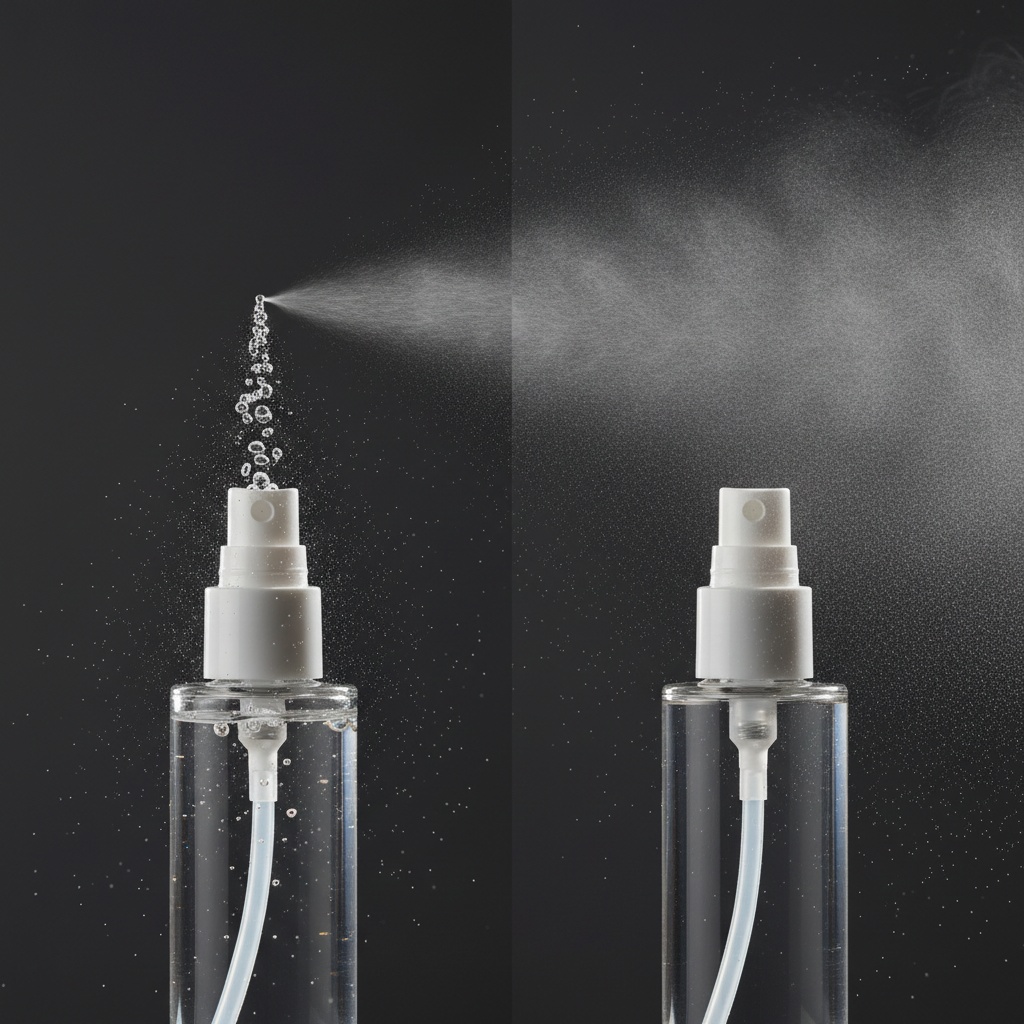
A fine mist spray pump is a precision dispensing mechanism that atomizes liquid into droplets ranging from 20 to 80 microns, producing the cloud-like spray pattern that consumers associate with premium facial mists and toners. This pump type dominates the facial care and body mist categories for good reason.
Fine mist pumps deliver 0.10 to 0.15 mL per actuation. That small dose output is deliberate. Facial toners and setting sprays need even coverage across the skin without saturation. The atomization quality depends on nozzle geometry and spring tension, which is why these pumps use stainless steel springs paired with PP (polypropylene) actuators and PE (polyethylene) dip tubes.
The viscosity ceiling sits at approximately 50 cPs. Anything thicker than a water-like consistency will compromise the mist quality. According to ASTM International’s D2196 standard, viscosity measurement using a rotational viscometer is the accepted method for evaluating cosmetic formulation compatibility with dispensing systems. When working with brands on pump selection, we tell them to test their formulation viscosity first. If it reads above 50 cPs on a viscometer, fine mist is not the right pump for that product.
For brands prioritizing sustainability, fine mist pumps offer high PCR (Post-Consumer Recycled) compatibility. PCR plastic is reclaimed resin that has completed at least one consumer use cycle, and both PP and PE components are widely available in recycled grades. Oulete manufactures fine mist spray systems with PCR content ranging from 10% to 50%, depending on component requirements. For a deeper technical breakdown of this pump category, see our guide on fine mist sprayers for cosmetic applications.
Fine mist spray pumps deliver particle sizes between 20 and 80 microns, creating the characteristic cloud-like application that premium facial mists require. This atomization range allows toners, setting sprays, and body mists to distribute evenly across the skin without pooling or dripping.
One decoration constraint worth knowing: fine mist actuators have a small surface area. Silk screening a logo onto these components requires precise registration, and complex multi-color designs often do not reproduce well. Brands wanting prominent actuator branding should consider treatment pumps instead.
Treatment Pumps: Versatile Dispensing for Hair and Body Care Lines
A treatment pump is a standard spray dispenser that produces larger droplets between 80 and 150 microns, bridging the gap between fine mist atomization and liquid stream dispensing. These pumps handle a broader viscosity range than fine mist systems while still delivering a spray pattern.
Treatment pumps output 0.12 to 0.25 mL per actuation and tolerate formulations up to 500 cPs. That viscosity range covers leave-in conditioners, detangling sprays, styling sprays, and light body sprays. The larger droplet size is actually an advantage for hair care products, where targeted application matters more than even mist coverage.
Treatment pumps deliver 0.12 to 0.25 mL per actuation with droplet sizes ranging from 80 to 150 microns, providing the balance between coverage and precision that hair care and body spray applications demand. Their PP construction makes them one of the most PCR-friendly spray pump options available.
From a production standpoint, treatment pumps cost less than fine mist systems because the nozzle design is simpler. The larger actuator surface accommodates branding better. Hot stamping and silk screening both work reliably on treatment pump actuators, giving brands more decoration flexibility.
Treatment pumps run primarily on PP construction. That material uniformity makes recycling easier and PCR sourcing straightforward. For brands running sustainability programs, this pump type offers the best combination of spray functionality and recycled content potential after lotion pumps.
Where treatment pumps fall short: they cannot produce the fine mist quality that facial products demand. If a brand tries to use a treatment pump on a facial toner, customers will notice the difference immediately. The spray pattern feels wetter, heavier, and less refined.
Lotion Pumps and Foam Pumps: High-Volume and Specialty Dispensing
A lotion pump is a high-volume dispenser designed for medium-to-thick formulations, delivering 0.5 to 2.0 mL per actuation through a stream or large-droplet output rather than an atomized spray. This is the workhorse of the cosmetic packaging industry.
Lotion pumps handle viscosities up to 3,000 cPs, covering everything from hand lotions and body creams to liquid soaps and facial cleansers. The design is the simplest among all pump types: PP actuator and closure with a PE dip tube. That simplicity translates directly to cost. Lotion pumps are the most cost-effective pump option and are often available as stock items with minimum orders as low as 1,000 units.
Lotion pumps handle viscosities up to 3,000 cPs and deliver 0.5 to 2.0 mL per actuation, making them the most versatile dispensing solution for thick creams and lotions in cosmetic packaging. Their simple PP and PE construction also gives them the highest PCR compatibility of any pump type.
On our production lines, lotion pumps run faster than any other pump type. Threading closures is quick, filling is straightforward, and quality control rejects are low. Brands operating under tight production timelines should default to lotion pumps whenever the formulation allows it.
A foam pump is a specialized dispenser with an internal foam chamber that aerates liquid into foam, achieving 8 to 10 times volume expansion from a liquid dose of 0.4 to 1.2 mL. Foam pumps require specific formulation chemistry.
The critical detail that many brands miss: foam pumps only work with surfactant-based formulations. The formulation needs approximately 10 to 20 percent surfactant content to generate stable foam. A standard moisturizer or serum will not foam. Before specifying a foam pump, confirm your formulation lab has designed the product specifically for foam dispensing.
Foam pumps require formulations with 10 to 20 percent surfactant content to generate the characteristic 8 to 10 times volume expansion. This makes them suitable only for specifically designed cleansing and styling products, not general cosmetic formulations.
Foam pump PCR compatibility sits at a medium level. The PP actuator and foam chamber accept recycled content, but the PE mesh screen that generates the foam texture may require virgin material for consistent pore size. When brands ask about recycled material properties in cosmetic packaging, foam pumps are always the most nuanced conversation.
Trigger Sprayers vs. Airless Spray Pumps: Utility Meets Premium
A trigger sprayer is a lever-action pump mechanism that allows adjustable spray patterns from fine mist to concentrated stream, delivering 0.5 to 1.5 mL per actuation. Trigger sprayers are common in salon and professional product lines but are losing ground in consumer cosmetics.
The reason is user experience. Trigger sprayers require two-hand operation: one hand holds the bottle, the other squeezes the trigger. For a hair styling spray used at home, that is acceptable. For a prestige facial mist or body spray, it creates a utilitarian perception that conflicts with premium brand positioning. Industry trends confirm that trigger sprayers are declining in prestige cosmetics as brands shift toward one-hand-operation dispensers.
Trigger sprayers deliver 0.5 to 1.5 mL per actuation with adjustable spray patterns from fine mist to concentrated stream, but their two-hand operation requirement limits their appeal in premium consumer cosmetics where one-hand convenience drives purchase decisions.
Trigger sprayer construction uses PP and PE for the mechanism plus POM (polyoxymethylene) or PP for the nozzle. That multi-material assembly brings PCR compatibility to a medium level and makes recycling more complex for end consumers. Oulete’s injection molding fleet includes 20 machines dedicated to cosmetic packaging production, capable of handling trigger sprayer component manufacturing at volumes exceeding 20 million sets annually.
An airless spray pump is a hybrid dispensing system that combines piston-based vacuum technology with an atomizing nozzle, preventing air contact with the formulation while delivering a fine mist spray. This pump type occupies the premium tier of cosmetic dispensing.
Airless spray pumps handle the widest viscosity range of any pump type: 1 to 5,000 cPs. That means a single airless platform can dispense thin serums, medium-weight foundations, and thick sunscreen formulations. The particle size ranges from 30 to 100 microns with a dose output of 0.08 to 0.20 mL per actuation.
The defining advantage is zero air exposure. Airless systems maintain a 95 percent or higher evacuation rate, meaning almost no product waste remains in the container. According to Packaging Europe, the premium cosmetics dispensing segment is growing at 12 to 15 percent annually as brands increasingly prioritize formulation protection over packaging cost. For formulations containing oxidation-sensitive actives like vitamin C, retinol, or natural preservative systems, airless spray is not a luxury. It is a formulation stability requirement.
Oulete produces airless fine mist sprayer pump bottles as a core product line, combining PETG bottle construction with multi-layer piston systems for premium cosmetic brands. For the full technical breakdown, see our detailed guide on airless fine mist sprayer systems.
Airless spray pumps combine piston-based vacuum technology with atomizing nozzles to deliver particle sizes of 30 to 100 microns while maintaining 95 percent or higher product evacuation rates and preventing oxidation through zero air contact. This makes them the preferred option for natural and active-rich formulations.
The cost reality: airless spray pumps carry a 2 to 3 times price premium over traditional spray pumps. Custom tooling requires higher MOQs, typically in the 5,000 to 10,000 unit range, compared to stock pump options that start at 1,000 units. The investment pays off when the formulation cost per unit is high enough that product waste reduction and shelf-life extension generate real savings.
How to Choose the Right Cosmetic Spray Pump Type
Selecting the right pump starts with your formulation, not your branding preferences. According to the Society of Cosmetic Chemists, dispensing system selection should begin with formulation characterization including viscosity, pH, and active ingredient stability requirements. Measure viscosity in centipoise (cPs), identify oxidation-sensitive ingredients, and determine surfactant content. Those three data points eliminate at least half the pump types immediately.

Cosmetic Spray Pump Types: Technical Specifications Comparison
| Pump Type | Dose Output (mL) | Viscosity Range (cPs) | Particle Size (microns) | PCR Compatibility | Relative Cost |
|---|---|---|---|---|---|
| Fine Mist Spray | 0.10 – 0.15 | 1 – 50 | 20 – 80 | High | Medium |
| Treatment Pump | 0.12 – 0.25 | 50 – 500 | 80 – 150 | High | Low-Medium |
| Lotion Pump | 0.5 – 2.0 | 100 – 3,000 | N/A (stream) | Very High | Low |
| Foam Pump | 0.4 – 1.2 | 1 – 200 | N/A (foam) | Medium | Medium |
| Trigger Sprayer | 0.5 – 1.5 | 1 – 300 | Adjustable | Medium | Medium-High |
| Airless Spray | 0.08 – 0.20 | 1 – 5,000 | 30 – 100 | Medium | High |
Start with formulation characteristics. A 30 cPs facial toner fits fine mist or treatment pumps. A 2,000 cPs body cream needs a lotion pump or airless system. A surfactant-based cleanser opens the foam pump option. Viscosity is the first filter, and it is non-negotiable.
Factor in product positioning. Premium and prestige lines should default to fine mist or airless spray pumps. The one-hand operation and refined spray pattern communicate quality before the customer even tries the formulation. Mass-market products perform well with lotion and treatment pumps where cost efficiency matters. Salon-professional lines can use trigger sprayers where adjustability outweighs aesthetics.
Evaluate production realities. Stock pumps ship in 15 to 20 days with MOQs as low as 1,000 units. Custom tooling requires 45 to 60 days and MOQs of 5,000 to 10,000 units. If you are launching a limited edition or testing a new SKU, start with stock pump options and custom decoration rather than custom tooling. Oulete offers ISO 9001 and GMP certified production with full in-house decoration capabilities including silk screening and hot stamping.
Assess sustainability requirements. If PCR content is a priority, lotion pumps lead the field with the most mature recycled material supply chain. Fine mist and treatment pumps follow closely. Foam pumps and airless systems sit in the middle due to components that may require virgin material for performance. For brands concerned about spray bottle design and material choices, understanding these trade-offs early prevents costly reformulation later.
Consider total cost of ownership. A $0.80 airless pump looks expensive next to a $0.20 lotion pump. But if the airless system prevents $10 of product waste per unit through its 95 percent evacuation rate and extends shelf life by six months for a $50 serum, the math favors the premium option. Brands launching sunscreen spray products face this calculation regularly, where formulation cost and UV-active stability drive pump selection beyond simple unit economics.
Frequently Asked Questions About Cosmetic Spray Pump Types
Can I use the same spray pump for different viscosity products?
Each spray pump type operates within a specific viscosity range, and using a pump outside its rated range causes performance failures. A fine mist pump rated for 1 to 50 cPs will clog or produce uneven spray with a 200 cPs formulation. If you need one platform across multiple products, airless spray pumps offer the widest viscosity tolerance at 1 to 5,000 cPs, though at a higher unit cost. Always test each formulation with the specific pump before committing to production quantities.
What is the difference between fine mist and regular spray pumps?
Fine mist spray pumps produce 20 to 80 micron droplets with a dose output of 0.10 to 0.15 mL, creating a cloud-like spray. Treatment pumps (regular spray) produce 80 to 150 micron droplets with 0.12 to 0.25 mL output, creating a wetter and more targeted spray. The choice depends on application: fine mist for facial products requiring even coverage, treatment pumps for hair and body care where larger droplets deliver product more efficiently to targeted areas.
Are airless spray pumps worth the higher cost?
Airless spray pumps justify their 2 to 3 times cost premium for formulations with oxidation-sensitive ingredients such as vitamin C, retinol, or natural preservative systems. The zero-air-contact mechanism prevents degradation that shortens shelf life, and the 95 percent or higher evacuation rate reduces product waste. For a $50 serum, the waste reduction alone can recover the pump cost premium. For a $5 hand lotion, the economics rarely justify the upgrade.
Can spray pumps be made with recycled materials?
PP and PE pump components are widely available in PCR grades, making lotion pumps, treatment pumps, and fine mist pumps the strongest candidates for recycled content at 10 to 50 percent PCR. Foam pumps have medium PCR compatibility because mesh screen components may need virgin material. Airless spray pumps require virgin material for piston and spring components to maintain performance and seal integrity over the product lifecycle.
How do I prevent pump clogging with thick formulations?
Pump clogging occurs when the formulation viscosity exceeds the pump’s rated range or when particulates in the formula block the nozzle orifice. Match the pump type to your measured viscosity in cPs. For formulations near the upper viscosity limit, request pump samples and run actuation tests at room temperature and at cold conditions (refrigerator storage simulation). Lotion pumps and airless systems tolerate thicker formulations better due to their wider flow paths and higher mechanical force.
What MOQ should I expect for custom spray pumps?
Stock spray pumps with custom decoration (silk screening or hot stamping) start at 1,000 units with lead times of 15 to 20 days. Custom-tooled pumps with unique actuator shapes or proprietary mechanisms require 5,000 to 10,000 unit MOQs with lead times of 45 to 60 days. For brands testing new products or running limited editions, stock pumps with custom decoration offer the fastest and most cost-effective path to market.
Do spray pumps work with natural and organic formulations?
Standard spray pumps work with most natural formulations that meet the viscosity requirements of each pump type. The critical concern is preservative-free products. Without synthetic preservatives, air exposure through traditional pump systems can accelerate microbial growth and ingredient degradation. Preservative-free natural formulations benefit significantly from airless spray systems, where zero air contact maintains formula integrity throughout the product lifecycle.
Which spray pump type offers the best sustainability profile?
Lotion pumps lead sustainability rankings due to their simple PP and PE construction, the most mature PCR supply chain, and easy recyclability. Treatment and fine mist pumps follow with high PCR compatibility. Foam pumps and trigger sprayers sit at medium levels due to multi-material assemblies. Airless spray pumps offset lower PCR compatibility with higher product evacuation rates, reducing overall product waste by 10 to 15 percent compared to traditional pump systems.
The spray pump you choose shapes every touchpoint your customer has with the product. Test samples with your actual formulation, not water. Run actuation tests at production speed, not hand speed. And request decoration proofs on the actual pump components, not flat sheets. Those three steps prevent the majority of pump-related production problems we see across the industry.