


Last year, a European skincare brand approached us with a regulatory problem. They had developed a makeup remover containing hydrocarbon-based solvents, and their existing supplier delivered standard screw caps. Two weeks before their US launch, they learned the product required child resistant closures by federal law. The reformulation timeline was zero. The packaging had to change.
Child resistant closures are reclosable packaging mechanisms designed to prevent children under five from accessing potentially harmful contents while remaining easily openable by adults, as required by the PPPA and ISO 8317 standards. For cosmetic brands selling internationally, getting this component right is not optional, it is a market access requirement.
What Child Resistant Closures Are and Why “Child-Proof” Is the Wrong Term
A child resistant closure is a packaging mechanism that requires two simultaneous or sequential actions to open, creating a barrier that children under five typically cannot overcome. The distinction between “child-resistant” and “child-proof” matters more than semantics suggest. No closure is truly child-proof. The CPSC specifically avoids the term “child-proof” because the standard is probabilistic, not absolute.
According to Drug Plastics, child resistant closures require testing with 200 children aged 42 to 51 months, where 85% must fail to open the package without demonstration and 80% must fail after demonstration. Adult panels of people aged 50 to 70 must achieve a 90% success rate in opening and resecuring the closure. These thresholds define what “child-resistant” actually means in regulatory terms.
The global child resistant closures market reflects how seriously manufacturers and regulators take this category. According to GlobeNewswire, the market was valued at US$1.7 billion in 2023 and is projected to reach US$2.3 billion by 2030, growing at a CAGR of 4.2%. That growth is driven by expanding regulation, not just in pharmaceuticals but increasingly in cosmetics and household products.
On our production floor, we see brands consistently underestimate how early they need to specify child resistant closures in their packaging development process. The closure affects bottle neck finish, torque requirements, and liner compatibility. Designing it as an afterthought creates delays.
Types of Child Resistant Closure Mechanisms
Three primary mechanisms dominate the market, each suited to different container formats and product categories.
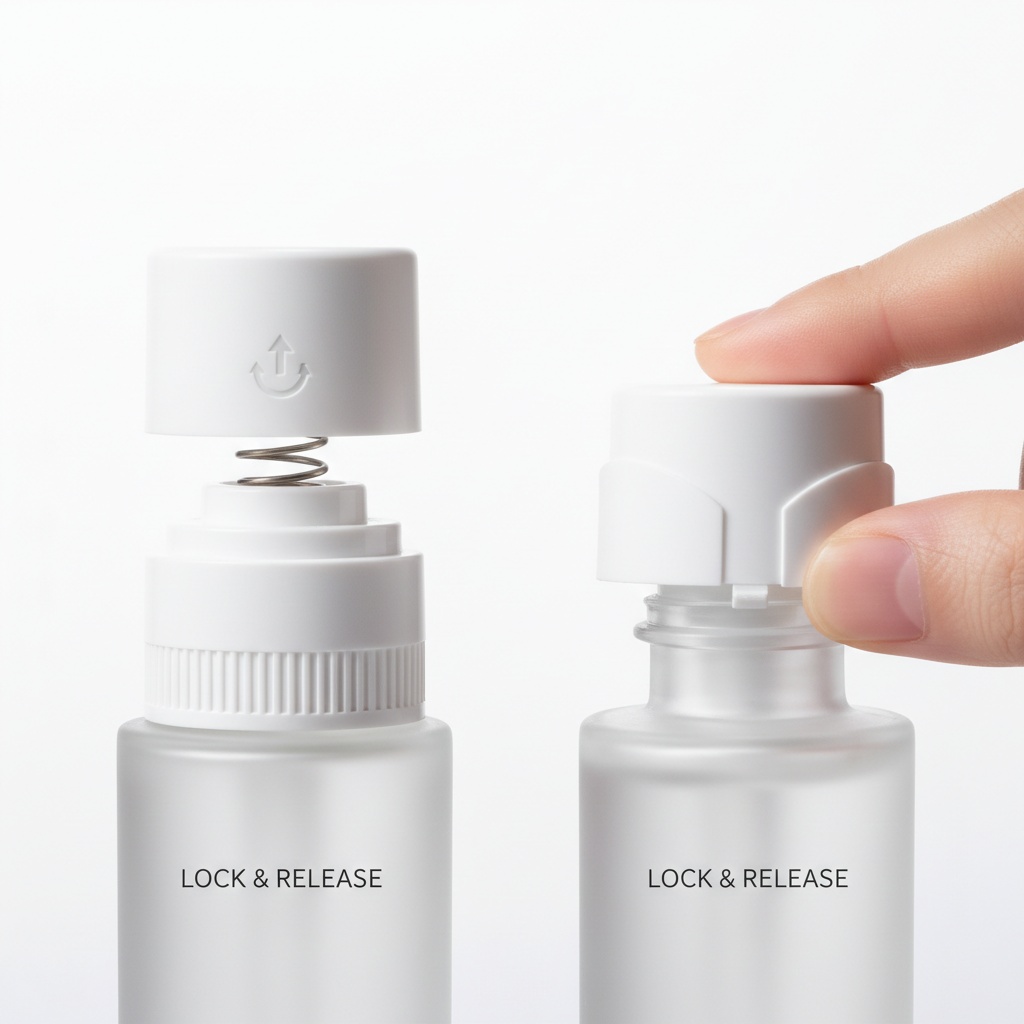
Push-and-turn closures require the user to push down on the cap while simultaneously rotating it. This is the most common mechanism for bottles, and the segment is substantial. According to GlobeNewswire, the push-and-turn closure segment alone is projected to reach US$1.8 billion by 2030, expanding at a 4.4% CAGR. The dominance of this mechanism in both pharma and cosmetics comes from its proven reliability and familiar user experience.
Squeeze-and-turn closures require lateral compression of the cap before rotation becomes possible. These work well on wide-mouth containers where push-down force would be impractical. Brands working with thick creams and balms in jar-style containers typically select this mechanism.
Snap closures use a locking tab or detent system that requires a specific finger action to release. These are newer in design and offer more aesthetic flexibility, which matters for premium cosmetic brands that resist the pharmaceutical look of traditional push-and-turn caps.
According to Reanin Market Research, over 46% of new packaging solutions now feature advanced closure systems such as push-and-turn, squeeze-and-turn, and snap-lock mechanisms, up from simpler single-action caps. This shift reflects both stricter regulation and growing brand demand for closures that are safe but also visually refined.
| Feature | Push-and-Turn | Squeeze-and-Turn | Snap Closure |
|---|---|---|---|
| Primary action | Push down + rotate | Squeeze sides + rotate | Press/slide tab to release |
| Best container format | Standard neck bottles | Wide-mouth jars | Bottles, vials, modern formats |
| Adult ease of use | High (familiar motion) | Moderate (requires grip strength) | High (intuitive once learned) |
| Aesthetic flexibility | Limited (pharmaceutical look) | Moderate | High (premium finish possible) |
| Common cosmetic use | Makeup removers, liquid products | Thick creams, scrubs | Serums, essential oils, edibles |
Which Cosmetic Products Require Child Resistant Closures
Not every cosmetic product needs a child resistant closure, but the products that do are clearly defined by regulation. The CPSC requires child-resistant packaging for cosmetic products containing 10% or more hydrocarbons by weight. This includes makeup removers, baby oils, and certain nail care products. The reason is specific: aspiration of hydrocarbons can cause chemical pneumonia in children.
The Poison Prevention Packaging Act (PPPA), enacted in 1970, is the US federal law that mandates child-resistant packaging across 31 categories of hazardous household substances. Administered by the CPSC and codified at 16 CFR Part 1700, it applies to cosmetics when the formulation crosses the hydrocarbon threshold. Brands that assume cosmetics are exempt from child-resistant requirements often discover the PPPA scope is broader than they expected.
Beyond legal mandates, certain product categories benefit from voluntary adoption of child resistant closures. Essential oil concentrates, nail polish removers below the hydrocarbon threshold, and products containing high concentrations of active ingredients increasingly ship with child-resistant packaging. For brands selling across the US and EU simultaneously, adding a child resistant closure preemptively simplifies tamper-evident packaging compliance for both markets.
When brands ask us about regulatory obligations, we always recommend mapping their full product line against the PPPA categories before selecting any closure format. Discovering a compliance gap after tooling is committed creates expensive delays.
Regulatory Standards: US, EU, and Dual-Market Compliance
The two primary standards governing child resistant closures operate independently but share similar performance thresholds.

16 CFR 1700.20 is the US testing protocol enforced by the CPSC. According to Paramount Global, this standard specifies that the child-resistant mechanism must be part of the primary packaging, not a secondary overwrap or shrink band. The child panel and adult panel testing requirements are mandatory for any product sold in the United States that falls under PPPA jurisdiction.
ISO 8317:2015 is the international standard for reclosable child-resistant packaging, adopted across the EU as EN ISO 8317. According to ISO.org, this standard specifies performance requirements and test procedures requiring 80% child resistance and 90% adult usability. EU market access requires testing by a recognized European testing organization, as confirmed by Locked4Kids.
ASTM D3475 provides the classification framework referenced by the CPSC, categorizing special packaging into types by closure action. This standard does not replace testing but structures the documentation process.
For brands selling in both the US and EU, ISO 13127:2012 offers a practical advantage. According to Drug Plastics, this standard permits limited mechanical machine testing for minor modifications to previously certified child-resistant designs, reducing re-testing burden. When a manufacturer has an existing certified design, small dimensional changes can be validated mechanically rather than through full child panel re-testing.
Oulete holds ISO 9001, CE, SGS, and GMP certifications, which means our quality management system meets the documentation and traceability requirements that US and EU regulatory bodies expect from component suppliers. Testing reveals that brands sourcing closures from uncertified manufacturers face longer customs delays and higher rejection rates during third-party audits.
Sourcing Child Resistant Closures from a Chinese Manufacturer
China’s role in child resistant closure manufacturing is growing faster than any other region. According to GlobeNewswire, China’s child resistant closures market is projected to grow at 7.1% CAGR to reach US$523.8 million by 2030, the fastest-growing region globally, driven by export manufacturing demand.
When specifying child resistant closures from a Chinese supplier, brands need to communicate three things clearly: the neck finish specification (thread dimensions and pitch), the required torque range for application and removal, and the liner material compatible with their formulation. These are the variables that determine whether a child resistant closure will perform correctly on the filling line and pass regulatory testing.
Certifications to request from any manufacturer include ISO 9001 for quality management systems, SGS testing reports for material safety, and CE marking for EU market compliance. Oulete provides all three, backed by our 20 injection molding machines and annual capacity exceeding 20 million sets. This production scale allows us to offer MOQs starting at 1,000 units, making pilot runs feasible before full production commitment.
Sustainability is becoming a sourcing criterion alongside safety. According to Reanin Market Research, approximately 38% of manufacturers are now introducing eco-friendly child resistant closures, responding to sustainability pressure from brands. Oulete’s PCR material capability covers PP, PE, and PET resins at 10% to 50% recycled content, enabling child resistant closures that meet both safety and sustainability requirements.
Integrating CRC with Airless and Pump Dispensers
One area where existing guides provide no guidance is the intersection of child resistant closures with airless pump bottle formats. Cosmetic brands increasingly want both product protection (airless dispensing) and child safety (resistant closure) in a single component. The engineering challenge is real: airless pumps rely on a vacuum mechanism that a secondary locking action can interfere with if not designed correctly.
The solution involves designing the child resistant mechanism into the outer cap assembly rather than integrating it with the pump actuator itself. This preserves the vacuum seal integrity while adding the required two-action opening sequence. When the closure is designed as an overcap with a push-and-turn lock, the pump underneath operates normally once the overcap is removed.
For products that require both child resistance and tamper-evident packaging, the two features can coexist in a single closure system. A shrink band or breakable ring provides tamper evidence on first opening, while the underlying push-and-turn mechanism delivers ongoing child resistance on every reclosure. Oulete’s customization services support this type of integrated design, with tooling for combined tamper-evident and child-resistant closure assemblies.
Brands developing products with active ingredients, such as concentrated retinol or glycolic acid formulations, should consider whether an airless pump jar with a child resistant overcap provides both the formulation protection and the safety compliance their product requires.
The brands that invest in dual-function closure engineering now are building a packaging platform that handles increasing regulatory requirements without redesigning from scratch each time a new market adds child safety mandates.
Frequently Asked Questions
What is a child resistant closure and how does it work?
A child resistant closure is a reclosable packaging mechanism requiring two simultaneous or sequential actions to open, such as pushing down while turning. This dual-action design prevents most children under five from accessing the contents while remaining accessible to adults, per the performance thresholds established by the CPSC and ISO 8317.
Which cosmetic products legally require child resistant packaging?
The CPSC mandates child-resistant packaging for cosmetic products containing 10% or more hydrocarbons by weight, including products like makeup removers and baby oils. Aspiration of hydrocarbons can cause chemical pneumonia in children, which is the specific health risk the regulation addresses.
What is the difference between ISO 8317 and US 16 CFR 1700.20?
ISO 8317:2015 is the international standard used for EU market access, while 16 CFR 1700.20 is the US CPSC-enforced testing protocol. Both require child panel and adult panel testing with similar performance thresholds, but ISO 8317 testing must be conducted by a recognized EU testing organization, and the US standard mandates that the mechanism be part of the primary packaging.
Is child-resistant packaging the same as tamper-evident packaging?
These are distinct safety features serving different purposes. Child-resistant packaging prevents repeated access by children through a two-action mechanism. Tamper-evident packaging provides visible evidence that a container has been opened for the first time. A single closure can incorporate both features, such as a push-and-turn cap with a breakable tamper band.
How are child resistant closures tested for compliance?
Testing requires a panel of 200 children aged 42 to 51 months, where 85% must fail to open the package without demonstration and 80% after demonstration. An adult panel of individuals aged 50 to 70 must achieve a 90% success rate in opening and resecuring the package. These tests must be conducted by certified laboratories.
Can child resistant closures be made from recycled (PCR) plastic?
PCR resins in PP, PE, and PET can be used for child resistant closures when the material meets the required mechanical strength for the locking mechanism. The recycled content typically ranges from 10% to 50% depending on the closure design and performance requirements. Material testing confirms the closure still passes the required child and adult panel thresholds.
How do I source certified child resistant closures from a Chinese manufacturer?
Request ISO 9001 certification, SGS testing reports, and CE marking documentation. Provide your exact neck finish specification, formulation compatibility requirements, and target market (US, EU, or both). Confirm whether the manufacturer can provide existing certified designs or whether custom tooling with new panel testing will be required.
Are child resistant closures required in the EU as well as the US?
EU member states require compliance with EN ISO 8317 for products classified under the CLP Regulation as hazardous. The scope differs from the US PPPA, but cosmetic products containing certain chemical substances may trigger the requirement. Brands selling in both markets should design closures that satisfy both standards simultaneously.