


A European skincare brand contacted our Shaoxing factory last year with a specific request: replace all their PP airless bottles with PLA. Their marketing team had promised “100% plant-based packaging” in a campaign launching six months out. After reviewing their formulations and running compatibility tests on our injection molding lines, we had to deliver some uncomfortable news. Bio-based packaging materials are packaging components derived from renewable biological sources such as sugarcane, corn starch, cellulose, or PHA rather than fossil fuels, offering brands a lower-carbon alternative to conventional plastic. But “plant-based” does not automatically mean “better,” and choosing the wrong bio-based resin for your product category can create more problems than it solves.
According to Mordor Intelligence, the global bioplastics packaging market was valued at USD 6.27 billion in 2025 and is projected to reach USD 18.89 billion by 2031, growing at a 20.18% CAGR. Personal care and cosmetics is the fastest-growing end-use segment, forecast to expand at 20.58% CAGR from 2026 to 2031. Those numbers reflect real demand from brand owners. But the gap between market enthusiasm and factory-floor readiness is wider than most procurement teams realize.
What Bio-Based Packaging Materials Actually Are
Bio-based packaging materials are polymers derived wholly or partially from biomass feedstocks instead of petroleum. The feedstock source is what defines “bio-based,” not how the material behaves after disposal. A bio-PET bottle made from sugarcane ethanol is chemically identical to conventional PET. It performs the same way, recycles the same way, and lasts just as long in a landfill.
The most common bio-based polymers relevant to cosmetic packaging fall into three categories. First, drop-in bioplastics like bio-PE and bio-PET replace fossil carbon with plant-derived carbon while keeping the same molecular structure. Second, novel biopolymers like PLA (polylactic acid) and PHA (polyhydroxyalkanoates) have entirely different chemical structures from conventional plastics. Third, natural polymers like cellulose and starch-based materials that are processed into packaging components.
According to Mordor Intelligence, Bio-PET holds 39.10% of the bioplastics packaging market share in 2025, while PHA is the fastest-growing material at 21.65% CAGR through 2031. For cosmetic brands, this distinction matters because drop-in bioplastics work with existing supply chains, while novel biopolymers require retooling and reformulation testing.
On our production floor, we process PP, PE, and PET daily across 20 injection molding machines. When a client requests bio-PE, the transition is straightforward because the melt flow characteristics are nearly identical. PLA is a different story. It requires lower mold temperatures, longer cooling cycles, and careful humidity control during material handling. These processing realities directly affect unit cost and lead time.
Bio-Based vs. Biodegradable vs. PCR: Three Paths That Brands Confuse
The single most common mistake in sustainable packaging procurement is treating “bio-based,” “biodegradable,” and “recycled content” as interchangeable terms. They describe entirely different material properties, and confusing them leads to regulatory problems and disappointed consumers.
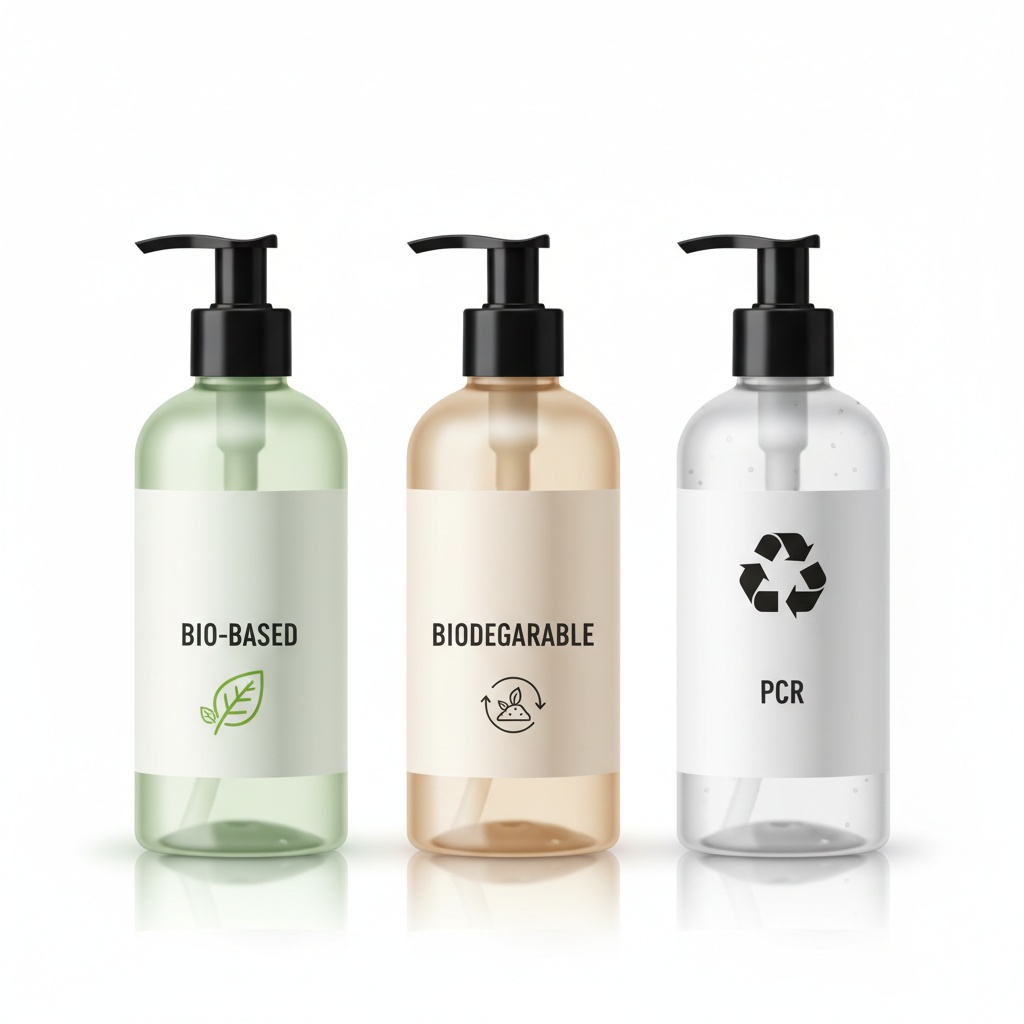
Bio-based refers to the origin of the raw material. A bio-based plastic comes from renewable feedstocks. It says nothing about whether the material will break down after disposal. Bio-PET, for example, is derived from sugarcane but is not biodegradable. According to the Netherlands Institute for Sustainable Packaging (KIDV), some fossil-derived materials like polycaprolactone are biodegradable but not bio-based. The two properties are independent.
Biodegradable means the material can be broken down by microorganisms under specific conditions. The critical detail is “under specific conditions.” A PLA bottle labeled “compostable” requires industrial composting facilities operating at 58 degrees Celsius for weeks. It will not decompose in a home compost bin, and it will not break down in the ocean. Standards like ASTM D6400 and EN 13432 define the conditions required for a valid compostability claim.
PCR (Post-Consumer Recycled) plastic is reclaimed resin that has completed at least one consumer use cycle. Oulete processes PP, PE, and PET with 10% to 50% PCR content using our existing injection molding tooling, with no mold modifications required. PCR reduces virgin plastic demand without changing the material’s fundamental chemistry or performance characteristics.
| Property | Bio-Based (e.g., Bio-PE) | Biodegradable (e.g., PLA) | PCR (e.g., Recycled PP) |
|---|---|---|---|
| Raw material source | Plant-derived (sugarcane, corn) | Varies (can be bio or fossil) | Post-consumer waste |
| Recyclable in standard streams | Yes (drop-in types) | No (contaminates PET/PP) | Yes |
| Requires industrial composting | No | Yes (for compostable claim) | No |
| Existing mold compatibility | High (drop-in) / Low (PLA) | Low | High |
| Formula compatibility risk | Low (drop-in) / Medium (PLA) | Medium-High | Low |
| Cost premium over virgin PP | Moderate | High | Low-Moderate |
| Regulatory simplicity | Medium | Complex (compost claims) | High |
For cosmetic brands choosing between these paths, the decision depends on your specific regulatory requirements, consumer messaging goals, and supply chain capabilities. Brands selling into the EU market should pay close attention to how each option aligns with the incoming PPWR requirements.
Five Bio-Based Materials for Cosmetic Bottles and Jars
Not every bio-based polymer works for cosmetic packaging. Formulation compatibility, barrier properties, and decoration feasibility narrow the practical options. Based on what we see in production requests and what actually performs in testing, these five materials cover the realistic choices for cosmetic bottles and jars.
PLA (Polylactic Acid) is a biopolymer derived from fermented corn starch or sugarcane. PLA offers good optical clarity, making it suitable for transparent serum bottles and display packaging. Its limitation for cosmetics is poor chemical resistance to high-pH formulations and essential oils, which can cause stress cracking over shelf life. PLA also has a low heat deflection temperature of around 55 degrees Celsius, meaning it deforms in hot warehouses or shipping containers during summer months.
PHA (Polyhydroxyalkanoates) is a family of polyesters produced by bacterial fermentation, offering both bio-based origin and marine biodegradability. According to PlasticsToday, Riman Korea uses a PHA-PLA bioplastic blend for 5.4 million units of premium skincare packaging annually, demonstrating commercial viability at scale. PHA’s main barrier to wider adoption is cost and limited global production capacity.
Bio-PE (Bio-based Polyethylene) is produced from sugarcane ethanol, primarily by Braskem in Brazil. It is chemically identical to fossil-derived PE, which means it works with existing molds, recycling streams, and decoration processes. For brands that want a bio-based claim without any supply chain disruption, bio-PE is the safest option.
Bio-PET (Bio-based PET) follows the same drop-in logic. Current commercial bio-PET typically contains around 30% bio-based content (the MEG component derived from sugarcane), with the remaining 70% still fossil-derived. Fully bio-based PET using bio-PTA is in development but not yet commercially available at scale.
Cellulose-based materials include paper-based packaging components, molded fiber caps, and cellulose acetate containers. These work best for secondary packaging, caps, and outer components rather than primary containers that directly contact formulations. Cellulose materials accept printing and embossing well but lack the moisture barrier required for liquid cosmetics.
| Bio-Based Material | Best Cosmetic Application | Chemical Resistance | Heat Tolerance | Decoration Compatibility | Relative Cost |
|---|---|---|---|---|---|
| PLA | Clear display bottles, samples | Low (avoid oils, high pH) | Low (55C HDT) | Screen printing OK; hot stamping limited | High |
| PHA / PHA-PLA blend | Premium skincare jars, refill pods | Medium | Medium | Screen printing OK; evolving options | Very High |
| Bio-PE | Tubes, caps, flip-top closures | High | High (same as PE) | Full compatibility (same as PE) | Moderate |
| Bio-PET | Transparent bottles, toners | High | High (same as PET) | Full compatibility (same as PET) | Moderate |
| Cellulose / Fiber | Caps, secondary packaging, gifts | Low | Medium | Embossing, printing excellent | Low-Moderate |
Manufacturing Realities: Processing Bio-Based Resins on the Factory Floor
This is where most sustainability articles stop and where factory experience begins. Processing bio-based materials is not as simple as swapping pellets in the hopper. Each resin family brings distinct requirements that affect cycle time, reject rates, and decoration outcomes.
When brands ask about converting to PLA on our 20 injection molding machines, we walk them through the specifics. PLA requires mold temperatures between 25 and 40 degrees Celsius, compared to 40 to 80 degrees Celsius for standard PP. The material is highly sensitive to moisture. PLA pellets need pre-drying at 80 degrees Celsius for a minimum of four hours before processing. Skip this step, and hydrolysis during melting produces brittle parts with visible defects. Injection speed must be slower to prevent shear-induced degradation, which adds cycle time per part.
Decoration is the second area where bio-based surfaces behave differently. PLA surfaces accept screen printing with UV-curable inks, but hot stamping adhesion is inconsistent without a primer coat. Foil adhesion depends on the specific PLA grade and any additives in the compound. We test decoration adhesion on sample parts before committing to production runs. Bio-PE and bio-PET, being chemically identical to their conventional counterparts, accept all standard decoration processes including hot stamping, UV coating, and metallization without modification.
Oulete maintains ISO 9001, CE, SGS, and GMP certifications across all production lines. When processing bio-based resins, the same quality management protocols apply. Dimensional tolerances, appearance standards, and functional testing follow identical procedures regardless of whether the resin is petroleum-derived or plant-derived. The material source changes, but the quality gate does not. Our approach to packaging quality and manufacturing standards remains consistent across all material types.
Testing reveals that formula compatibility is the issue most brands underestimate. We strongly recommend that any brand considering PLA or PHA packaging conduct a minimum 12-week compatibility test with their actual formulation in the proposed container. Conventional PP and PE have decades of compatibility data behind them. Novel biopolymers do not, and every formulation presents a unique interaction profile. Retinol serums, vitamin C treatments, and formulations with high essential oil content are the most common problem categories. Our compatibility testing processes follow established protocols to catch these issues before production commitment.
Mold tooling is another cost factor that brands overlook. If your existing mold was designed for PP processing, running PLA through it may require gate modifications and cooling channel adjustments. Bio-PE and bio-PET, being drop-in materials, run in the same molds without modification. This tooling compatibility difference is a significant factor in the total cost of transitioning to bio-based materials.
EU PPWR and the 2025-2026 Regulatory Shift
Regulation is accelerating the bio-based packaging conversation faster than material science can keep up. Brands sourcing packaging from China for EU distribution need to understand what is changing and when compliance deadlines actually hit.
The EU Packaging and Packaging Waste Regulation (PPWR) entered into force on 11 February 2025, with full application beginning mid-2026. According to GoEcoPure’s regulatory analysis, the PPWR requires all packaging to be recyclable by 2030 and bans all PFAS substances in packaging from August 2026. The regulation also sets minimum recycled content thresholds for plastic packaging, with increasing targets through 2040.
For bio-based materials specifically, the PPWR’s recyclability requirement creates a paradox. PLA and PHA are not recyclable in existing PET or PP recycling streams. In fact, PLA contamination in PET recycling batches causes quality problems. The KIDV explicitly recommends recyclable packaging over compostable alternatives for this reason. Bio-based drop-in plastics (bio-PE, bio-PET) meet the recyclability requirement because they are chemically identical to their conventional counterparts.
California’s Extended Producer Responsibility law adds another layer for brands selling in the US market. The law requires brand enrollment by mid-2025 and mandates a 25% reduction in plastic packaging by 2032, with full recyclability or compostability by 2032. Brands need packaging strategies that satisfy both EU and US requirements simultaneously. Understanding the regulatory framework across markets connects to broader compliance requirements for cosmetic packaging that affect material selection decisions.
Oulete produces packaging with SGS-verified material certifications and can provide documentation for bio-based content percentage, recycled content percentage, and material composition. For brands navigating the PPWR, having a supplier that documents material provenance from resin to finished part simplifies the compliance process considerably. Brands that source bio-based or PCR packaging from China should request material traceability certificates and third-party test reports as part of every purchase order. These documents become essential when EU customs authorities request proof of packaging compliance at the point of import.
Cost, Sourcing, and Choosing the Right Material Path
Every procurement manager asks the same question first: how much more does it cost? The honest answer varies by material. Bio-PE and bio-PET carry a moderate cost premium over their fossil-derived equivalents because the sugarcane-derived feedstock costs more than naphtha cracking, but the processing is identical. The premium fluctuates with oil prices and sugarcane harvests.
PLA and PHA premiums are higher. PLA resin costs more than PP per kilogram, and the longer cycle times in injection molding add further to the per-unit cost. PHA is the most expensive option currently available. According to PlasticsToday, Riman Korea’s PHA-PLA blend for 5.4 million units demonstrates that volume helps, but the material premium remains substantial compared to commodity plastics.
Minimum order quantities also shift. Standard PP and PE components at Oulete start at 1,000 units MOQ. Bio-based resins, particularly PHA blends, may require higher minimums because suppliers ship in larger lot sizes and because mold setup for PLA processing takes additional calibration time. Lead times extend by one to three weeks compared to conventional materials, primarily due to resin procurement rather than manufacturing.
For brands that want a sustainability claim without the full cost impact of novel biopolymers, PCR content offers the most cost-effective path. Oulete compounds PP, PE, and PET with 10% to 50% PCR content in-house, using established processes with no cycle time penalty. According to Sustainable Beauty Packaging trends reported by Meyers, L’Oreal has achieved 32% of its packaging in recycled or bio-based materials, demonstrating that the industry’s largest players pursue blended strategies rather than going all-in on a single material pathway.
The decision between bio-based, PCR, and conventional materials is a portfolio decision. Brands with transparent packaging needs should evaluate bio-PET first. It offers bio-based content claims with zero compromise on clarity, chemical resistance, or recyclability. For opaque containers like tubes, caps, and closures, bio-PE delivers the same outcome.
Brands with premium positioning and a sustainability-first story may benefit from PHA or PHA-PLA blends for select hero SKUs, concentrating the cost premium on products that can absorb it while using PCR or drop-in bioplastics for the rest of the line. Brands entering the EU market in 2026 or later should prioritize recyclability, since the PPWR makes it mandatory by 2030.
Approximately two-thirds of bio-based polymers produced globally currently go into food packaging applications, according to PMC research. Cosmetics is the next fastest-growing sector, which means supply availability is improving but has not yet reached the reliability and price stability of conventional resins. Our coverage of ocean plastic packaging details another pathway that works alongside bio-based strategies.
Oulete works with brands at every stage of this decision. Our production engineering team runs compatibility trials, provides material cost comparisons for specific SKU geometries, and documents bio-based or PCR content percentages for regulatory submission. Our customization services include material consultation for sustainable packaging transitions. The starting point is always the same: send us your formulation and your target packaging specs, and we will tell you which material options work and which ones create risk you should avoid.
Frequently Asked Questions
What is the difference between bio-based and biodegradable packaging?
Bio-based packaging is made from renewable feedstocks like sugarcane or corn starch, while biodegradable packaging can decompose through microbial action under specific conditions. The two properties are independent. Bio-PET is bio-based but not biodegradable. Polycaprolactone is fossil-derived but biodegradable. A material can be both, neither, or one without the other.
Is PLA packaging suitable for cosmetics like serums, creams, and oils?
PLA works for low-pH, water-based formulations in short shelf-life applications. It performs poorly with essential oils, high-pH creams, and formulations containing aggressive surfactants. Stress cracking and warping become risks above 55 degrees Celsius, which limits warehouse and shipping conditions in warm climates.
How much more do bio-based packaging materials cost than conventional plastic?
Drop-in bioplastics like bio-PE and bio-PET carry a moderate premium over their fossil counterparts, with the exact figure fluctuating with feedstock prices. PLA costs noticeably more than PP per kilogram, and longer injection molding cycle times increase per-unit production costs. PHA remains the most expensive commercial option. PCR content offers sustainability claims at a lower cost premium than novel biopolymers.
Which bio-based material is best for cosmetic bottles: PLA, PHA, or bio-PE?
Bio-PE is the safest choice for most cosmetic applications because it is chemically identical to conventional PE, fully compatible with existing molds and decoration processes, and recyclable in standard streams. PHA offers superior sustainability credentials but at higher cost and with limited supply. PLA works for transparent display packaging when formula compatibility is confirmed through testing.
Are bio-based plastics recyclable in standard recycling streams?
Drop-in bioplastics like bio-PE and bio-PET recycle in the same streams as their conventional counterparts. PLA and PHA cannot be recycled in standard PET or PP streams and actually contaminate those recycling batches. This recyclability distinction is critical under the EU PPWR, which mandates recyclable packaging by 2030.
What EU regulations apply to bio-based cosmetic packaging in 2025-2026?
The EU PPWR entered force in February 2025 and reaches full application in mid-2026. It requires all packaging to be recyclable by 2030, bans PFAS in packaging from August 2026, and sets minimum recycled content thresholds for plastics. Brands importing bio-based packaging from China must ensure compliance documentation covers material composition and recyclability classification.
Can bio-based packaging be decorated with hot stamping, UV coating, and screen printing?
Bio-PE and bio-PET accept all standard decoration processes without modification because they are chemically identical to conventional PE and PET. PLA accepts screen printing with UV-curable inks but shows inconsistent hot stamping adhesion without a primer coat. Decoration feasibility testing on sample parts is essential before committing to PLA production runs.
What is the minimum order quantity for bio-based cosmetic packaging from China?
Standard MOQ at Oulete starts at 1,000 units for conventional materials. Bio-based resins, particularly PHA and specialty PLA grades, may require higher minimums due to larger resin lot sizes from suppliers and additional calibration time during mold setup. Lead times typically extend by one to three weeks compared to conventional materials, mainly due to resin procurement timelines.