


A brand founder walked into our Shaoxing facility last spring with a straightforward problem. She had launched a vitamin C serum—expensive to formulate, beautifully positioned—and within eight weeks of hitting retail shelves, her return rate was climbing. The formula was oxidizing inside the bottle. Her existing dip-tube pump was letting air back in with every stroke. We pulled a 30 ml round airless pump bottle off the production line, had her fill it, and ran a three-week accelerated stability comparison. The difference was clear enough that she rewrote her wholesale order on the spot.
Airless pump bottle wholesale sourcing is the process of procuring piston-driven dispensing containers in bulk from a manufacturer, allowing cosmetic brands to scale oxygen-sensitive formulations without sacrificing packaging performance. The technology is not complicated, but getting the details right—mechanism, material, decoration, and QC—determines whether a wholesale order protects your formula or simply looks like it does.
How the Piston Mechanism Actually Works
![Airless pump bottle cross-section diagram showing piston mechanism, vacuum chamber, and pump actuator in a clean studio render with transparent walls revealing internal components, photorealistic 3D product visualization, white background, sharp technical detail]
An airless pump bottle replaces the conventional dip tube with a sealed piston at the base of the container. When the pump actuator is depressed, it creates a partial vacuum that draws the piston upward, pushing product toward the nozzle. No air enters the bottle at any point during dispensing.
This is the fundamental difference from standard pump dispensers. In a dip-tube system, product is drawn up through a tube and air fills the space left behind. That air contact degrades actives like vitamin C, retinol, and peptide complexes far faster than the formula’s intended shelf life.
Airless dispensing preserves formulations by eliminating oxygen ingress, maintaining internal pressure equilibrium through piston travel, and allowing near-complete evacuation of product—typically recovering 95–99% of contents versus 75–85% for dip-tube designs. This matters commercially: a brand losing 15–25% of product per unit to residual waste is paying for product customers never use.
The piston mechanism also delivers metered dosing. Each stroke dispenses a fixed volume—typically 0.3 ml to 0.5 ml depending on pump calibration—which reduces over-application and gives end users a consistent experience across the product’s entire lifecycle.
On our production floor, we verify piston travel accuracy on every batch. A piston that sticks or moves unevenly produces pump hesitation—the kind of inconsistency that generates customer complaints six months after a launch.
Wholesale Format Options: Sizes, Shapes, and Specialty Variants
![Assortment of airless pump bottles in different shapes and sizes arranged on a white reflective surface: cylindrical round bottles, square flat bottles, dual-chamber bottle, and oval flat bottle, professional product photography style, overhead and slight angle view, clean studio lighting, minimalist composition]
Airless pump bottles are not a single product. Wholesale catalogs span multiple geometries and configurations, each suited to different product categories and retail positioning.
Standard sizes cover the full commercial range from travel formats to home-use SKUs. The most common capacities in wholesale orders are 15 ml (travel and sample), 30 ml (standard retail), 50 ml (hero product size), and 100 ml (professional or value tier). Less common but increasingly requested: 20 ml for prestige positioning and 150 ml for salon-professional lines.
| Format | Typical Capacity | Best Application |
|---|---|---|
| Round cylindrical | 15–100 ml | Serums, essences, lightweight moisturizers |
| Square/rectangular | 30–100 ml | Foundation, BB/CC cream, tinted SPF |
| Flat oval | 15–30 ml | Eye cream, targeted treatments |
| Dual-chamber | 15+15 ml | Two-formula combinations, A+B actives |
| Airless pump jar | 30–50 ml | Rich creams, balms, thick gel formulas |
The dual-chamber format deserves specific attention. Brands working with active-heavy formulations—particularly retinoid-plus-hydrator combinations—use dual-chamber airless bottles to keep two formulas physically separated until the moment of application. We produce these with independently actuated pumps sharing a single outer shell, which requires tighter injection tolerances than single-chamber units.
Refillable airless bottles are also gaining traction in sustainable skincare packaging programs. These feature a replaceable inner cartridge that docks into a permanent outer case. Brands use them for loyalty programs and zero-waste retail initiatives. Cartridge tolerances must be tight enough that the replacement mechanism clicks into place without play—a requirement that eliminates lower-grade suppliers from the conversation.
Materials for Every Sourcing Requirement
![Close-up comparison of four airless bottle material finishes: matte white PP, crystal-clear AS, frosted PETG, and PCR-content bottle with recycled texture, macro product photography, studio soft lighting, arranged side by side on a neutral gray surface]
Material selection determines weight, clarity, chemical compatibility, and sustainability credentials. Wholesale buyers typically choose based on formula viscosity, brand aesthetic, and target market expectations.
| Material | Transparency | Weight | Chemical Resistance | Sustainability Option |
|---|---|---|---|---|
| PP (Polypropylene) | Opaque or colored | Lightest | High | PCR PP 10–50% |
| AS (Acrylic Styrene) | Crystal clear | Medium | Medium | Limited PCR availability |
| PETG | High clarity | Medium | High | Recyclable in most markets |
| PCR PP/PE | Opaque, slight texture variation | Light | High | 10–50% post-consumer recycled |
PP is the workhorse of airless bottle production. It handles a wide viscosity range, bonds well to standard decoration processes, and carries the lowest unit cost at volume. For brands prioritizing clarity—particularly those selling serum-weight formulas where product color is part of the brand story—AS delivers a glass-like appearance at a fraction of glass’s weight and fragility risk.
PETG combines reasonable clarity with strong impact resistance, making it the preferred choice for foundation and BB cream applications where the product’s pigment-forward color needs to read through the packaging. It also performs well in markets requiring shatter-resistance certification.
PCR material options have expanded significantly. We currently offer PP and PE airless bottles with 10% to 50% post-consumer recycled content, certified by SGS. At 30% PCR and above, slight surface texture variation is visible on close inspection—something brands need to account for when finalizing decoration artwork. At 10–20%, the visual difference from virgin material is negligible.
Incompatibility between formula and packaging material is one of the most costly mistakes in cosmetic wholesale. High-alcohol formulations can stress-crack AS bottles over time. Silicone-heavy formulas may swell certain gasket materials, affecting piston travel. We run compatibility checks on new formula types before production sign-off—a step wholesale buyers should request from any supplier.
Decoration and Brand Customization
![Professional cosmetic packaging customization process: airless pump bottle undergoing silk screen printing in a manufacturing facility, technician operating screen printing equipment with precision, industrial setting with good lighting, sharp focus on print registration, editorial style photography]
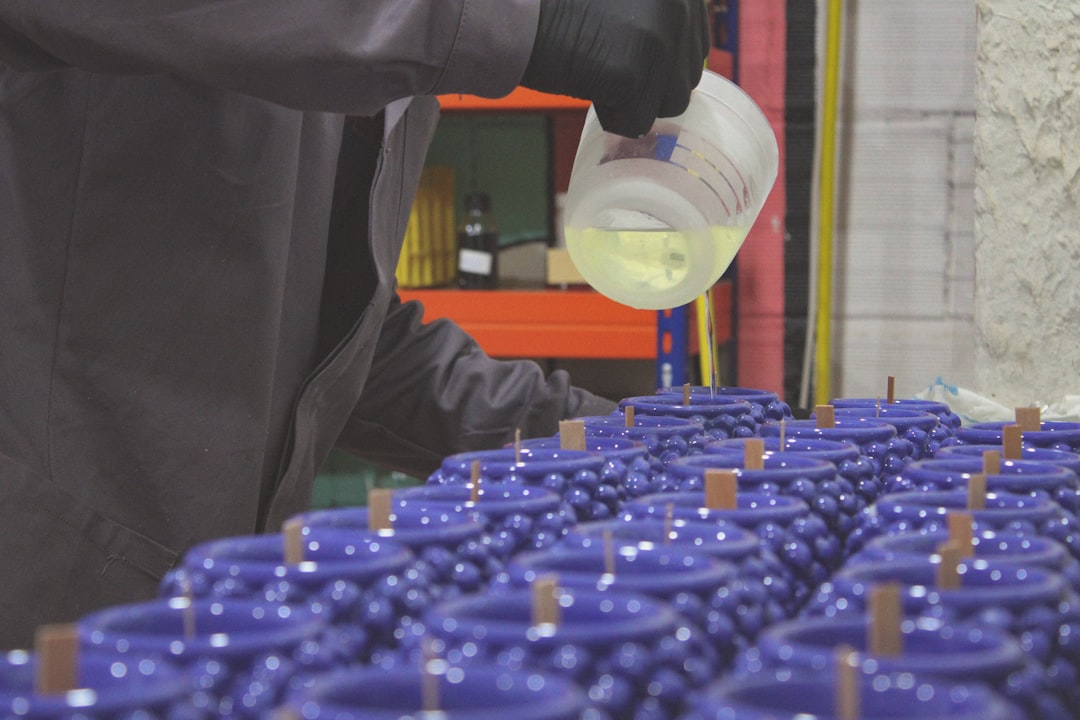
Decoration is where an airless pump bottle becomes a brand object rather than a container. Wholesale orders that arrive with generic finishes get shelved next to dozens of visually identical competitors.
We run four primary decoration processes in-house: silk screen printing, hot stamping, matte/gloss coating, and label application. Each has a different cost profile and visual output.
Silk screen printing deposits ink directly onto the bottle surface in one to four color passes. It is the most cost-effective decoration for simple logos or text, holds up well to retail handling, and is available on both PP and PETG substrates. Registration accuracy matters: poor registration on a two-color print becomes obvious at retail scale.
Hot stamping applies metallic or pigmented foil under heat and pressure, producing sharp-edged metallic accents that silk screen cannot replicate. It is particularly effective for brand marks on matte-coated bottles, where the foil-to-matte contrast creates a premium tactile signal. Minimum quantity for hot stamp decoration typically aligns with standard wholesale MOQ.
Matte coating is applied as a UV-cured topcoat over the molded surface, transforming a glossy bottle into the soft-touch finish that premium skincare brands now broadly favor. It does add cost per unit, but the market-tier signal it communicates is disproportionate to that cost increment.
Custom color matching follows the Pantone system. Brands supply a Pantone reference; we run color samples against that standard before production sign-off. Metamerism—the phenomenon where a color matches under one light source but shifts under another—is checked under D65 (daylight) and A (incandescent) illuminants because retail environments vary.
Internal linking note: our full customization services page covers tooling requirements and minimum run specifications in detail.
Quality Checkpoints Before You Order
![Quality control inspector examining airless pump bottles on a production line, checking pump actuation with white gloves, industrial inspection lighting, cosmetic manufacturing facility, sharp detail on inspection process, documentary photography style]
Sourcing airless pump bottles wholesale without a QC protocol is how brands end up with 50,000 units they cannot sell. The mechanism adds complexity that does not exist in a standard pump bottle, and failures tend to cluster: if a piston seals poorly in one unit, the same tooling issue affects every unit from that cavity.
The five checkpoints that matter most in wholesale airless bottle qualification:
1. Piston seal integrity. Fill the bottle with water, actuate the pump repeatedly, then invert and apply light pressure. Any weeping around the piston seal indicates a gasket fit problem that will allow slow air ingress in the field.
2. Pump actuation force. A properly calibrated airless pump requires consistent, moderate actuation—not heavy force that fatigues users, not so light that accidental actuation occurs in transit. We specify actuation force in gram-force on our QC sheets; wholesale buyers should ask for this data.
3. Evacuation rate. A well-manufactured airless bottle should evacuate above 95% of fill volume. Test by filling to rated capacity, dispensing to pump failure, then disassembling and measuring residual. Anything below 90% indicates piston travel restriction.
4. Decoration adhesion. Silk screen and hot stamp adhesion is checked with a cross-hatch tape test per ASTM D3359. Decoration that lifts at retail—from handling or moisture exposure—creates brand liability that far exceeds the per-unit cost of running the test.
5. Certifications. ISO 9001 covers manufacturing process consistency. SGS and CE address material safety. GMP compliance is increasingly required by EU market entry for cosmetic contact materials. Verify that certifications are current—not from a prior facility audit that predates current production.
For brands placing their first wholesale order, we recommend a 300-unit pre-production sample run before full-volume commitment. This catches tooling issues, decoration alignment problems, and formula compatibility concerns before they multiply across a full batch.
FAQ
What is the minimum order quantity for wholesale airless pump bottles? Most reputable airless bottle manufacturers set MOQ at 1,000 to 5,000 units per SKU. At Oulete, our MOQ is 1,000 units, which covers a standard retail launch quantity while keeping per-unit tooling amortization reasonable.
Which formula types benefit most from airless pump bottle packaging? Airless bottles provide the greatest preservation benefit for oxidation-sensitive actives: vitamin C (ascorbic acid), retinoids, peptides, and natural botanical extracts without synthetic preservative systems. They also extend shelf life for water-based formulas that degrade through repeated air exposure in conventional pumps.
Can airless pump bottles be refilled or are they single-use? Standard airless pump bottles are technically refillable but not designed for consumer refilling—the piston makes disassembly difficult. Refillable airless systems use a cartridge-in-case design with a replaceable inner reservoir. These are available at wholesale for brands building sustainability-oriented loyalty programs.
What is the difference between an airless pump bottle and a vacuum bottle? The terms are often used interchangeably in the market. Technically, both describe the same piston-based dispensing mechanism. “Vacuum bottle” emphasizes the pressure differential that drives the piston; “airless pump bottle” emphasizes the absence of air in the product chamber. There is no functional difference between products sold under either name.
How long does it take to manufacture a wholesale airless pump bottle order? Lead time depends on whether tooling exists and decoration complexity. Standard in-stock shapes with silk screen decoration typically take 25–35 days. Custom shapes requiring new tooling add 20–30 days to that timeline. Dual-chamber and specialty formats may require additional lead time for tooling validation.
Are PCR airless pump bottles structurally equivalent to virgin material bottles? At 10–30% PCR content, mechanical performance is equivalent for standard retail applications. At higher PCR percentages (40–50%), slight variation in wall thickness uniformity can affect piston travel consistency, which is why we QC-test PCR batches against the same actuation and evacuation standards as virgin-material production.
What decoration processes work with matte-coated airless bottles? Hot stamping adheres well to matte UV-coated surfaces and produces the highest visual contrast against a soft-touch finish. Silk screen printing on matte coating requires ink formulations compatible with the UV topcoat—not all inks bond correctly, so material compatibility should be confirmed before production sign-off.
How do I evaluate whether a wholesale airless bottle supplier is reliable? Request current certification documents (ISO 9001, SGS, GMP), ask for a QC specification sheet with actuation force and evacuation rate data, and request a pre-production sample against your actual formula. A supplier unwilling to provide any of these is not a supplier to trust with a wholesale run.