


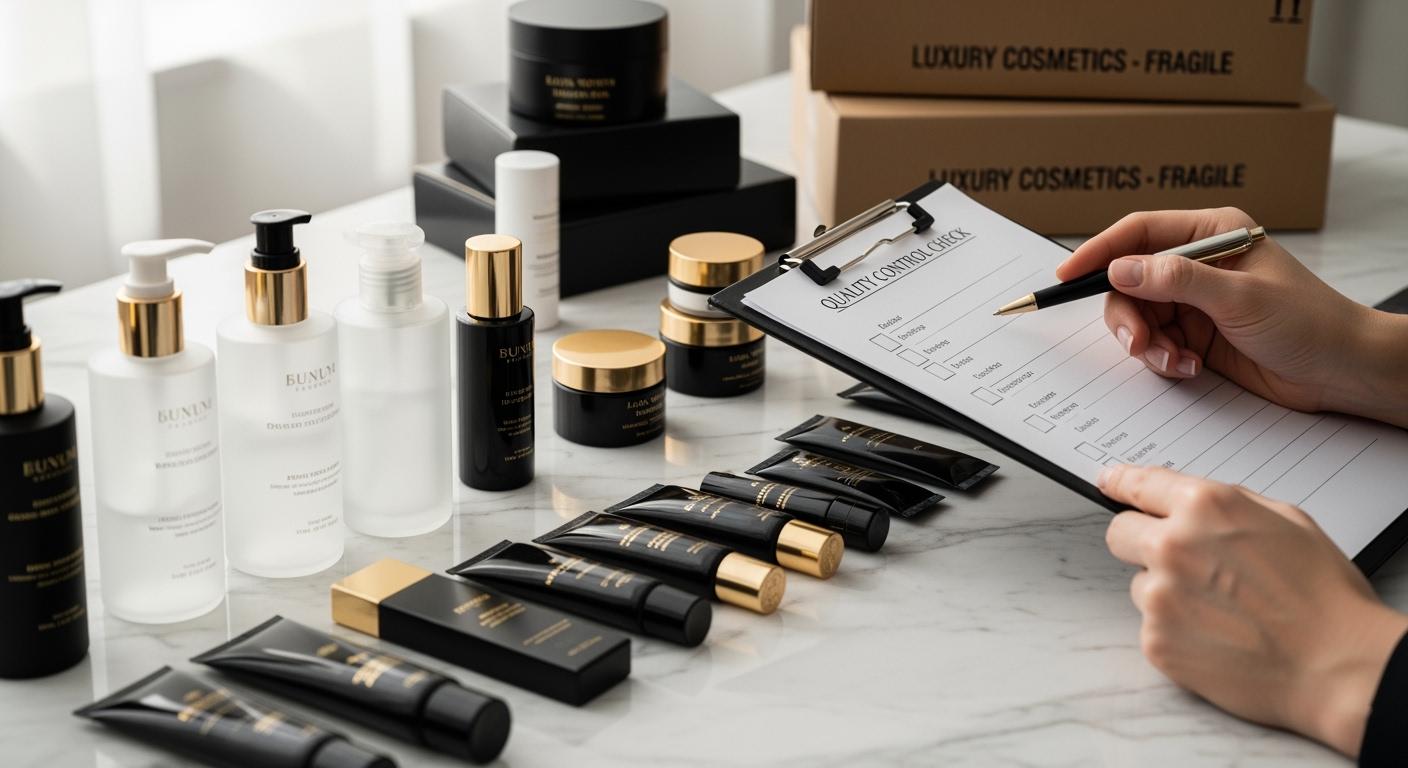
You face many challenges when shipping cosmetic bottles. Cosmetic Packaging Quality Control helps you catch defects before your products reach clients. Skipping these checks can lead to compliance failures, safety hazards, and unhappy customers. Quality control protects your brand image and ensures you follow all regulations. You build trust with your business partners when you deliver safe, compliant, and high-quality bottles every time. If you need supplier support for samples, inspection standards, or packaging specifications, you can contact Oulete for a quote.
Key Takeaways
Implement a structured quality control process to catch defects early and ensure compliance with regulations.
Conduct thorough pre-shipment checks to enhance customer satisfaction and build trust in your brand.
Stay updated on industry standards and regulatory requirements to avoid costly delays and ensure safe products.
Use digital tools for quantity verification and batch control to minimize errors and streamline operations.
Document all inspections and compliance checks to respond quickly to audits and maintain transparency with clients.
Part1: Cosmetic Packaging Quality Control Overview
1.1 Key Stages of Inspection
You manage several stages when you implement Cosmetic Packaging Quality Control for bottles. Each stage plays a vital role in preventing defects and ensuring compliance. The process starts with material sourcing and vendor vetting. You check that all components meet quality standards before production begins. Incoming Quality Control (IQC) and Acceptable Quality Level (AQL) inspections help you catch issues early.
You set up production lines and clear them to avoid cross-contamination. Equipment calibration and fill validation guarantee accurate dosing and sealing. Primary packaging execution follows strict CGMP monitoring, including filling and sealing. These steps help you maintain high standards for every batch.
Stage | Description |
|---|---|
Material sourcing and vendor vetting | You ensure all components meet quality standards. |
Incoming Quality Control (IQC) and AQL inspection | You inspect components before production. |
Pre-production setup and line clearance | You prevent cross-contamination. |
Equipment calibration and fill validation | You confirm accurate dosing and sealing. |
Primary packaging execution under CGMP monitoring | You oversee filling and sealing. |
You also conduct multiple inspections throughout production. Each inspection stage serves a unique purpose. The table below shows how these stages help you reduce risks and maintain compliance.
Inspection Stage | Purpose of Inspection |
|---|---|
Pre-Production Inspection (PPI) | You verify raw materials and components. You review production readiness and assess supplier capability. |
During Production Inspection (DUPRO) | You monitor production processes. You identify defects early and verify quality in-process. |
Pre-Shipment Inspection (PSI) | You perform final inspection of finished goods. You use AQL-based sampling and check packaging and labeling. |
Container Loading Supervision (CLS) | You verify loading conditions, confirm quantity, and prevent shipment errors. |
You build a strong quality control system by following these stages. Early detection of issues helps you avoid non-compliant bottles reaching your clients.
1.2 Why Pre-Shipment Checks Matter
You protect your business and your clients when you carry out pre-shipment checks. These inspections ensure that bottles meet all specifications and regulatory requirements. You avoid costly recalls and compliance failures by catching problems before shipment.
Pre-shipment checks also improve customer satisfaction. You deliver high-quality and safe bottles every time. Customers trust your brand when they receive products that meet their expectations. Satisfied clients often become repeat buyers and recommend your bottles to others. This drives business growth and strengthens your reputation.
You consistently deliver high-quality and safe bottles, which enhances customer satisfaction and builds trust.
Satisfied clients are more likely to become repeat buyers and recommend your bottles, helping your business grow.
You scrutinize bottles before they leave the factory, ensuring they adhere to specifications and requirements. This demonstrates your commitment to providing top-notch products.
Cosmetic Packaging Quality Control gives you confidence that every shipment meets industry standards. You reduce risks, protect your brand, and support long-term success.
Part2: Health and Safety Checks

2.1 Regulatory Requirements
You must follow strict regulations when shipping cosmetic bottles. Regulatory bodies like the FDA and the European Commission set rules to protect users and ensure product safety. You need to check that your bottles meet all legal requirements before shipment. These rules cover material safety, labeling, and packaging design. You should review the latest guidelines from FDA Cosmetics and EU Cosmetics Regulation to stay compliant.
Tip: Keep a checklist of regulatory requirements for each market. This helps you avoid missing critical steps and reduces the risk of shipment delays.
You must document every compliance check. You should keep records of material certifications, test results, and supplier audits. These documents prove that your bottles meet safety standards and help you respond quickly to regulatory inquiries.
2.2 Safety and Chemical Testing
You protect your clients by testing bottles for safety and chemical hazards. You must check for harmful substances like BPA, phthalates, and heavy metals. You should use laboratory tests to confirm that bottles do not leach chemicals into cosmetic products. These tests include migration studies, toxicity screening, and allergen checks.
Test Type | Purpose | Frequency |
|---|---|---|
Migration Testing | Checks for chemical leaching | Every batch |
Toxicity Screening | Identifies harmful substances | Quarterly |
Allergen Checks | Detects potential allergens | As needed |
You should inspect bottles for physical safety as well. You must check for sharp edges, cracks, and weak seals. These defects can cause injuries or product contamination. You need to reject any bottles that fail safety tests.
Cosmetic Packaging Quality Control ensures that you deliver safe bottles to your clients. You build trust and protect your business by following health and safety checks.
Part3: Compliance Checks
3.1 Industry Standards
You must understand that industry standards for cosmetic bottle packaging differ across global markets. Each region sets its own rules for safety, labeling, and material use. If you ship bottles to multiple countries, you need to stay updated on these differences.
Cosmetic packaging regulations change from one region to another. You may see different requirements for ingredient disclosure, language, and packaging materials.
The European Union enforces strict rules. You must complete safety assessments for all packaging materials. The EU also focuses on sustainability and consumer safety.
In the United States, the FDA oversees cosmetic packaging. You must follow guidelines for labeling and material selection. The FDA wants you to use safe materials and provide clear information on your bottles.
You should review the standards for each target market before you ship. This step helps you avoid costly delays and rejected shipments. You show your business partners that you value compliance and quality.
Tip: Assign a compliance officer or team to track updates in international packaging standards. This helps you stay ahead of regulatory changes.
3.2 Documentation Review
You need to keep detailed records for every batch of bottles you ship. Documentation review forms a key part of your compliance checks. You must verify that all paperwork matches the latest regulations and your clients’ requirements.
Check packaging integrity reports. These documents confirm that your bottles remain sealed and durable during transport.
Review label accuracy. You must list all ingredients and required information. Each market may have its own labeling rules.
Confirm that your principal display panel shows the product name, identity, and net contents.
Make sure you include warning statements if safety has not been fully proven.
List the manufacturer’s name and address on the information panel.
Prove that all packaging materials are safe for cosmetic use. You must show that no harmful substances can leach into the product.
You should organize your compliance documents for easy access. This practice helps you respond quickly to audits or client questions. You build trust when you show that your bottles meet every standard.
Part4: Quantity Verification
4.1 Counting and Batch Control
You must verify the quantity of cosmetic bottles before shipment. This step ensures that your clients receive the correct number of units and the right assortment. Pre-shipment inspection helps you confirm that every order matches the purchase agreement.
You can use several methods to check quantity:
Count the total number of bottles produced.
Verify the number of packed cartons.
Check that each carton contains the correct assortment of bottles.
Review the breakdown by size, color, or SKU.
Confirm that the SKU quantity remains consistent across all cartons.
Ensure the carton count matches the shipping documents.
Batch control systems play a key role in quantity verification. These systems give you real-time visibility at the SKU level. You can track inventory and prevent overselling. Lot and expiration tracking help you monitor bottles throughout their lifecycle. You avoid shipping expired or outdated bottles. FEFO (First Expired, First Out) ensures you ship older bottles first, which reduces waste and supports compliance.
Tip: Use digital batch control tools to automate counting and tracking. This reduces human error and saves time.
4.2 Handling Discrepancies
You may find discrepancies during quantity checks. These issues can include missing bottles, extra units, or incorrect assortments. You must address these problems before shipment.
Start by investigating the root cause. Check production records, packing lists, and inventory logs. If you find a counting error, recount the affected cartons. For missing bottles, review the production line for bottlenecks or losses. If you discover extra units, verify if they belong to another order.
You should document all discrepancies and corrective actions. Share this information with your quality control team and your client. Clear communication builds trust and prevents future issues.
A strong quantity verification process helps you deliver accurate orders. You protect your reputation and keep your clients satisfied.
Part5: Product Specification Confirmation
5.1 Specification Matching
You must confirm that every bottle matches your client’s specifications before shipment. This process involves several key steps that help you avoid costly errors and ensure consistency. You should follow a structured protocol for color, material, and finish. The table below outlines the main steps you need to take:
Step | Description |
|---|---|
Color Approval Protocol (CAP) | Use a protocol that covers material identification, surface finish, light source, tolerance, and sign-off. |
Feasibility Assessment | Consult your supplier to check if the target color works on the chosen material and finish. |
Masterbatch Color Card | Request a resin chip made with the exact pigment and base resin for accuracy. |
Standardized Evaluation Tools | Use a D65 light box and a neutral environment for approvals. Avoid using mobile phones. |
Tolerance Standards | Agree on an acceptable ΔE value and set rules for managing deviations. |
On-Site Color Approval | Send your QC engineers to the production site for adjustments during initial runs. |
Note: You must set zero tolerance for bottle deformation, bubbles, stains, leakage, obvious color differences, and printing errors. Comprehensive quality manuals and clear procedures, including employee training and final inspection specifications, help you maintain these standards.
5.2 Sample Testing
You need to perform sample testing on bottles to confirm they meet all requirements. This step helps you catch defects and verify performance before shipment. Key types of sample testing include:
Pre-shipment inspections
Functional testing
Labeling and compliance checks
Packaging tests
Sample testing covers many areas. You check dimensions and measurements during pre-shipment inspections. You run functional tests to ensure bottles work as intended. You review labels for accuracy and compliance. You test packaging materials for strength and durability.
Sample testing results play a big role in shipment approval. You assess tensile strength and elongation to confirm bottles can handle stress. You perform impact resistance tests to prevent breakage during transport. You use salt spray tests for bottles shipped to coastal areas. You stack cartons to check compressive strength. You simulate transportation vibration and perform drop tests to ensure bottles stay intact.
You build trust with your clients when you deliver bottles that pass all specification and sample tests. This process protects your brand and reduces the risk of returns or complaints.
Part6: Packaging and Label Inspection
6.1 Visual and Dimensional Checks
You need to inspect every bottle for visual and dimensional accuracy before shipment. This step helps you catch defects that can affect product safety and brand reputation. Start by checking the surface for scratches, stains, or discoloration. Examine the shape and size of each bottle to confirm they match your specifications. Use calibrated tools to measure height, diameter, and wall thickness.
A structured inspection process ensures consistency. The table below outlines key areas you should review:
Inspection Focus | Details |
|---|---|
Packaging integrity | Sealing and durability checks |
Label accuracy | Verification of ingredient listings and required information |
Compliance with labeling rules | Adherence to market-specific regulations |
Final Product Inspection | Assessment of product appearance, functional performance, and packaging condition |
Quantity and assortment accuracy | Ensuring correct product quantities and assortments |
Sampling Method | AQL-based inspection plans aligned with ISO 2859-1 |
You should also test printing quality. Focus on abrasion resistance, adhesion fastness, and color identification. Mechanical properties testing includes tensile strength, heat sealing strength, and impact resistance. These checks help you deliver bottles that meet your clients’ expectations.
6.2 Label and Seal Integrity
You must verify that every label is accurate and every seal is secure. Label inspection involves checking ingredient lists, regulatory statements, and branding elements. Confirm that all information is clear, legible, and placed correctly. Use visual inspection protocols to spot wrinkles, incomplete seals, or discoloration.
Seal integrity is critical for product safety. You can use several methods to detect leaks and weak seals. The table below summarizes common techniques:
Method | Description |
|---|---|
Helium Leak Detection | Identifies leaks as small as 10⁻⁹ to 10⁻¹² mbar·L/s, suitable for high-value applications. |
Dye Penetration Testing | Detects defects as small as 50–75 microns using colored dye under vacuum. |
Visual Inspection Protocols | Targets specific defects like wrinkles, incomplete seals, and discoloration with defined criteria. |
Vacuum Decay Testing | Non-destructive method detecting leaks as small as 10–50 microns in a short time frame. |
Ultrasonic Seal Inspection | Uses high-frequency sound waves to identify unbonded areas and foreign material inclusions. |
You should document all findings and address any issues before shipment. This process supports Cosmetic Packaging Quality Control and helps you avoid costly returns. For more information on label inspection, see our label inspection service page.
Tip: Regularly update your inspection protocols to match new regulations and client requirements.
Part7: Pre-Shipment Review
7.1 Final Inspection Reports
You need to complete a final inspection report before shipping cosmetic bottles. This report gives you a clear summary of the batch quality and helps you decide if the shipment is ready. You check several key areas during this review:
Quantity Verification – Confirm that the total number of finished cartons and bottles matches the purchase order.
Workmanship & Defects – Inspect the appearance and workmanship for any quality issues.
Measurements & Specs – Ensure size, weight, materials, and components meet requirements.
Functionality – Test bottles to verify they operate as intended.
Compliance – Check that bottles meet safety standards and legal requirements.
Packaging & Labeling – Review packaging and labeling for accuracy and safe delivery.
Documentation Review & Record – Examine previous inspection reports and record findings.
You use this report to ensure consistent quality. You safeguard safety and compliance by confirming bottles meet regulatory standards. You prevent costly mistakes by identifying issues before shipment. This process reduces the risk of rejected shipments and protects your business.
Tip: Keep your inspection reports organized and accessible. This helps you respond quickly to client questions or audits.
7.2 Shipment Documentation
You must prepare essential shipment documents for every cosmetic bottle export. These documents support customs clearance and protect your business from delays. Common documents include:
Proforma Invoice
Commercial Invoice
Packing List
Certificates of Origin
Certificate of Free Sale
Shipper’s Letter of Instruction
BIS-711 Form
Inland Bill of Lading
Ocean Bill of Lading
Air Waybill
Dangerous Goods Forms
Bank Draft
Customs authorities often inspect packaging to ensure it meets local regulations. If your shipment lacks proper labeling or safety warnings, you may face clearance delays, penalties, or even destruction of goods. Shipment documentation errors can cause delays ranging from 6% to 15%. Incomplete paperwork is a common issue for non-EU shipments. You need specific documents to avoid these problems.
Note: Double-check all documents before shipment. Accurate paperwork helps you deliver bottles on time and keeps your clients satisfied.
You need thorough cosmetic packaging quality control before shipment. These checks help you meet compliance standards, protect health, and satisfy your clients. You reduce risks and avoid costly mistakes by inspecting bottles at every stage. Strong quality control processes build trust and support your brand.
Tip: Invest in robust inspection systems to lower costs and prevent shipment issues. Your business grows when you deliver safe, compliant bottles every time.
FAQ
What is the most common defect found during cosmetic bottle inspections?
You often find issues like bottle deformation, leakage, or incorrect labeling. These defects can affect product safety and compliance. You must reject bottles with visible flaws to protect your brand and meet regulatory standards.
How can you ensure accurate quantity verification for bottle shipments?
You should use digital batch control systems and AQL-based sampling. These tools help you track inventory and confirm carton counts. You reduce errors and deliver the correct number of bottles to your clients.
Why do you need chemical testing for cosmetic bottles?
Chemical testing helps you detect harmful substances like BPA or heavy metals. You protect end users and comply with regulations. You must test every batch to ensure bottles do not leach chemicals into cosmetic products.
What documents do you need for international bottle shipments?
You need a commercial invoice, packing list, certificates of origin, and bill of lading. Customs authorities require these documents for clearance. You avoid shipment delays by preparing accurate paperwork.
How often should you update your bottle inspection protocols?
You should review and update protocols every quarter or when regulations change. Regular updates help you stay compliant and meet client requirements. For sample checks, quality documentation, or supplier coordination, you can contact Oulete for a quote.