


The customization process for cosmetic containers lets you pick every detail. This helps your brand and meets what people want. When you choose custom packaging, you do more than keep your cosmetics safe. You also make a special brand image that people notice. Studies show that 72% of buyers say packaging design helps them choose beauty products. Also, 61% want to buy again if the container feels special. The right style, material, and graphics help you reach your audience. They also make your cosmetics different from others. The global market for custom cosmetic packaging is getting bigger. It will be $57.55 billion in 2025 and could reach $89.72 billion by 2034.
| Year | Market Size (USD Billion) | CAGR (%) |
|---|---|---|
| 2025 | 57.55 | N/A |
| 2026 | 59.88 | N/A |
| 2034 | 89.72 | 5.19 |
You can use the customization process to build trust. It can help you sell more and make sure your packaging matches your product’s quality.
Key Takeaways
- Know your brand and who will buy your products. This helps you make packaging that shows your values and brings in the right people.
- Pick materials and styles that keep products safe and easy to use. Make sure they are good for the environment too.
- Use prototyping to try out designs first. This lets you fix problems before making a lot of containers. It saves time and money.
- Add smart features and use digital printing. These make your packaging more fun and help it get noticed.
- Follow safety rules and labeling laws. This helps people trust your products and keeps your packaging legal.
Understanding the Customization Process
Defining Brand and Audience
You begin by learning about your brand and audience. This step guides every choice for your custom cosmetic packaging. You must know what your brand means and who will use your cosmetics. This helps you make packaging that matches your values and draws in the right people.
Tip: Ask yourself, “What does my brand stand for?” and “Who do I want to buy my cosmetics?”
To figure out your brand and audience, try these steps:
- Decide your brand identity. Pick a style, fonts, and colors that show your brand.
- Set design rules. Choose if your packaging should look classic, fancy, or simple.
- Collect key details. Check legal rules and think about special product features, like cruelty-free or eco-friendly claims.
- Study what buyers like. See what is trending in the cosmetics world.
- Look at your competition. Notice what other brands do and which influencers they use.
- Find your target market. Think about age, lifestyle, and if your product is high-end or for everyone.
- Design for your audience. Make packaging that fits your customers’ needs and interests.
When you know your brand and audience, you can make custom cosmetic packaging that stands out. This step also helps you avoid errors and wasting time or money later.
Aligning Style and Materials
Once you know your brand and audience, you pick style and materials. This part is important for choosing your custom cosmetic packaging containers. You want your packaging to look nice and work well for your cosmetics.
Here are some tips for picking your custom cosmetic packaging containers:
- Safety: Choose containers that do not react with your cosmetics. Make sure they follow industry rules.
- Environmental Impact: Pick eco-friendly materials. This helps cut down on waste and supports the planet.
- Practicality: Think about how easy the container is to use, how well it works, and how easy it is to move.
You can choose jars, bottles, tubes, or droppers. Each type works for different products and users. For example, jars are good for creams, while droppers are best for serums.
The material you pick changes both product quality and user experience. Glass containers look fancy and keep products pure. They block UV light and can be recycled, but they are heavy and can break. Plastic containers are light and do not break easily, so they are good for travel and daily use. Metal containers, like aluminum, keep out light and air, so products stay fresh longer. The finish and design of metal containers can change how people see your brand.
Note: Always use airtight and secure lids. This keeps your cosmetics safe from leaks and germs.
When you match style and materials with your brand, you make packaging that feels right for your customers. You also make sure your cosmetics stay safe and fresh.
The main stages in the customization process for B2B clients include:
- Decide your brand identity.
- Look for ideas and inspiration.
- Work with a packaging designer.
- Check out customization options.
- Test and improve your design.
- Move to production and check quality.
Each stage helps you make packaging that fits your brand and meets your customers’ needs. You should always focus on quality control and use the best production methods. This makes sure your custom cosmetic packaging looks good and works well from the first sample to the final product.
Packaging Design Essentials
Creating Dielines and Prototypes
You begin by making dielines for your packaging. Dielines are flat guides that show where to cut, fold, and glue. These guides help you see what your cosmetic containers will look like. Dielines are important because they help stop mistakes and save time.
After you finish the dieline, you make a prototype. Prototypes let you test your packaging in real life. You can check the size, shape, and how the container feels. Many suppliers use 3D printing to make prototypes quickly and cheaply. This helps you see your ideas fast and change them before making a lot. You can also use digital models or real mock-ups to check your design.
Here is a table of common prototyping methods:
| Prototyping Method | Description |
|---|---|
| Digitally Printed Prototypes | Test design and function with custom sizes and materials. |
| Skin Print Prototypes | Confirm color on actual printed material. |
| Plate Printed Prototypes | Check color accuracy with complex designs. |
| 3D Printing | Create detailed models fast, good for complex shapes. |
| Mock-ups | Show visual look, less for function. |
| Digital Simulations | Evaluate design without a physical model. |
| Physical Prototypes | Test ideas and get user feedback with real samples. |
Prototyping is a key part of good cosmetic packaging design. It helps you find problems early and fix them. You can ask your supplier to make a sample from your idea. You look at the sample and give your thoughts. You might want to change the color, size, or material. The supplier changes the prototype until it fits your brand and works well.
Tip: Rapid prototyping saves money and time. It lets you test many ideas and fix design flaws before you start mass production.
Customizing Graphics and Typography
Graphics and typography are important for good cosmetic packaging design. They help your product get noticed on the shelf. You can use clear words so people see your product name from far away. Simple fonts and clean lines give a modern look. Retro typography uses bold, fun letters for a special style.
You can also use strong graphics and expressive fonts for bold packaging design. Textured packaging gives a special feel and makes your cosmetics more fun. Geometric shapes can make your packaging look new and cool.
Here are some advanced ways to customize your packaging:
- Thermography printing makes raised effects. This makes your packaging design feel special and professional.
- Engraving adds texture and detail, helping your brand stand out.
- Both methods are cost-effective and work for many cosmetic brands.
Custom packaging design lets you try new patterns and finishes. You can test these in your prototypes and change them if needed. This step is one of the first steps to cosmetic packaging design and helps you build a strong brand image.
Trends in Colour Cosmetics Packaging
Visual Identity and Market Trends
Every year, new trends appear in colour cosmetics packaging. These trends change how you design and show your products. Brands use packaging to tell their story and connect with buyers. Research says packaging design helps you stand out and build trust. When you pick the right colors, fonts, and materials, you make a strong visual identity. This makes your cosmetic products look high-quality and makes people want to try them.
Your packaging choices matter a lot. Most buyers pick what to buy in just a few seconds. If your colour cosmetics packaging matches your brand and speaks to your audience, people notice you. You also make an emotional bond with your customers. That is why many brands follow packaging trends that mix style and function.
Here is a table of the latest trends in colour cosmetics packaging:
| Trend | Description |
|---|---|
| Eco-friendly materials | Use of sustainable packaging materials. |
| Minimalistic design | Clean, simple looks that feel modern. |
| Smart packaging features | Interactive elements for better user experience. |
| Personalization | Limited editions and custom designs for engagement. |
| Innovative structures | New shapes that make products easy to use. |
| Colorful and user-friendly | Bright designs that attract and help users. |
| Airless glass and pumps | Keep products fresh and easy to dispense. |
Tip: You can use these trends to update your colour cosmetics packaging and get more buyers.
Differentiation Through Custom Shapes
You can make your brand special with unique shapes in colour cosmetics packaging. Custom shapes help your products stand out on the shelf. You might pick a round jar, a slim tube, or a bold geometric bottle. These shapes make your cosmetic containers easy to see and remember.
Custom shapes also make it easier to use your cosmetics. A good container feels nice to hold and makes using the product simple. You can match the shape to the product, like using a dropper for serums or a pump for lotions. This makes your colour cosmetics packaging both pretty and useful.
Brands use custom shapes to show what they care about. Eco-friendly brands pick shapes that use less material. Luxury brands choose heavy glass or metal for a fancy feel. Fun brands use bright colors and playful shapes. When you pick the right shape, you tell your brand’s story without words.
Note: Always test your custom shapes with real users. This helps you find the best design for both style and function.
Colour cosmetics packaging keeps changing. You need to watch for new trends and try new ideas. This helps your brand stay fresh and keeps your customers excited about your cosmetics.
Functionality and User Experience
Matching Packaging to Formula
You must match your packaging to your cosmetic formula. This helps protect your product and makes users happy. Every formula has its own needs. Some cosmetics need airtight containers to stay fresh. Others need special materials so they do not react. Picking the right custom packaging keeps your cosmetics safe. It also makes customers feel good about your brand.
Here is a simple table that shows the main steps for matching packaging to your formula:
| Step | Description |
|---|---|
| Product Preparation | Test your formula to make sure it stays stable and consistent before filling. |
| Container Selection | Choose packaging that works well with your formula and stops chemical reactions. |
| Filling | Fill containers carefully to avoid waste. |
| Sealing and Capping | Seal containers tightly so the formula stays safe and does not leak. |
| Labelling and Coding | Label each container clearly for safety, rules, and tracking. |
Following these steps makes your product work better. It also makes customers happier. You lower the chance of returns or complaints. Good packaging choices help build trust. They create a better experience for everyone who uses your cosmetics.
Ergonomics and Application
You want your custom cosmetic containers to feel nice in your hand. They should work well every time. Ergonomic design helps make user experience better. People like containers that are easy to hold and use. Custom bottle shapes can fit your hand. They make applying cosmetics simple. Easy applicators help you get the right amount without mess.
You can add features like textured grips for better control. Color-coded parts help users find products fast. Braille labels help people with disabilities use your packaging. Lightweight materials make cosmetics easy to carry and use daily. When you balance style and function, you make a good experience for all users.
Smart design gives great user experience. You should test your packaging with real people. Listen to their feedback and make changes if needed. This way, your custom packaging will stand out. It will make your cosmetics more fun and easy to use.
Sustainability in Cosmetic Packaging
Eco-Friendly Materials
When you pick eco-friendly packaging, you help the planet. This also makes your brand look good. Many brands use things like recycled paper, glass, metals, and biodegradable materials. These choices make less trash and lower pollution.
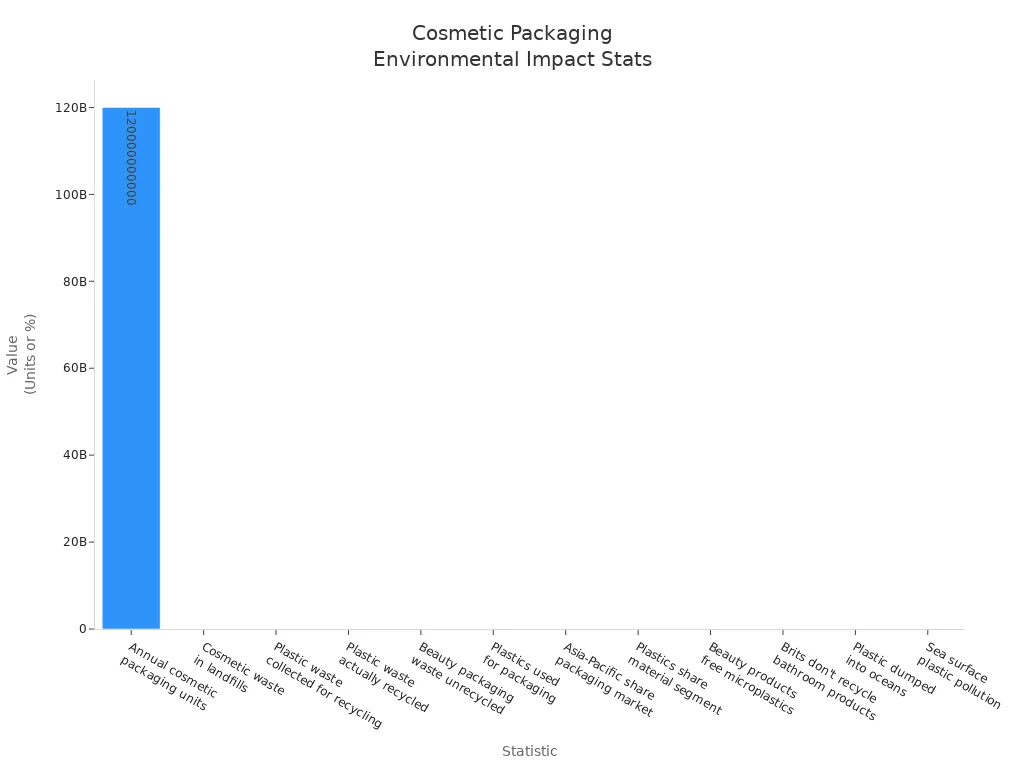
Here is a table that shows how cosmetic packaging affects the environment:
| Statistic | Value |
|---|---|
| Annual cosmetic packaging units produced | 120 billion |
| Percentage of cosmetic packaging waste in landfills | 70% |
| Percentage of plastic waste collected for recycling | 14% |
| Percentage of plastic waste that actually gets recycled | 19% |
| Percentage of beauty packaging waste that goes unrecycled | 95% |
| Percentage of plastics used for packaging | 40% |
| Share of Asia-Pacific in cosmetics packaging market (2024) | 42% |
| Projected growth of global cosmetic packaging market (2025-2032) | $58 billion to nearly $80 billion |
| Share of plastics in cosmetic packaging material segment (2023) | 59% |
| Percentage of beauty products free from microplastics | 13% |
| Percentage of Brits who don’t recycle bathroom products | 56% |
| Annual plastic dumped into oceans | 10 million tonnes |
| Percentage of sea’s surface polluted by plastic waste | 88% |
Most cosmetic packaging ends up in landfills. Picking sustainable packaging helps fix this problem. Using bamboo, glass, or recycled plastics is better for the earth. You help keep oceans and animals safe when you use less plastic.
Tip: Always ask your supplier where the packaging comes from and if it can be recycled.
Recyclability and Reuse
You help the earth when you pick packaging that can be recycled or used again. Metals are recycled more than plastics. Aluminum lids are recycled about half the time. Aluminum cans are recycled even more, between 54% and 70%. Plastic recycling rates are not all the same. PP is recycled 11% of the time, HDPE is 43%, and PET is 50%.
- Metals are recycled more often than plastics.
- Plastic recycling rates are different: 11% for PP, 43-50% for HDPE, and 50% for PET.
- Reusable packaging, like flexible mono-material pouches, is good for the planet and easy to recycle.
Recyclable packaging makes less trash and saves resources. Reusable packaging lasts longer and means less waste. Both types have problems. Recyclable packaging can get dirty and not be recycled. Reusable packaging needs to be cleaned and taken care of.
You can pick custom packaging that works for your product and helps the planet. When you use recyclable and reusable containers, you help your brand and the earth.
Note: Using sustainable packaging makes your brand special and shows you care about the environment.
Technology Integration in Custom Cosmetic Packaging
Smart Features and Digital Printing
New technology is changing how you make custom cosmetic packaging. Smart features make containers more fun and helpful. Many brands use QR codes, NFC tags, and augmented reality on their packaging. These features help you talk to buyers and give them more info.
| Feature | Description |
|---|---|
| QR Codes | Let buyers watch tutorials and learn about your brand from the container. |
| NFC Tags | Give fast access to rewards and product info with a phone tap. |
| Augmented Reality (AR) | Make fun experiences that keep buyers interested in your cosmetics. |
Digital printing also makes custom cosmetic packaging better. You can change designs quickly and print just a few at a time. This helps you launch new products fast and try out new ideas. Digital printing lets you put special designs, names, or QR codes on each container. You can fix designs right away and print them fast.
| Evidence | Description |
|---|---|
| Faster Turnaround | You get custom packaging in days, not weeks, so you can react to changes fast. |
| Design Flexibility | You can switch designs for different products or ads without waiting. |
| Variable Data | Each container can have its own look or info, making it special for buyers. |
| Small Batch | You can print just a few, which saves money and helps you test new ideas. |
Tip: Use digital printing to make limited edition packaging or special deals for your buyers.
Enhancing Consumer Engagement
You want your packaging to do more than just hold your product. Smart features and digital printing help you connect with buyers and build loyalty. You can add raised labels to make containers feel fancy. Interactive labels, like QR codes, help buyers find tutorials and info easily.
- Raised labels give buyers a cool feeling and make your products seem fancy.
- Interactive labels help buyers learn more about your products and your brand.
- Eco-friendly packaging shows buyers you care about the earth, which builds trust.
Many buyers want brands that reward green choices. Most Gen Z buyers stay loyal to brands that help the planet. Clear info about being eco-friendly helps buyers trust your packaging. You should make refills easy, because many buyers skip them if they are hard to use.
| Statistic | Value |
|---|---|
| Gen Z loyalty to sustainable brands | 74% |
| Gen Z want clarity on sustainability claims | 78% |
| Consumers avoid refill options due to inconvenience | 39% |
Note: Smart packaging and digital printing help you connect with buyers, share your story, and make your products stand out.
Regulatory Compliance in Cosmetic Packaging
Safety and Labeling Standards
You have to follow safety and labeling rules for cosmetic packaging. These rules keep customers safe and help your brand stay out of trouble. Different places have their own rules for packaging. You need to learn these rules before selling your custom packaging.
| Region | Key Regulations |
|---|---|
| China | New packaging rules, labeling needs, and CSAR changes for safety checks. |
| Europe | Safety checks, eco-friendly rules, and using recyclable materials. |
| United States | FDA rules for labels, picking materials, and safety standards for packaging. |
You must make sure the ingredient list is easy to find and uses the right font size. List ingredients from most to least. If your cosmetics have risks, you must put clear warnings on the packaging. These steps help you earn trust and keep your products safe.
- Ingredient list must be clear and easy to read.
- List ingredients from most to least.
- Add warnings for any risky cosmetics.
Tip: Always check your labels before making lots of packages. Mistakes can cause recalls or fines.
International Requirements
Cosmetic packaging rules are different in each country. You need to check the rules for every place you want to sell your cosmetics. The European Union, United States, and Asia all have their own rules for packaging.
| Region | Key Requirements |
|---|---|
| European Union | Must have a Responsible Person. Show Country of Origin. List allergens for 26 substances. Use official languages. |
| United States | Easier rules than EU. No Responsible Person needed. Basic label rules. |
| China | All info must be in Simplified Chinese. Local agent must be listed. NMPA registration needed. |
| Japan | Labels must be in Japanese. Cosmetics and Quasi-Drugs have different rules. |
| South Korea | Labels must be in Korean. Functional Cosmetics need MFDS checks. |
- The EU needs a Responsible Person for rules.
- The US does not need a Responsible Person and has easier rules.
- China needs all info in Simplified Chinese and a local agent.
- Japan splits products into Cosmetics and Quasi-Drugs, each with its own rules.
Asia is not just one market. Each country has its own packaging laws. For example, China’s NMPA checks all labels and needs local help. Japan’s Ministry of Health, Labour and Welfare sets rules for each product type. You must research each country before sending your custom packaging.
Note: Following international rules helps you avoid delays and keeps your packaging on store shelves.
Managing the Customization Process
Supplier Collaboration
You begin by working with your supplier. This helps you make the right packaging for your cosmetics. You need to tell your supplier what you want. Explain how you want your packaging to look and feel. Your supplier listens and gives advice about materials.
- Packaging should show what your product is like.
- It needs to connect with your customers.
- Good materials and bright labels are important.
Here are steps to work well with your supplier:
- Share your ideas. Tell your supplier about your brand and what you want.
- Make your design better. Look at the plans and check things like logo spots and colors.
- See your design in real life. Say yes to the design, then your supplier makes a sample. You check how it looks and feels.
You and your supplier pick how to make the containers. You might use injection molding or blow molding. You both agree on the way before making a lot. Before making many, you test the packaging. You check if it is strong, closes tight, and works with your cosmetics. This stops problems and makes sure your packaging is good.
Tip: Always ask for samples and try them with your cosmetics before you say yes.
Prototyping and Quality Control
After you finish your design, you make a prototype. Prototyping lets you see and touch your new packaging. You put your cosmetics inside to see if it fits and works. You look for leaks and weak spots. You also check if the lid closes well.
Quality control keeps your packaging safe. Here are the steps you follow:
- Test raw materials to check if they are clean and pure.
- Check packaging materials to make sure they are safe and labeled right.
- Watch the process to check things like pH and thickness.
- Test the finished product for safety and quality.
- Keep records and check everything before you send out products.
You keep track of every step. You make sure your packaging is strong and safe. You test if it lasts and closes tight. You check if it works with your cosmetics. This helps you stop problems and keeps your customers happy.
Note: Good testing and quality checks make your custom cosmetic packaging strong and safe.
Oulete’s Technical Advantages
Advanced Customization Capabilities
You want your cosmetic brand to be special. Oulete gives you many choices for custom packaging. You can pick features that match your product and brand style. Choose the size you need, from small bottles to big jars. Pick the material that works best, like PET for clear or PP for strong and recycled. Add your logo, label, or embossing to make your packaging unique. Tactile embossing makes your brand feel fancy and different.
Here is a table that shows what you can customize with Oulete:
| Customization Feature | Description |
|---|---|
| Branding | Customize logos, labels, or embossing for exclusive branding. |
| Capacity | Select sizes from 15ml to 250ml to match product volume. |
| Material | Opt for PET (clear/translucent) or PP (recycled/durable) based on needs. |
| Customizable Embossing | Adds tactile branding for high-end differentiation. |
You get to control your cosmetic packaging. This helps you build a strong brand and meet your customers’ needs.
End-to-End Support
Oulete helps you through every step of custom packaging. You start with a needs check. Oulete helps you pick the right dropper tube diameter for your formula. You check the neck finish threading so the bottle and cap fit well. Choose the bulb material for safety and good use. Set the tube length for accurate dispensing. Oulete tests for leaks to keep your cosmetics safe when shipping. You also get feedback on how the packaging works in real life.
Here is a table that shows key steps in Oulete’s support:
| Aspect | Importance |
|---|---|
| Dropper Tube Diameter | Affects the number of drops per milliliter, crucial for product consistency. |
| Neck Finish Threading | Ensures compatibility with the bottle, preventing production failures. |
| Bulb Material Compatibility | Impacts the performance and safety of the serum during use. |
| Tube Length | Influences the dispensing accuracy and user experience. |
| Leakage Testing | Essential for ensuring product integrity during shipping and handling. |
| Consumer Experience | Directly linked to how well the product performs in real-world conditions. |
You get help from design to mass production. Oulete checks quality at every stage. You can trust your cosmetic packaging will look good and work well. This support makes your custom cosmetics project easy and successful.
You can make your cosmetic packaging special by doing these steps: First, learn about your brand and who will use your products. Next, keep up with new packaging trends. Pick fonts and patterns that are different from others. Choose colors that stand out and catch the eye. Make sure your packaging is easy to use and works well. Care about the planet by using eco-friendly choices. Add technology to make your packaging smarter. Always follow the rules for packaging safety.
If you manage these steps well, your cosmetics will get noticed in stores. Work with experts like Oulete to help make your ideas real. Begin your custom packaging journey now and make your cosmetics unique.
FAQ
What is the first step in the custom cosmetic packaging process?
First, you learn about your brand and who will buy your products. This helps you pick the best packaging for your cosmetics. You also set your goals and think about what makes your products special.
How do you make sure custom packaging fits your cosmetic formula?
You try your formula with different packaging types. You look for leaks and see if anything reacts. You choose materials that keep your cosmetics safe and fresh. This step keeps your products safe and makes customers happy.
Why is quality control important in cosmetic packaging?
Quality control checks every part of your packaging. You test the materials and the finished containers. This stops problems before your cosmetics get to buyers. Good quality control keeps your packaging strong and safe.
Can you change the design after seeing a prototype?
Yes, you can. You look at the prototype and share your thoughts. You can ask to change the size, color, or material. This helps you get the best packaging for your cosmetics.
How does Oulete help with custom cosmetic packaging?
Oulete helps you from design to making lots of packaging. You get help picking the right packaging for your products. Oulete checks quality at every step. You can trust your packaging will look nice and work well.