


Most cosmetic brand founders assume roll-on deodorant bottles are commodity packaging that any factory can produce. The reality is different. Roll-on deodorant bottles are precision-dispensing containers that use a rotating ball applicator to deliver liquid or gel deodorant evenly onto the skin, available in HDPE, PET, PETG, and glass with MOQ from 1,000 units. The ball mechanism, material pairing, and housing fitment each affect product performance, shelf stability, and regulatory compliance. Getting any one of these wrong leads to leaking bottles, formula degradation, or shipments held at customs.
How the Roll-On Ball Mechanism Works
A roll-on deodorant bottle works through a straightforward but demanding principle: a hollow sphere sits in a precision-fitted housing at the bottle neck, partially submerged in the liquid reservoir below. When rolled across the skin, the ball rotates inside the housing, picking up product from the reservoir and transferring it through surface contact.
According to HONGDA Roll-On Ball Manufacturer, standard roll-on ball diameters used in cosmetics are 25.4 mm (1 inch), 33 mm (1.3 inch), and 35.56 mm (1.4 inch). The ball diameter determines the application stripe width and volume dispensed per stroke. Larger balls cover more skin per pass but require wider neck finishes.
The seal between ball and housing separates a functional roll-on from a leaking one. The housing cradles the ball with enough clearance for free rotation but tight enough to prevent liquid seepage. If the ball-to-housing tolerance is too loose, product weeps during transit. Too tight, and the ball sticks or drags.
Two primary housing fitment types exist: snap-in and press-fit. Snap-in designs let the ball click into place during assembly, while press-fit housings use friction to hold the ball. The correct choice depends on formula viscosity and target ball diameter.
Roll-on deodorant bottles are dispensing containers consisting of a plastic or glass body, a precision-fitted ball applicator, and a screw-top overcap, engineered to deliver liquid or gel formulations through controlled rolling contact with the skin, serving deodorant, fragrance, and therapeutic personal care applications.
Bottle Materials: HDPE, PET, PETG, and Glass Compared
Material selection for the bottle body affects formula compatibility, recycled content options, and shelf appearance. Each material carries trade-offs against formula type, price point, and sustainability goals.
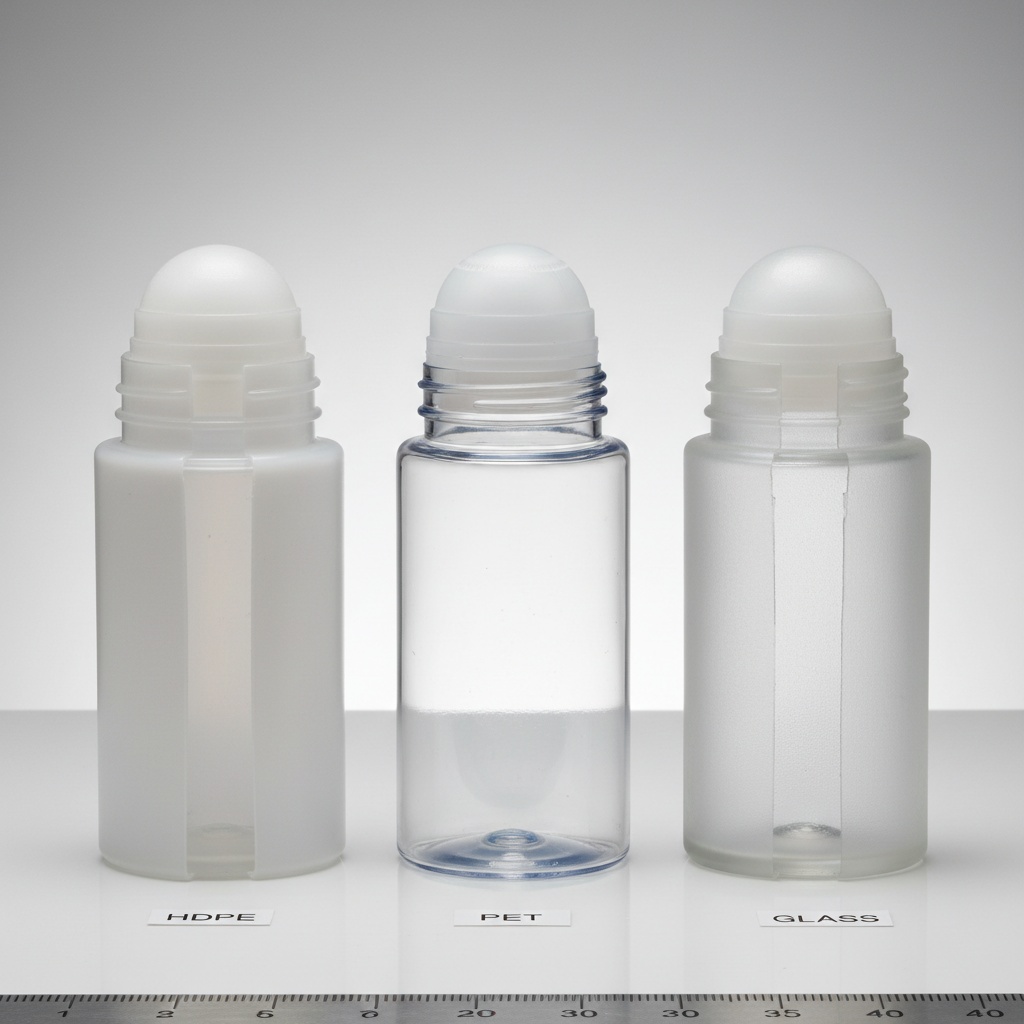
| Material | Best For | PCR Availability | Chemical Resistance | Appearance |
|---|---|---|---|---|
| HDPE | Standard deodorant formulas | Up to 50% PCR | Excellent (alcohol, oil, gel) | Opaque only |
| PET | Clear/translucent designs | Up to 30-60% PCR | Good (aqueous, light alcohol) | Crystal clear or tinted |
| PETG | Premium aesthetic packaging | Limited PCR supply | Good (aqueous formulas) | Glass-like clarity |
| Glass | Luxury and fragrance roll-ons | N/A (infinitely recyclable) | Excellent (all formula types) | Premium weight and feel |
According to Berlin Packaging, HDPE is the dominant material for deodorant roll-on bottles because it is BPA-free, phthalate-free, and FDA-acknowledged as food-contact safe. For brands selling standard antiperspirant or deodorant formulations, HDPE remains the most practical choice due to its broad chemical compatibility and low unit cost.
PET and PETG bottles appeal to brands that want consumers to see the product level or color inside. This visibility works well for clear gel deodorants or naturally colored formulas. The trade-off is thinner wall sections and slightly narrower formula compatibility compared to HDPE.
Glass roll-on bottles serve the luxury and essential oil segments. According to Jarsking, glass provides chemical inertness that makes it the preferred body material for alcohol-based and oil-based deodorant formulations where plastic absorption or migration is a concern. Glass also carries a premium perception that aligns with higher retail price points, similar to how material choice drives brand positioning in nail polish bottles.
HDPE is the dominant material for deodorant roll-on bottles worldwide, valued for its BPA-free composition, phthalate-free formulation safety, broad chemical compatibility with alcohol-based and gel deodorant formulas, established FDA food-contact safety acknowledgment, and low unit cost that makes it the default material for mass-market deodorant brands.
![AI-generated image: Comparison of HDPE, PET, and glass roll-on deodorant bottles showing material differences and transparency levels]
Roller Ball Materials and Formula Compatibility
The ball itself is a separate material decision from the bottle body, and the wrong pairing can ruin an otherwise solid design. According to Jarsking, roller ball housing materials include stainless steel, glass, and PP plastic, each serving distinct application needs.
Stainless steel balls provide a cooling sensation on application, which many consumers associate with product effectiveness. Steel balls resist scratching and deformation, work well with water-based and alcohol-based formulas, and add perceived value at the shelf.
Glass balls offer the best chemical inertness of any ball material. For brands formulating with essential oils or high-concentration active ingredients, glass prevents absorption and staining that can occur with plastic balls over time. Glass is the standard for perfume roll-ons and clinical-grade deodorant formulas.
PP (polypropylene) plastic balls are the most economical option. They run silently with minimal friction, making them the default for mass-market deodorant packaging. PP balls perform well with standard aqueous and gel formulations at the lowest per-unit material cost.
Choosing the wrong ball material is a common sourcing mistake. An alcohol-based natural deodorant paired with a PP ball may cause the ball to swell or degrade over the shelf life. Our factory recommends confirming ball material compatibility through a stability test before committing to tooling, the same approach we apply to deodorant stick containers and other formats.
Stainless steel roller balls deliver a cooling on-skin sensation and maximum durability, glass balls provide the highest chemical inertness for essential oil and alcohol-based formulas, and PP plastic balls offer the most economical option with silent friction-free rolling for mass-market deodorant packaging.
Sizes, Capacities, and Sourcing Specifications
According to Berlin Packaging and Amcor, common roll-on bottle capacities range from 5 ml to 100 ml, with deodorant-specific sizes most commonly 30 ml (1 oz) and 89 ml (3 oz).
Travel and sample sizes (5-15 ml) serve trial programs, hotel amenities, and airline-compliant packaging. These smaller formats often use glass bodies with steel balls for a premium sample presentation.
Standard personal care sizes (30-50 ml) cover the majority of retail deodorant products. The 50 ml format suits retail display constraints and airline carry-on rules, making it a versatile mid-range choice.
Full-size body deodorant (75-100 ml) targets consumers who prefer fewer repurchases. The 89 ml (3 oz) format is one of the most common full-size deodorant volumes.
When sourcing, the specification checklist should include body material, ball material, ball diameter, capacity, neck finish, overcap style, decoration method, and PCR percentage. According to Accio, typical B2B MOQ for custom roll-on bottles ranges from 1,000 to 2,000 units, with lead times of 15 to 25 days for custom orders and 3 to 5 days for stock items.
At Oulete, our MOQ starts at 1,000 units. We run 20 injection molding machines in our Shaoxing, Zhejiang facility with annual capacity exceeding 20 million sets, accommodating both indie brands and multinational orders. Our customization services cover ball diameter selection through complete decoration finishing.
Chinese cosmetic packaging manufacturers in Zhejiang province offer custom roll-on deodorant bottles at MOQ 1,000 units with lead times of 15 to 25 days, ISO 9001 quality and GMP certification, and post-consumer recycled content up to 50 percent on request.
![Stock image: Production line of roll-on deodorant bottles showing various sizes from 5ml to 100ml arranged in order]
Factory Selection and Sourcing from China
Sourcing from Chinese manufacturers offers cost advantages, but the supplier selection process requires attention to factors that separate reliable factories from trading companies.
Factory selection criteria that matter. Look for manufacturers with ISO 9001 certification, GMP compliance, in-house decoration capability, and documented PCR processing experience. A factory that produces the bottle body, fits the ball assembly, applies decoration, and ships from one location eliminates handoff risks. Oulete operates all processes in-house at our Shaoxing facility.
Decoration options for brand differentiation. Roll-on bottles support silk screen printing, hot stamping in gold, silver, or holographic foils, frosted or matte finishes, and shrink sleeve labels. All processes are available in-house at Oulete, eliminating third-party vendors and extra lead time. The same approach to integrated decoration applies across our full packaging range.
Red flags during supplier evaluation. Be cautious of suppliers who cannot provide factory audit reports, those quoting MOQs far below industry norms, and companies that cannot show sample production from their own facility.
Lead time expectations. Stock roll-on bottles ship in 3 to 5 days. Custom orders using existing molds take 15 to 25 days. New mold development typically requires 45 to 60 days plus the production run.
Oulete operates 20 injection molding machines in Shaoxing, Zhejiang, with ISO 9001, GMP, CE, and SGS certifications, in-house silk screen, hot stamping, and frosting capabilities, PCR content up to 50 percent, and MOQ starting at 1,000 units for custom roll-on deodorant bottles.
![Stock image: Factory floor showing injection molding machines producing cosmetic packaging components]
Sustainable Roll-On Packaging and PCR Options
Sustainability is no longer optional for brands sourcing deodorant packaging. Consumer expectations, retailer requirements, and emerging regulations all push toward higher recycled content and reduced material usage.
According to Packaging Insights, Amcor’s Shadow roll-on bottle can contain up to 60% post-consumer recycled (PCR) plastic in both the polyethylene bottle and polypropylene closure, and its patented ball manufacturing technology enables up to 100% PCR content. This sets the benchmark for what is technically achievable in roll-on sustainability.
According to Packaging World, Wild’s refillable roll-on deodorant system reduces plastic use by up to 80% compared to purchasing individual deodorant units. The refillable model uses a durable outer case with replaceable formula pods, eliminating the need to discard the entire bottle assembly after each use.
For brands not ready for refillable systems, PCR integration provides a more accessible pathway. At Oulete, we manufacture PP, PE, and PET bottles with 10% to 50% PCR content. For opaque HDPE deodorant bottles, PCR content up to 50% has minimal impact on visual quality or mechanical performance. Our PCR sustainable packaging capabilities extend across all personal care formats.
Other approaches include mono-material assemblies where bottle, ball housing, and overcap use the same polymer family (typically all-PP) to simplify recycling stream separation. Bio-based alternatives like sugarcane-derived HDPE offer a drop-in replacement with lower carbon footprint.
According to Packaging Insights, Amcor’s roll-on deodorant bottles can incorporate up to 60 percent post-consumer recycled plastic in both the bottle body and closure, with patented ball manufacturing technology capable of achieving 100 percent PCR content in the ball component.
![Stock image: Sustainable packaging materials including PCR pellets and finished roll-on bottles with recycling symbols]
FDA and MoCRA Compliance for Roll-On Deodorant Packaging
Any brand selling roll-on deodorant in the United States must comply with federal packaging and labeling regulations. The regulatory framework has expanded significantly since the passage of MoCRA in late 2022.
Under the Federal Food, Drug, and Cosmetic Act, deodorants are classified as cosmetics (not drugs), which means no premarket FDA approval is required before selling. However, products must be safe for their intended use, and packaging must not contain substances that could adulterate the contents. Roll-on liquid deodorant net contents must be expressed as volume (fluid ounces or milliliters) under the Fair Packaging and Labeling Act.
According to Registrar Corp, the Modernization of Cosmetics Regulation Act (MoCRA) of 2022 requires deodorant manufacturers and brands to register their manufacturing facilities with the FDA, list their cosmetic products, maintain safety substantiation records, report serious adverse events, comply with Good Manufacturing Practice requirements, and include domestic contact information on product labels.
For brands importing roll-on bottles from overseas manufacturers, packaging compliance is a shared responsibility. The bottle must be produced from materials that will not contaminate the formula, and the brand owner is responsible for all labeling compliance under both FPLA and MoCRA. Our FDA cosmetic packaging compliance guide covers the full regulatory scope.
At Oulete, our ISO 9001, CE, SGS, and GMP certifications provide the quality documentation that US-bound brands need for MoCRA compliance filings.
Under the Modernization of Cosmetics Regulation Act of 2022, all deodorant brands selling in the US must register their facilities with the FDA, list products, maintain safety substantiation records, comply with GMP requirements, and include domestic contact information on labels.
![Stock image: Regulatory compliance documentation and certification badges for cosmetic packaging]
According to Straits Research, the global deodorant roll-on market was valued at USD 7.15 billion in 2024 and is projected to reach USD 12.22 billion by 2033, growing at a CAGR of 6.14%. For brands evaluating roll-on as a format, this growth trajectory confirms sustained consumer demand and retail shelf commitment for years ahead. The packaging decisions you make now set the foundation for manufacturing scale, sustainability claims, and regulatory readiness as your brand grows. If you need a factory partner that handles the full scope from material selection to decorated, compliance-ready bottles, contact Oulete for a project review.
Frequently Asked Questions
What is the difference between roll-on and stick deodorant packaging? Roll-on bottles use a rotating ball applicator for liquid or gel formulas, while stick containers use a twist-up platform for solid formulas. Roll-on formats offer more precise coverage and work with a wider range of viscosities.
What materials are roll-on deodorant bottles made from? Body materials include HDPE, PET, PETG, and glass. HDPE dominates the market due to chemical resistance and cost efficiency. Ball materials include stainless steel, glass, and PP plastic, each selected based on formula compatibility.
Can roll-on deodorant bottles contain recycled plastic? Yes. HDPE and PET bottles can incorporate 10% to 50% PCR content. Amcor has demonstrated up to 60% PCR in bottle bodies and up to 100% PCR in ball components.
What ball size is standard for deodorant roll-ons? Standard diameters are 25.4 mm, 33 mm, and 35.56 mm. The 35.56 mm ball delivers the widest application stripe of the three standard sizes.
What regulations apply to roll-on deodorant packaging in the US? Roll-on deodorants are regulated as cosmetics under the FD&C Act. MoCRA (2022) adds requirements for facility registration, product listing, safety substantiation, GMP compliance, and adverse event reporting.
What MOQ is typical for custom roll-on deodorant bottles from China? Typical MOQs range from 1,000 to 2,000 units for custom orders using existing molds. Oulete starts at 1,000 units MOQ.
Are HDPE roll-on bottles compatible with alcohol-based deodorant formulas? Yes. HDPE provides excellent chemical resistance against alcohol-based formulations and will not absorb, swell, or degrade in contact with standard deodorant alcohol concentrations.
How much PCR content can I specify in a roll-on deodorant bottle? HDPE bottles can reach up to 50% PCR with minimal visual impact. PET bottles support 30% to 60% PCR depending on resin supply.