


A hair care brand launches a new leave-in conditioner spray for salon professionals. The 250 mL bottles arrive from the filling line. The trigger sprayers arrive from a separate supplier. On assembly day, the triggers will not thread onto the bottles. The bottle necks are 28/410. The triggers are 28/400. Same diameter, different thread pitch, completely incompatible. Three weeks of lead time lost because one number on a specification sheet was wrong.
A trigger sprayer is a lever-actuated pump mechanism that draws liquid through a piston-and-cylinder assembly and expels it through an adjustable nozzle in stream, mist, or foam patterns, delivering 0.5 to 1.5 mL per actuation. Trigger sprayers are the standard dispensing format for salon professional products, room sprays, and utilitarian cosmetic applications where adjustable spray patterns and high output per stroke outweigh the two-hand operation requirement.
This guide covers the piston mechanism, nozzle positions, four trigger sprayer types, closure compatibility rules, materials, cosmetic applications, quality testing, and customization options. Every specification referenced comes from packaging engineering standards and production-floor experience at Oulete’s cosmetic packaging facility in Shaoxing.
How Trigger Sprayers Work: The Piston Mechanism
A trigger sprayer operates on a piston-and-cylinder mechanism driven by a hand lever. The sequence is mechanical and repeatable.
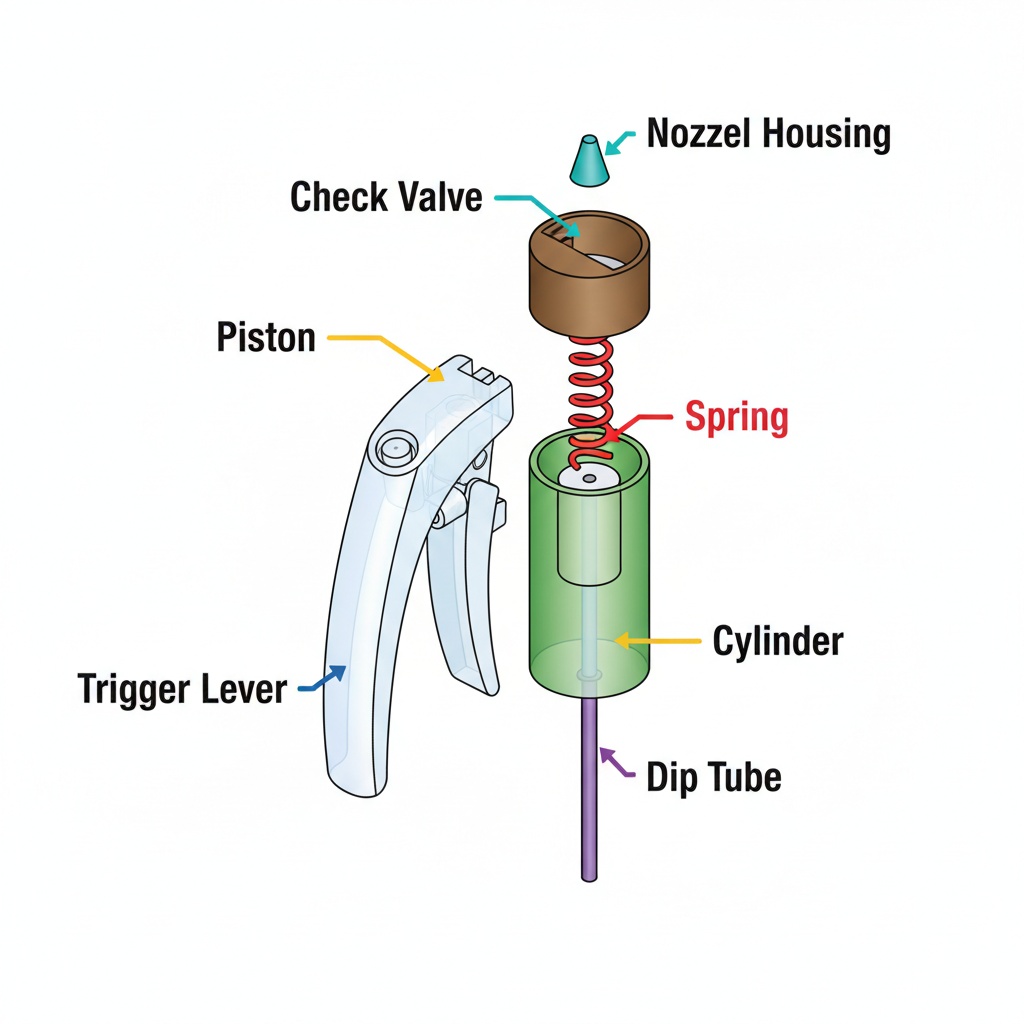
Squeezing the trigger lever pushes the piston rearward inside the cylinder, creating negative pressure. That vacuum pulls liquid up the dip tube from the bottle. Releasing the lever allows the spring to return the piston forward, compressing the liquid. The check valve opens, and liquid exits through the nozzle. Each complete squeeze-and-release cycle is one actuation.
A trigger sprayer is a lever-actuated dispensing mechanism that uses a piston-and-cylinder assembly to create suction and expel liquid through an adjustable nozzle, delivering 0.5 to 1.5 mL per actuation with spray patterns ranging from a concentrated stream to a dispersed mist.
The component list is short but each material matters. The trigger lever, cylinder, and nozzle housing are polypropylene (PP). The piston is polyethylene (PE), chosen because its softer flex creates a tighter seal against the cylinder wall without cracking over thousands of actuations. The spring is stainless steel, rated for corrosion resistance against cosmetic formulations in the pH 3 to 9 range. The nozzle insert is POM (polyoxymethylene), selected for dimensional stability and low-friction cam rotation. The dip tube is LDPE or HDPE, cut to bottle height with a tolerance of plus or minus 2 mm.
One material decision worth noting: some trigger sprayer designs replace the stainless steel spring with a PET (polyester) plastic spring. This eliminates all metal from the assembly, which matters for brands pursuing organic or natural certifications where metal-free packaging is a marketing advantage. The trade-off is real. Plastic springs produce 15 to 25 percent less return force than stainless steel, resulting in slower trigger return and a less crisp feel during actuation. For salon professionals using the trigger hundreds of times per day, that difference in hand fatigue accumulates.
Nozzle Adjustment: Stream, Mist, Foam, and Off Positions
The adjustable nozzle is what separates trigger sprayers from single-pattern pump sprayers. Rotating the outer nozzle cap shifts an internal cam against a pin inside the nozzle seat, changing the orifice geometry and altering the spray output.

A trigger sprayer nozzle rotates through cam-controlled positions, with the mist setting producing droplets in the 100 to 300 micron range, notably larger than fine mist spray pump atomization at 20 to 80 microns, which affects coverage uniformity on skin and hair.
Four positions are standard on most cosmetic-grade trigger sprayers:
OFF seals the nozzle completely. This prevents accidental discharge during shipping, storage, and retail display. Many trigger sprayers include a secondary shipping lock on the trigger lever itself for additional transport security.
STREAM opens the orifice fully, producing a concentrated jet with minimal atomization. This position delivers the highest volume per actuation. Applications include targeted cleaning (brush cleaners, tool sanitizers) and precision application to specific areas.
MIST partially restricts the orifice and engages a swirl chamber, producing dispersed droplets in the 100 to 300 micron range. This is the primary setting for hair sprays, room sprays, and body treatment applications. The 100 to 300 micron droplet size is significantly larger than the 20 to 80 micron range produced by fine mist spray pumps. That distinction explains why trigger sprayers do not substitute for fine mist pumps in facial care applications. The spray feels wetter and coarser on skin.
FOAM (on models with a mesh insert at the nozzle exit) forces liquid through a screen that entrains air, generating foam output. This position requires surfactant-based formulations with approximately 10 to 20 percent surfactant content. Applications include foaming hand washes and professional salon cleansers.
Trigger Sprayer Nozzle Position Comparison
| Nozzle Position | Droplet Size | Output per Actuation | Best Application |
|---|---|---|---|
| Off | N/A (sealed) | 0 mL | Shipping, storage, display |
| Stream | No atomization (jet) | Highest (full volume) | Brush cleaners, targeted application |
| Mist | 100 – 300 microns | Medium-high | Hair sprays, room sprays, body treatments |
| Foam | N/A (foam) | Medium | Surfactant-based cleansers, salon foam products |
Types of Trigger Sprayers: Standard, Mini, Foam, and Industrial
Four trigger sprayer categories cover the full range of cosmetic and professional applications.
Standard trigger sprayers use 28/400 or 28/410 closures and fit 500 mL to 1 L bottles. Output ranges from 0.5 to 1.5 mL per actuation. This is the dominant format for household cleaning products and professional salon back-bar sprays. In cosmetic packaging, standard triggers appear on room sprays, linen sprays, and professional hair styling products where volume output matters more than portability.
Mini trigger sprayers fitted with 24/410 or 28/410 closures deliver 0.3 to 0.7 mL per actuation, making them the preferred format for salon professional products in 100 to 250 mL bottles where precision application and portability outweigh the convenience of one-hand operation.
Mini trigger sprayers fit 100 to 300 mL bottles, typically with 24/410 or 28/410 closures. Their lower output of 0.3 to 0.7 mL per actuation makes them better suited for precision applications. Salon professionals use mini triggers for color refreshers, heat protectant sprays, and leave-in conditioners. The travel cosmetics segment is also driving mini trigger adoption as brands expand their professional-size ranges into portable formats.
Foam trigger sprayers combine the standard lever-piston mechanism with an integrated foam chamber at the nozzle. The liquid passes through a mesh screen on exit, generating foam through air entrainment. These require surfactant formulations, the same 10 to 20 percent surfactant content requirement that applies to standalone foam pump dispensers. Applications include foaming hand washes in salon settings and professional surface cleaning products.
Industrial heavy-duty trigger sprayers use reinforced mechanisms, larger piston bores, UV-stabilized materials, and chemical-resistant seals. These serve agricultural, industrial cleaning, and paint applications with 38/400 closures on 1 to 5 L containers. Industrial triggers are outside the scope of cosmetic packaging. Many use materials not approved under EU Cosmetics Regulation 1223/2009 or FDA 21 CFR for cosmetic contact.
Trigger Sprayer Type Comparison
| Type | Closure Size | Output per Stroke | Bottle Size | Cosmetic Applications |
|---|---|---|---|---|
| Standard | 28/400, 28/410 | 0.5 – 1.5 mL | 500 mL – 1 L | Room sprays, salon back-bar, linen sprays |
| Mini | 24/410, 28/410 | 0.3 – 0.7 mL | 100 – 300 mL | Salon hair products, travel formats, setting sprays |
| Foam | 28/400, 28/410 | Medium | 300 mL – 500 mL | Foaming cleansers, salon foam products |
| Industrial | 38/400 | Up to 2.0 mL | 1 – 5 L | Not for cosmetic use |
Closure Sizes and Bottle Compatibility: 28/400, 28/410, and 24/410
Closure sizing errors are the single most preventable failure in trigger sprayer procurement. Understanding the numbering system eliminates the problem entirely.
The 28/400 and 28/410 closure designations share the same 28 mm neck diameter but use different thread pitches. The 400 designation indicates a coarser thread with fewer turns per inch. The 410 designation indicates a finer thread with more turns per inch. They are not interchangeable despite appearing identical at first glance. Specifying the wrong closure is one of the most common trigger sprayer procurement errors.
A 28/400 trigger on a 28/410 bottle will not seat correctly. It may partially thread, giving the appearance of a fit during a quick visual check. Under fill-line conditions, the mismatched threads produce leaks, failed QC, and production stoppages. The reverse error (28/410 trigger on a 28/400 bottle) creates the same result.
How to prevent this: always cross-reference the trigger sprayer closure specification against the bottle neck finish specification. Do not rely on the neck diameter alone. A procurement document that says “28mm neck” without specifying 400 or 410 is incomplete.
For detailed analysis of bottle-pump fitment issues including thread compatibility, see our engineering guide on plastic spray bottle design flaws.
Closure Size Reference
| Closure | Neck Diameter | Thread Pitch | Typical Bottle Format | Common Applications |
|---|---|---|---|---|
| 28/400 | 28 mm | Coarser (fewer threads) | 500 mL – 1 L PET/HDPE | Household cleaning, professional spray products |
| 28/410 | 28 mm | Finer (more threads) | 200 mL – 500 mL PET/HDPE | Personal care, cosmetic trigger products |
| 24/410 | 24 mm | Fine | 100 – 300 mL PET/PP | Mini trigger, travel cosmetics, salon retail |
| 38/400 | 38 mm | Coarser | 1 – 5 L HDPE | Industrial applications (not cosmetic) |
For brands evaluating bottle material options alongside trigger sprayer selection, PETG bottle construction offers chemical clarity and impact resistance that pairs well with 28/410 cosmetic trigger formats.
Materials: PP Body, PE Piston, Stainless Steel Spring, POM Nozzle
Trigger sprayer assemblies combine polypropylene body components, polyethylene pistons, stainless steel springs, and POM nozzle inserts. This multi-material construction achieves medium PCR compatibility overall, compared to the high PCR compatibility of single-material lotion pumps, because each material type requires separate recycled-content sourcing.
PP (polypropylene) body and housing form the structural backbone: trigger lever, cylinder, nozzle housing, and closure ring. PP resists most aqueous cosmetic formulations, accepts any Pantone color in injection molding, and is available with PCR content from 10 to 50 percent from major resin suppliers.
PE (polyethylene) piston creates the seal that makes the pump mechanism work. PE is softer than PP, which allows the piston to flex against the cylinder wall without cracking. PCR availability for PE piston components runs 10 to 30 percent, lower than PP because piston performance is more sensitive to resin consistency.
Stainless steel spring provides the return force that resets the piston after each actuation. Stainless steel resists corrosion from water-based formulations across the pH 3 to 9 range typical of cosmetic products. The PET plastic spring alternative eliminates metal entirely but reduces return force by 15 to 25 percent.
POM (polyoxymethylene) nozzle insert handles the precision work. POM maintains dimensional stability through thousands of nozzle rotations, resists deformation under repeated use, and provides the low-friction surface that keeps the cam rotation smooth. Some lower-cost triggers substitute PP nozzles, which function but wear faster in high-cycle salon applications.
LDPE/HDPE dip tube connects the piston mechanism to the product inside the bottle. LDPE offers flexibility for bottles with angled or narrow necks. HDPE provides rigidity for wide-neck containers. Incorrect dip tube length is a common failure point. A tube cut too short leaves product in the bottle. A tube cut too long bends inside the bottle and blocks liquid uptake.
For brands pursuing PCR sustainable packaging goals, trigger sprayers present a challenge. The multi-material assembly means overall PCR content for the complete unit is lower than what single-material dispensing systems can achieve. Brands should weigh this against the functional requirements of their application.
Cosmetic Applications: Where Trigger Sprayers Fit (and Where They Do Not)
Trigger sprayers occupy a specific zone in cosmetic packaging: professional, utilitarian, and high-volume-output applications. Knowing where they fit and where they fail prevents expensive misspecification.
Where trigger sprayers fit:
Salon professional hair products are the core cosmetic application. Styling sprays, heat protectants, detangling sprays, and color refreshers in 250 to 500 mL formats. The adjustable spray pattern allows stylists to switch between mist for broad application and stream for section-by-section work. Mini triggers in 100 to 250 mL bottles serve the professional retail shelf.
Room and linen sprays represent the fastest-growing trigger sprayer category in the cosmetic-adjacent space. Fragrance products in 100 to 200 mL formats, where the higher output per stroke provides better room coverage than a fine mist pump.
After-sun and body treatment sprays in professional spa settings where higher output per stroke is an operational advantage. Trigger format at 28/410 in 200 to 300 mL bottles.
Makeup tool and brush cleaners. Cleaning is a utilitarian task where two-hand operation is acceptable and the adjustable spray pattern (stream for targeted cleaning, mist for general sanitizing) adds functional value.
Where trigger sprayers do not fit:
Consumer prestige facial mists and toners. The two-hand operation conflicts with premium positioning. The 100 to 300 micron mist is too coarse for facial application, where consumers expect the 20 to 80 micron cloud from a fine mist pump. As covered in our cosmetic spray pump types guide, consumer expectations for one-hand operation and refined spray patterns push prestige brands toward fine mist pumps and airless spray systems.
Consumer body spray products where one-hand convenience drives purchase decisions. Fine mist pumps and treatment pumps serve this segment better.
Formulations above approximately 300 cPs viscosity. Trigger sprayers struggle with thicker liquids. Lotion pumps or airless pumps handle viscous formulations more reliably.
Products requiring fine atomization below 80 microns. Trigger sprayer mist settings cannot achieve this level of atomization regardless of nozzle adjustment.
Quality Testing and Specifications
Six tests define whether a trigger sprayer meets cosmetic packaging standards.
According to ISO packaging quality standards, spray pattern consistency is measured at a fixed distance of 30 cm under controlled conditions. The pattern spread should be consistent within plus or minus 10 percent across a production batch. Inconsistent spray patterns indicate nozzle manufacturing variance or assembly defects.
Trigger sprayer chemical resistance testing follows ASTM D543, evaluating polypropylene and polyethylene components against the specific formulation chemistry, including ethanol content, essential oil concentration, and pH range, before finalizing material specification for cosmetic applications.
Chemical resistance testing per ASTM D543 evaluates PP and PE components against the actual formulation. This is critical for cosmetic products containing ethanol (sanitizing sprays, some toners), essential oils (natural cosmetics), acids (AHA toners at pH 3 to 4), and alkaline surfactants. Never skip formulation compatibility testing.
Fatigue and cycle life testing uses automated actuation at controlled force and frequency. The spring return force and piston seal integrity are the primary failure modes at high cycle counts. Salon professional triggers need higher cycle ratings than consumer products because professionals actuate far more frequently.
Drop testing at 1.2 m onto a concrete surface with a full product load. The trigger lever is the most vulnerable component in drop scenarios due to the stress concentration at the lever arm pivot point.
According to Packaging Digest, leakage testing places filled assemblies inverted and on-side at 40 degrees Celsius for 24 hours, simulating transport and warehouse conditions. Acceptable leakage threshold is typically zero for inverted orientation.
Formulation compatibility testing goes beyond ASTM D543. Always test your actual formulation against trigger sprayer components before committing to production MOQ. This is especially critical for high-alcohol formulations, essential oil-heavy products, and low-pH acids. Oulete holds ISO 9001, CE, SGS, and GMP certifications that cover the testing protocols for cosmetic packaging components.
Customization, Decoration, and MOQ Realities
Trigger sprayer customization starts with color. Stock triggers are available in white, black, and clear PP. Custom Pantone colors require injection molding tool changeover, with minimum order quantities typically starting at 5,000 to 10,000 units depending on the color.
Silk screening on the trigger body is the most effective branding method. The flat panel of a trigger sprayer body offers more surface area than a fine mist pump actuator, accommodating 1 to 4 color designs. Complex gradients and photographic images are not achievable with silk screening. Those require label application or heat-shrink sleeves on the bottle body instead.
Hot stamping works on flat areas of the trigger body for simple logos and text in gold, silver, or holographic foils. This is the go-to method for adding a premium metallic accent to salon professional products.
Clear and transparent triggers in clear PP allow brands to showcase the product color inside the bottle. This matters for products where liquid color is part of the brand identity, such as blue hair toners or amber essential oil blends.
Dip tube length is cut to order with plus or minus 2 mm tolerance to match the specific bottle height. Always provide the exact internal bottle height measurement when ordering. A specification error of even 5 mm causes functional problems.
MOQ and lead time reality: Stock trigger sprayers with custom decoration (silk screening or hot stamping) start at 1,000 units with 15 to 20 day lead times. Custom mold tooling for a new trigger design requires 10,000 to 50,000 unit commitments and 45 to 90 day lead times. For brands testing new products or limited runs, stock triggers with custom decoration offer the fastest and most cost-effective path.
Oulete operates 20 injection molding machines with in-house silk screening and hot stamping capabilities. PCR PP and PE materials are available for brands with sustainability requirements.
Trigger sprayers are not the right choice for every cosmetic product, and that honesty is the most useful thing a packaging manufacturer can offer. They perform well in salon professional applications, room and linen sprays, and utilitarian cosmetic uses where adjustable spray patterns and high output matter. They do not perform well in consumer prestige products where one-hand operation and fine mist atomization are expected. Sample before committing to production volumes. Test closure compatibility with your existing bottle inventory. Run your actual formulation against component materials. Those three steps prevent the failures that cost time and money. Contact Oulete for trigger sprayer samples and closure compatibility consultation.
Frequently Asked Questions About Trigger Sprayers
What is the difference between a trigger sprayer and a fine mist spray pump?
A trigger sprayer uses a lever-actuated piston mechanism delivering 0.5 to 1.5 mL per actuation with droplets in the 100 to 300 micron range. A fine mist spray pump uses a finger-press mechanism delivering a much smaller dose per actuation with droplets in the 20 to 80 micron range. Trigger sprayers require two-hand operation and produce a wetter, coarser spray. Fine mist pumps allow one-hand use and produce the cloud-like atomization expected in premium facial and body mist products.
Can trigger sprayers be used with alcohol-based cosmetic formulations?
PP and PE components in trigger sprayers tolerate moderate ethanol concentrations found in most cosmetic formulations. However, high-alcohol products can cause stress cracking in certain PP grades over time. Always conduct chemical resistance testing per ASTM D543 with your actual formulation before committing to production. Essential oil-heavy products and low-pH acids (AHA toners at pH 3 to 4) also require specific compatibility testing.
What does 28/400 vs. 28/410 mean for trigger sprayer closures?
The first number (28) is the bottle neck diameter in millimeters. The second number (400 or 410) indicates thread pitch, with 400 being a coarser thread and 410 a finer thread. A 28/400 trigger will not seat correctly on a 28/410 bottle, even though both share the same 28 mm diameter. Always match the full closure specification, not just the diameter.
Are trigger sprayers available with PCR (recycled) materials?
PP body components accept PCR content from 10 to 50 percent. PE piston components accept 10 to 30 percent PCR. The stainless steel spring can use recycled steel grades. However, the multi-material assembly means overall PCR content for the complete trigger sprayer unit is lower than what single-material dispensing systems achieve. For detailed PCR material properties and testing data, see our PCR plastic testing guide.
What is the minimum order quantity for custom trigger sprayers?
Stock trigger sprayers with custom decoration (silk screening, hot stamping, or custom color) start at 1,000 units with lead times of 15 to 20 days. Custom mold tooling for a new trigger design requires 10,000 to 50,000 unit commitments with lead times of 45 to 90 days.
Which trigger sprayer type is best for salon professional products?
Mini trigger sprayers with 24/410 or 28/410 closures in 100 to 250 mL bottles are the standard for salon retail products such as heat protectants and leave-in conditioners. Standard triggers with 28/410 closures in 250 to 500 mL bottles serve back-bar applications where higher output per stroke and adjustable spray patterns give stylists operational flexibility.
Why do trigger sprayers feel different from regular spray pumps?
Trigger sprayers require two-hand operation and produce a stronger lever-action feel compared to the softer finger-press of standard spray pumps. The return force depends on the spring material: stainless steel springs provide a crisper, faster return, while plastic PET springs feel softer with slower return. Salon professionals who actuate triggers hundreds of times daily should test spring type for hand fatigue before committing to a supplier.
How do I prevent dip tube problems in trigger sprayer assemblies?
Dip tube length must match the internal bottle height within plus or minus 2 mm. A tube cut too short leaves product unreachable at the bottom. A tube cut too long bends inside the bottle and blocks liquid flow. Provide the exact internal height measurement to your supplier. For bottles with angled or narrow necks, specify LDPE dip tubes for flexibility. For wide-neck containers, HDPE provides the rigidity needed to prevent tube collapse under vacuum.