


How many pumps does it take to empty a 300 mL body lotion bottle? The answer depends on whether your supplier specified a 1.0 mL or 2.0 mL output pump, whether the neck finish matches the bottle threading, and whether the formula viscosity falls within the pump’s operating range. Get any of those wrong, and you are looking at consumer complaints, wasted product, or a pump that locks up mid-bottle.
A lotion dispenser pump is a metered dispensing mechanism that delivers body lotion, hand cream, and similar formulations in controlled doses per actuation. Key specifications include neck finish size (20/410, 24/410, or 28/410), output volume (0.5 to 2.0 mL per stroke), viscosity compatibility (100 to 5,000 cPs for standard pumps), and material composition (PP actuator, PE dip tube, stainless steel or plastic spring). Selecting the correct lotion pump requires matching these factors to your bottle format and formula.
If you search “lotion dispenser” online, you will find bathroom soap dispensers and wall-mounted fixtures. This article is not that. This is a B2B specification guide for cosmetic brand managers and procurement teams who need to source the right lotion pump dispenser for their product line. For a broader overview of bottles with dispensers for cosmetic brands, see our pillar guide.
Types of Lotion Dispensers for Cosmetic Packaging
Four distinct mechanisms cover the full viscosity spectrum, and each fits a different formulation profile.
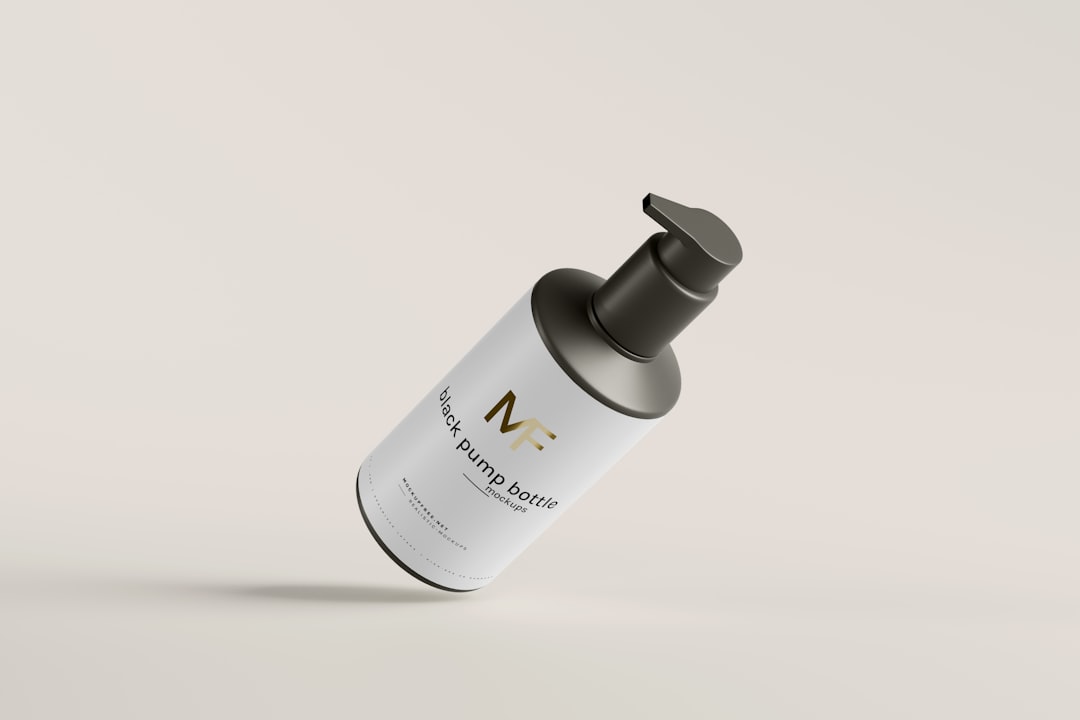
A standard lotion pump is a dispensing mechanism that uses a piston-and-spring assembly to draw viscous product up a dip tube and dispense it through an actuator nozzle in a dose of 0.5 to 2.0 mL per actuation, making it the most widely used dispensing format for body lotion, hand cream, and liquid soap in cosmetic packaging.
An airless lotion dispenser is a pump-free vacuum system where a rising piston plate replaces the dip tube, eliminating air contact and ensuring near-complete product evacuation at rates of 95% or higher. Airless systems handle viscosities from 1,000 to 50,000 cPs. Oulete manufactures airless lotion dispensers as a core product line, and our airless pump bottles sourcing guide covers the full range.
A disc-top cap is a flip-opening dispensing closure that allows direct pour dispensing without a pump mechanism, suitable for high-viscosity formulas above 5,000 cPs that resist flow-controlled pumping. It is the lowest-cost dispensing option for body butters and thick paste formulations.
For brands comparing lotion pumps against cosmetic spray pump types, the primary differentiator is viscosity. Spray pumps atomize thin liquids; lotion pumps push thick emulsions.
| Dispenser Type | Dose Output (mL) | Viscosity Range (cPs) | Best For | Relative Cost |
|---|---|---|---|---|
| Standard Lotion Pump | 0.5 – 2.0 | 100 – 5,000 | Body lotion, hand cream, liquid soap | Low |
| Airless Lotion Dispenser | 0.3 – 0.8 | 1,000 – 50,000 | Premium cream, natural formulas | High (2-3x) |
| Treatment Pump | 0.5 – 1.0 | 100 – 2,000 | Fluid foundation, lightweight moisturizer | Low-Medium |
| Disc-Top Cap | User-controlled | 5,000 – 100,000 | Body butter, thick masks, paste | Very Low |
Neck Finish Sizes: 20/410, 24/410, and 28/410
A neck finish is the standardized thread and opening size that determines which pump fits which bottle. The number before the slash is the diameter in millimeters; the number after indicates the thread profile. Miss this, and the pump cross-threads, leaks, or wobbles.
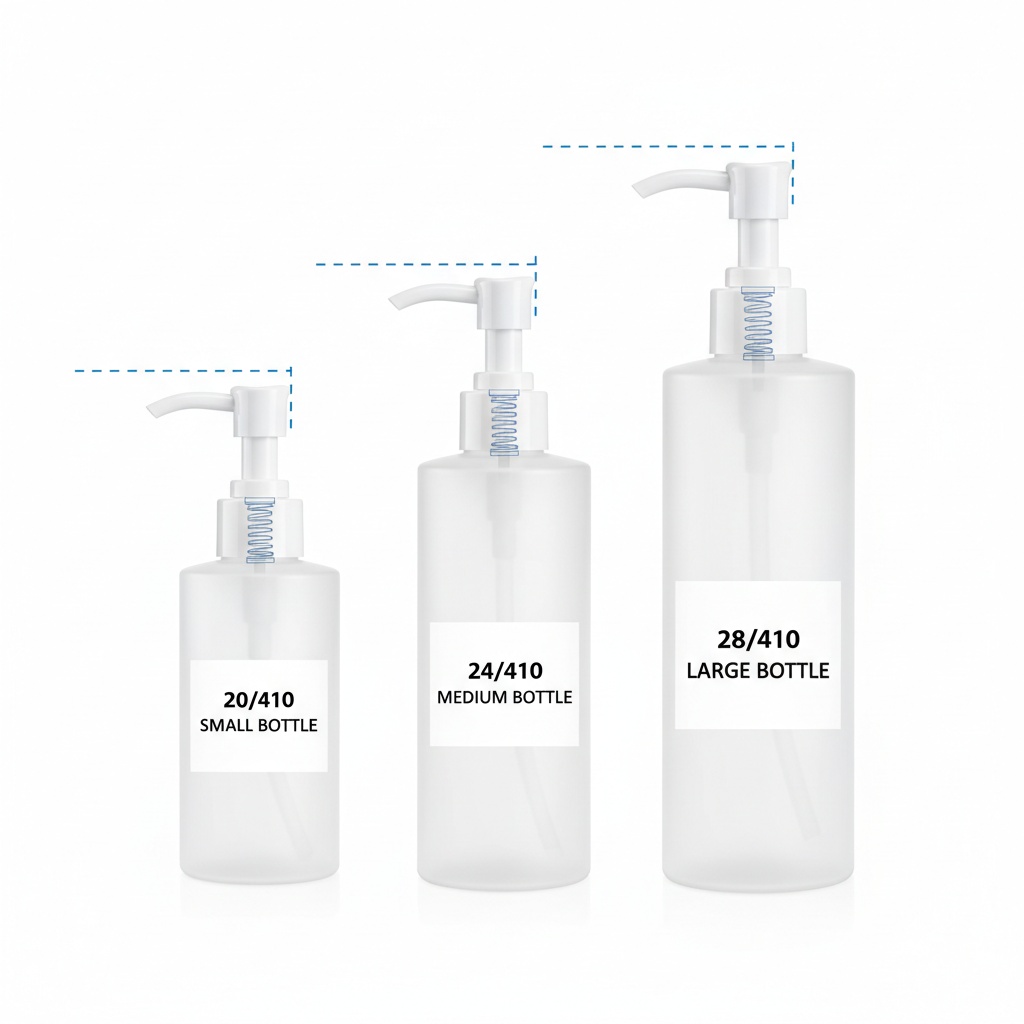
The 24/410 neck finish, a 24mm diameter continuous-thread opening, is the most widely used standard for cosmetic lotion pump bottles, accommodating bottle volumes from 100 mL to 300 mL and providing the widest selection of stock pump heads from cosmetic packaging manufacturers.
20/410 fits 30 to 100 mL bottles. Travel-size lotions and serum bottles use this neck with slim-profile, short-stroke pumps.
24/410 fits 100 to 300 mL bottles. This is the workhorse for body lotions, hand creams, and cleansers. At Oulete, 24/410 stock pumps carry the shortest lead time at our 1,000-unit minimum order.
28/410 fits 200 to 500 mL bottles. Larger formats need this wider neck for higher output pumps and the wider dip tubes required by viscous formulas above 3,000 cPs.
| Neck Finish | Diameter | Typical Bottle Size | Common Output | Primary Applications |
|---|---|---|---|---|
| 20/410 | 20 mm | 30 – 100 mL | 0.5 – 1.0 mL | Travel lotion, serum, portable hand cream |
| 24/410 | 24 mm | 100 – 300 mL | 1.0 – 1.5 mL | Body lotion, hand cream, facial cleanser |
| 28/410 | 28 mm | 200 – 500 mL | 1.5 – 2.0 mL | Large body lotion, shampoo, conditioner |
Output Per Stroke and Viscosity Matching
Dose output drives formulation yield and consumer satisfaction. A 300 mL bottle with a 2.0 mL pump gives approximately 150 uses. The same bottle with a 1.0 mL pump delivers 300 uses but requires two pumps per application. When brands bring us a 300 mL body lotion, we recommend 1.5 mL output as the balance point.
Standard lotion pumps are engineered to handle formulations in the 100 to 5,000 cPs viscosity range. The dose output remains consistent across actuations when viscosity falls within the rated range. Outside that range, output becomes unpredictable.
Viscosity, measured in centipoise (cPs), determines whether a pump can draw and dispense product reliably. According to ASTM D2196, viscosity measurement using a rotational viscometer is the accepted protocol for evaluating formulation compatibility with dispensing systems. Selecting a pump mismatched to viscosity is the most common cause of pump failure complaints.
| Viscosity (cPs) | Example Formulations | Recommended Dispenser |
|---|---|---|
| 100 – 500 | Lightweight moisturizer, fluid foundation | Treatment pump (0.5 – 1.0 mL) |
| 500 – 2,000 | Hand lotion, facial cleanser, conditioner | Standard lotion pump (1.0 – 1.5 mL) |
| 2,000 – 5,000 | Rich body lotion, thick hand cream | High-output pump (1.5 – 2.0 mL); 28/410 neck |
| 5,000 – 15,000 | Body cream, hair mask | Airless dispenser or wide-valve pump |
| 15,000 – 50,000+ | Body butter, thick balm | Disc-top cap or jar |
Temperature affects viscosity significantly. A lotion measuring 2,000 cPs at 25 degrees Celsius may reach much higher viscosity at 5 degrees Celsius during cold storage. When formulas cross the 5,000 cPs threshold, standard pumps air-lock. For thick creams above this viscosity, Oulete’s airless pump bottles eliminate the dip tube entirely.
Materials: PP Actuator, PE Dip Tube, and the Spring Decision
Every lotion pump consists of a PP (polypropylene) actuator head, PP collar and body, PE (polyethylene) dip tube, and a spring. PP actuators resist cosmetic formulations across pH 3 to 11 and accept PCR content at 10% to 50%. The PP surface takes silk screen printing and hot stamping well.
PE dip tubes must be trimmed at the factory to match bottle height. Too short, and the pump cannot reach product at the bottom. Too long, and flow restricts. Both HDPE and LDPE variants are available in PCR grades with comparable performance.
The spring choice is where sustainability enters the conversation.
| Feature | Stainless Steel Spring | Plastic (PP/PE) Spring |
|---|---|---|
| Actuation Feel | Firm, consistent snap-back | Softer, slightly variable |
| Corrosion Risk | Yes, with high-acid or high-salt formulas | None |
| PCR Impact | Cannot use PCR | Full PCR compatibility |
| Cost | Standard (+$0.02-0.05/unit) | Lower; growing adoption |
| Formulation Limits | Avoid with >3% saline, pH <3.5 | No restriction |
| Recyclability | Multi-material (disassembly needed) | Mono-material possible |
According to industry data, stainless steel springs account for approximately 80% of lotion pump production as of 2025, but the EU Packaging and Packaging Waste Regulation (PPWR) is accelerating plastic spring adoption by requiring design-for-recyclability.
According to ASTM D543 chemical compatibility testing protocols, lotion pump components including PP actuators, PE dip tubes, and stainless steel springs must be immersed in the actual customer formulation for 30 to 90 days before production approval, with dimensional change, weight change, and visual degradation assessed to confirm long-term material integrity.
Testing and Quality Standards
Dispensing Consistency Testing targets plus or minus 5% dose variation across 50 or more consecutive actuations. The test method is gravimetric: weigh dispensed volume across a defined actuation series.
Pump Cycle Life Testing subjects the pump to repeated actuations until failure. Oulete pumps are tested to ISO 9001 standards. Our durability test standards for body lotion pump bottles article covers the methodology.
Leak Testing includes inversion testing, drop testing from 1.2 to 1.5 meters, and temperature cycling from -5 to +50 degrees Celsius.
Chemical Compatibility per ASTM D543 catches failures before production. Springs corrode in high-acid formulas. Dip tubes soften in high-solvent formulas. Testing with the actual formulation is non-negotiable.
Customization and Decoration
Stock pumps in white, black, or natural PP ship at Oulete’s 1,000-unit minimum. Custom colors require masterbatch formulation and higher minimums. PCR PP carries a gray tone; bright white needs TiO2 at 3 to 5% loading.

Three decoration methods work on lotion pump actuators. Hot stamping applies gold or silver foil on PP surfaces and is an Oulete in-house capability. UV coating with metallic effect maintains PCR compatibility underneath. Electroplating produces the highest-shine finish but requires ABS substrate, eliminating PCR compatibility. As a cosmetic packaging manufacturer with full in-house decoration, Oulete matches the method to your positioning and sustainability targets.
Locking mechanisms include travel locks, retail seal bands, and protective over-caps. Custom lock features require tooling and affect lead time.
Sustainability: Mono-Material and PCR Pumps
A mono-material lotion pump is a dispensing mechanism engineered entirely from polypropylene, including a PP spring valve replacing the conventional stainless steel spring, enabling single-stream recycling without disassembly. Adoption is accelerating in Europe driven by the EU Packaging and Packaging Waste Regulation’s design-for-recyclability requirements.
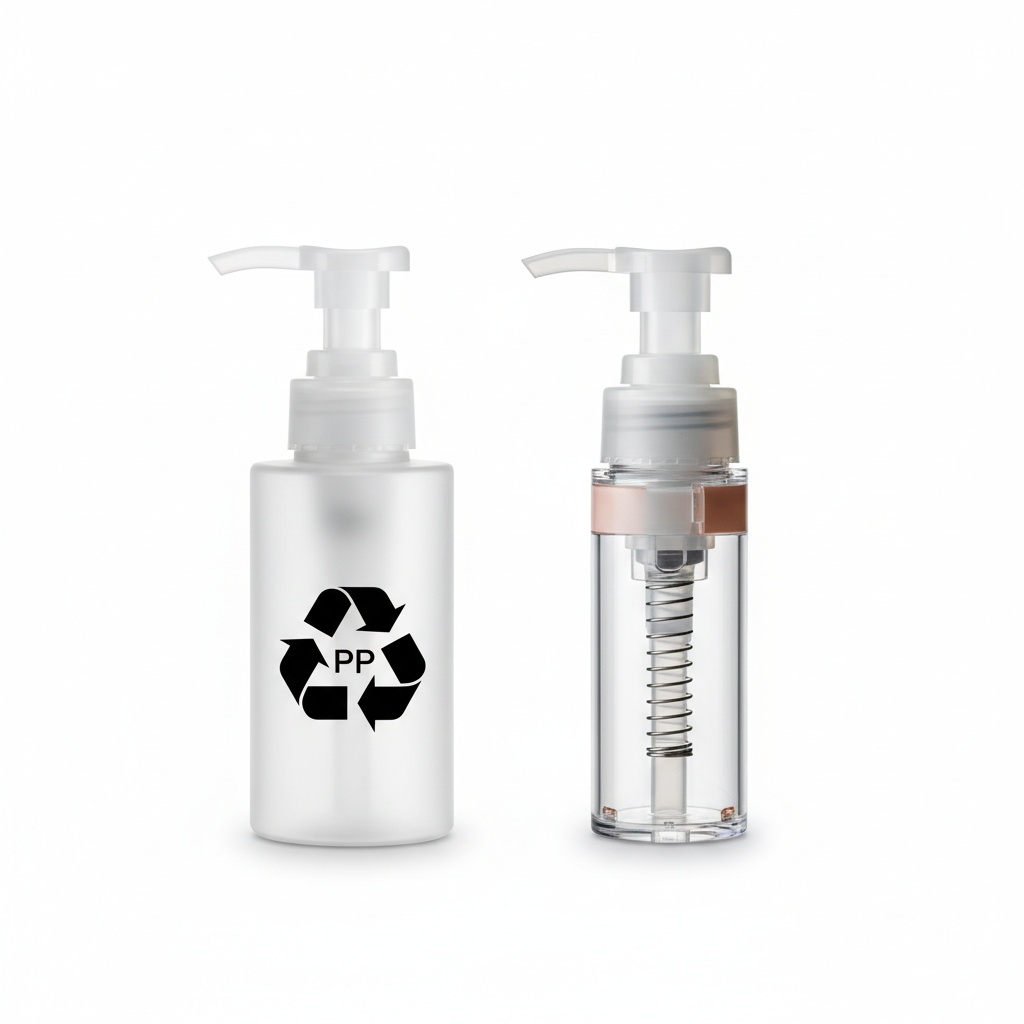
According to Ellen MacArthur Foundation guidelines referenced in the EU PPWR framework, mono-material pump design is a priority pathway for cosmetic packaging circularity. PP actuators and collars accept 30 to 50% PCR content without performance loss. PE dip tubes perform comparably in PCR grades.
For premium formats, springless airless dispensers eliminate metal entirely, making the assembly fully recyclable mono-material PP. Oulete’s airless line serves brands pursuing the highest sustainable packaging with recycled materials standard.
Decision Framework
Oulete + lotion pump dispenser + 24/410 neck finish compatibility represents our most requested configuration. Oulete + PCR-grade PP + mono-material pump addresses the fastest-growing request from European brand clients. Oulete + airless lotion dispenser + 95% evacuation rate serves the premium and natural formulation segments.
| Priority Factor | Recommended Pump | Key Consideration |
|---|---|---|
| Lowest unit cost | Standard pump, 24/410 stock | Highest MOQ flexibility |
| Thick formula (>5,000 cPs) | Airless dispenser | 2-3x cost, 95%+ evacuation |
| Mono-material recyclability | All-PP pump (plastic spring) | EU PPWR compliant |
| Premium positioning | Airless + UV metallic finish | Custom tooling required |
| Travel/sample size | Treatment pump, 20/410 | 0.5-1.0 mL output |
Match the viscosity to the mechanism, confirm the neck finish to the bottle, test with the actual formula, and start with stock 24/410 if this is your first sourcing order. Those four steps prevent the majority of lotion dispenser failures we see across the industry.
Frequently Asked Questions About Lotion Dispensers
What is the difference between a lotion pump and an airless pump dispenser?
A standard lotion pump uses a piston-and-spring assembly with a dip tube that draws product from the bottle. Air enters as product is dispensed. An airless dispenser uses a rising piston plate that prevents air contact entirely, handles up to 50,000 cPs, and achieves 95%+ evacuation. The trade-off is a 2 to 3 times cost premium.
How do I know which neck finish my bottle takes?
Common finishes are 20/410 (30-100 mL bottles), 24/410 (100-300 mL), and 28/410 (200-500 mL). Measure the outer diameter of the bottle opening in millimeters and match to the standard chart.
Can I use a lotion pump with a thick body cream?
Standard pumps handle up to approximately 5,000 cPs. Body creams above this may air-lock. For 5,000-15,000 cPs, use airless dispensers. Above 15,000 cPs, disc-top caps or jars are the only practical option.
Are lotion pump dispensers recyclable?
Standard multi-component pumps require disassembly before recycling. Mono-material all-PP pumps with PP spring valves enable single-stream recycling. PCR grades at 30 to 50% are available for both formats.
What MOQ should I expect for custom color lotion pumps?
Stock colors (white, black, natural) ship at 1,000-unit MOQ. Custom color matching requires higher minimums. Starting with stock pumps plus custom decoration at 1,000 units provides the fastest branded path.
Do lotion dispensers need testing with my specific formulation?
Yes. According to ASTM D543, pump components must be immersed in the actual formula for 30 to 90 days. Steel springs may corrode with high-acid formulas; dip tubes may soften with high-solvent formulas. Generic ratings are insufficient.
What is the difference between 24/410 and 28/410 neck finish?
The 24/410 has a 24mm opening for 100-300 mL bottles. The 28/410 has a 28mm opening for larger bottles with higher-output pumps. The wider neck also allows wider dip tubes needed for formulas above 3,000 cPs.
Can lotion pumps be used with preservative-free formulations?
Standard pumps allow air entry that accelerates oxidation and microbial growth in preservative-free products. These formulations benefit from airless dispensers where zero air contact maintains formula integrity throughout the product lifecycle.