


An airless pump bottle is a non-pressurized dispensing package designed to dispense a formula without using the traditional dip tube found inside many conventional pump bottles.
In a typical piston-based airless bottle, pressing the pump dispenses the product while an internal piston gradually moves upward from the bottom of the container. This reduces the empty space inside the product chamber and limits the amount of outside air introduced as the formula is used.
For skincare and cosmetic brands, this design can provide practical advantages including reduced air exposure, cleaner dispensing, efficient product evacuation and more controlled dosing.
However, airless packaging is not automatically the best choice for every product. Formula viscosity, chemical compatibility, dosage, filling process, material structure and package design all need to be evaluated together.
This guide explains how airless pump bottles work, their main benefits and limitations, common materials, suitable applications and what cosmetic packaging buyers should evaluate before selecting an airless dispensing system.
What Is an Airless Pump Bottle?
An airless pump bottle is a dispensing container that uses an internal mechanical system to move the product toward the pump as the bottle is emptied.
Unlike a traditional lotion pump, most piston-style airless bottles do not use a dip tube extending from the pump to the bottom of the container.
Instead, the formula sits above a movable piston. Each time the pump is operated, some product leaves the bottle and the piston gradually rises, reducing the available volume inside the product chamber.
This operating principle is particularly useful for skincare, cosmetics and personal care formulations where controlled dispensing and reduced exposure to the surrounding environment are important.
How Does an Airless Pump Bottle Work?
A piston airless bottle may appear simple from the outside, but the pump, piston, product chamber and bottom vent work together during every dispensing cycle.
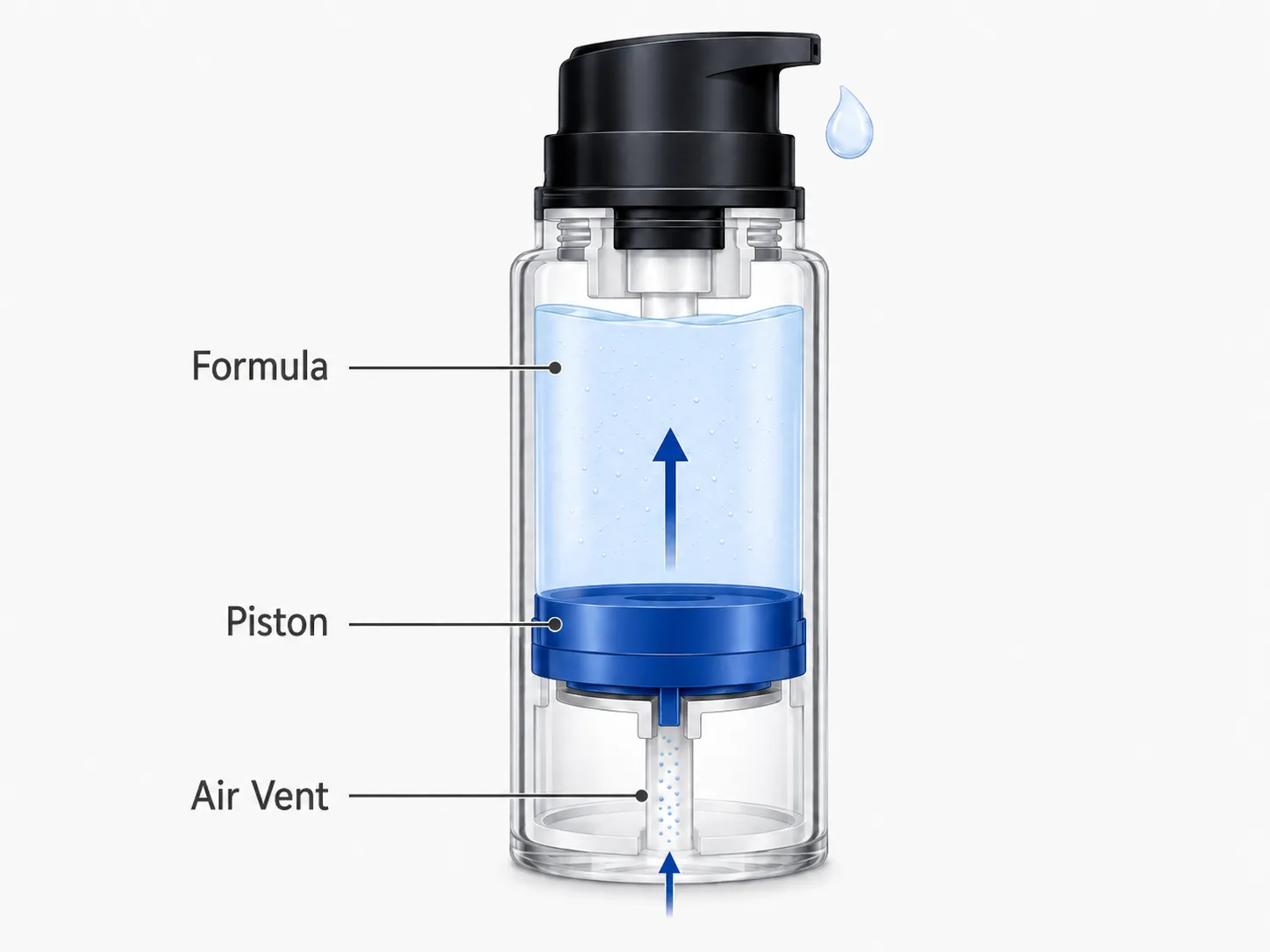
Press the Pump
Pressing the actuator activates the pump mechanism and begins the dispensing cycle.
Formula Is Dispensed
The pump releases a controlled amount of formula without relying on a traditional dip tube.
The Piston Moves Up
As product leaves the chamber, the internal piston rises and reduces the remaining chamber volume.
Air Enters Below the Piston
Air enters beneath the piston through the bottom vent while remaining separated from the formula chamber.
What happens during use:
each pump stroke removes a small amount of formula. The piston moves upward, while incoming air remains beneath the piston rather than mixing directly with the formula.
Is an Airless Bottle Really Vacuum-Sealed?
The word airless can be misleading if it is interpreted to mean that absolutely no air exists inside the package.
An airless cosmetic bottle should not be considered a laboratory vacuum chamber. Small amounts of residual air may remain after filling, assembly, transportation or pump priming.
The important difference is what happens as the product is dispensed. In many conventional bottles, the volume left by the dispensed product is replaced by incoming air. In a piston airless system, the piston instead moves upward and reduces the chamber volume.
A more accurate description:
airless packaging is designed to minimize the introduction of outside air into the product chamber during normal dispensing.
Main Components of an Airless Pump Bottle
Although structures vary between bottle designs, a typical piston airless system contains several important components.
| Component | Main Function |
|---|---|
| Actuator | The part pressed by the user to dispense the formula. |
| Pump Engine | Controls product intake and dispensing. |
| Product Chamber | Holds the skincare or cosmetic formula. |
| Piston | Moves upward as formula is dispensed. |
| Outer Bottle | Provides structural protection and visual appearance. |
| Bottom Vent | Allows atmospheric pressure to act beneath the piston. |
Airless Pump Bottle vs. Regular Pump Bottle
| Feature | Airless Pump Bottle | Regular Pump Bottle |
|---|---|---|
| Dip Tube | Usually not required | Usually required |
| Product Movement | Piston or collapsing chamber | Dip tube draws product upward |
| Replacement Air | Limited in the formula chamber | Commonly enters the bottle |
| Product Evacuation | Often high when matched correctly | More product may remain |
| Complexity | Higher | Lower |
What Are the Benefits of Airless Pump Bottles?
Helps limit repeated introduction of outside air into the formula chamber.
The rising piston helps keep remaining product close to the dispensing system.
Users access the formula through the pump rather than repeatedly touching the product.
Pump output can be selected according to the intended application amount.
Smooth pumping and clean dispensing can support premium skincare positioning.
Which Products Are Suitable for Airless Packaging?
Airless packaging is commonly considered for products that benefit from controlled dispensing, cleaner application or reduced exposure during repeated use.
01Skincare & Treatment
- Facial serums
- Moisturizers
- Eye creams
- Anti-aging treatments
- Vitamin C products
- Retinol products
- Facial lotions
- Sunscreen
02Cosmetics & Personal Care
- Foundations
- Primers
- BB & CC creams
- Hand treatments
- Hair treatments
- Concentrated formulas
Formula fit still matters:
viscosity, particles, product-contact materials and pump performance should be tested with the actual formulation.
When Is an Airless Bottle Not the Best Choice?
Airless packaging provides several functional advantages, but unnecessary use can also increase packaging cost and complexity.
Can Airless Bottles Handle Thick Creams?
Yes — but the pump must match the formula.
Many airless systems can dispense lotions, emulsions, creams and other medium- to high-viscosity formulations effectively.
There is no single viscosity range that applies to every airless pump. Formula behavior, pump construction and dispensing requirements should be evaluated together using the actual formulation.
What affects pump performance?
Practical recommendation:
evaluate the selected pump and bottle with the actual bulk formula before mass production, especially for thick creams, high-viscosity emulsions or formulas containing suspended ingredients.
What Materials Are Airless Pump Bottles Made From?
Airless packaging can use different plastic materials depending on structure, appearance, product-contact requirements, target price and sustainability objectives.
PP Airless Bottles
Lightweight, practical chemical resistance and broad manufacturing flexibility for skincare packaging.
PET / PETG
Useful when clarity and a clean transparent cosmetic appearance are important.
Acrylic Airless Bottles
Often selected for premium packaging requiring visual depth, clarity and a heavier glass-like appearance.
PP vs. Acrylic Airless Bottles
| Factor | PP | Acrylic |
|---|---|---|
| Weight | Lighter | Heavier |
| Appearance | Clean & functional | Premium thick-wall look |
| Transparency | Limited | High outer-shell clarity |
| Positioning | Mass market to premium | Premium / prestige |
Piston Airless vs. Pouch Airless Systems
Piston Airless System
The product sits above a movable piston. As formula is dispensed, the piston rises and reduces the remaining chamber volume.
Pouch / Bag-in-Bottle
The formula is stored inside a flexible chamber that collapses as product is dispensed.
What Is the Hole at the Bottom of an Airless Bottle?
The small opening at the bottom of many piston airless bottles is a functional vent.
It allows atmospheric pressure into the space below the piston. Blocking this vent can interfere with piston movement and prevent the dispensing system from operating correctly.
Why Does a New Airless Pump Need Several Pumps?
Air can initially remain inside the pump mechanism and dispensing pathway. Several complete strokes may be required to prime the pump.
How to Choose the Right Airless Pump Bottle
Check plastics, seals, pump components and formula-contact materials.
Match pump design to real formula flow behavior.
Determine how much product should be dispensed per stroke.
Select a capacity that fits product positioning and existing mold availability.
Consider compatibility, weight, appearance and sustainability.
Plan printing, coating, hot stamping, color and surface finish.
Evaluate leakage, priming, evacuation, transportation and formula compatibility.
Common Airless Pump Bottle Problems
Pump Does Not Dispense
Check priming, filling, viscosity, assembly and pump compatibility.
Piston Does Not Rise
Possible causes include blocked vent, leakage or incorrect assembly.
Leakage Around the Pump
Review sealing surfaces, filling level and component compatibility.
Inconsistent Dispensing
May relate to trapped air, formula rheology or pump selection.
Residual Product
Formula behavior and bottle geometry influence final evacuation.
Are Airless Pump Bottles Refillable?
Some airless bottles are specifically engineered as refillable systems, while others are intended for a single filling cycle. Refillability should therefore be considered during the initial package-development stage.
Refillable systems may require:
• Replaceable cartridges
• Durable outer packaging
• Repeatable sealing
• Hygienic replacement
• Reliable pump life
• Material compatibility
Are Airless Pump Bottles Recyclable?
Recyclability depends on the complete package structure rather than the resin used for only one visible component.
Airless Bottle vs. Cosmetic Jar: Which Is Better?
Airless Bottle
Better suited to controlled, low-contact dispensing for serums, moisturizers and treatment products.
Cosmetic Jar
Useful for very thick creams, masks and balms that are intended to be scooped directly from the container.
How to Choose an Airless Bottle Manufacturer
For commercial skincare and cosmetic projects, choosing an experienced airless bottle manufacturer involves more than comparing bottle appearance or unit price.
- Which materials directly contact the formula?
- Which pump outputs are available?
- Can samples be tested with the actual formula?
- Which capacities are available?
- Which decoration processes are supported?
- Can custom colors and branding be produced?
- Which package tests are recommended?
- What is the MOQ?
- What is the production lead time?
- Can custom tooling be developed?
Airless Pump Bottle FAQ
What is an airless pump bottle?
How does an airless pump bottle work?
Does an airless bottle contain no air?
Why is there no dip tube inside an airless bottle?
What is the small hole at the bottom of an airless bottle?
Why is my new airless pump not working?
Can airless bottles be refilled?
Are airless pump bottles recyclable?
What products are suitable for airless bottles?
Choosing the Right Airless Packaging for Your Formula
An airless pump bottle is more than a cosmetic container without a dip tube. It is a complete dispensing system that controls how the product moves through the package while limiting the introduction of outside air during use.
When correctly matched with the formula, airless packaging can provide efficient product evacuation, controlled dosing, cleaner dispensing and a refined consumer experience.
For commercial skincare packaging projects, define the formula type, capacity, pump dosage, material preference, decoration requirements and order quantity first, then evaluate suitable bottle structures using actual formula samples before bulk production.
Custom Airless Packaging for Skincare & Cosmetic Brands
Oulete supports skincare, beauty and personal care brands with custom cosmetic packaging, including airless bottles for different formula, material, capacity, pump and decoration requirements.
For new packaging projects, bottle structure and pump performance can be evaluated together with the actual formulation before bulk production.