

What Is an Airless Pump Bottle? How It Works & Benefits

An airless pump bottle is a non-pressurized dispensing package designed to dispense a formula without using the traditional dip tube found inside standard pump bottles.

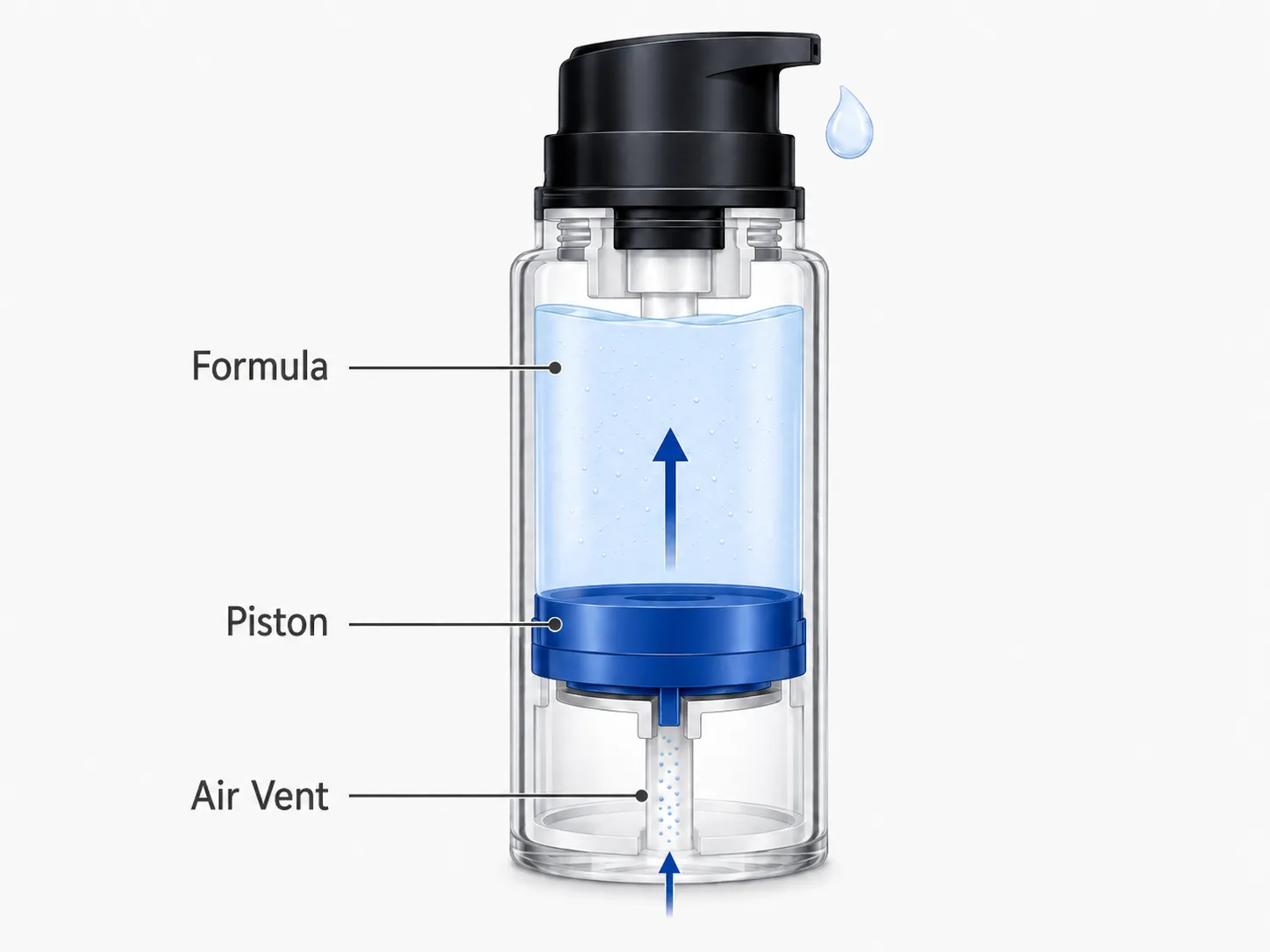
In a typical piston-based airless bottle, pressing the pump dispenses the product while an internal piston gradually moves upward from the bottom of the container. This reduces the empty space inside the product chamber and limits the amount of outside air introduced as the formula is used.

For skincare and cosmetic brands, this design can provide several practical advantages, including reduced air exposure, cleaner dispensing, efficient product evacuation, and more consistent dosing.

However, airless packaging is not automatically the best solution for every formula.

The right packaging depends on the formula’s viscosity, chemical compatibility, required dosage, filling process, material choice, and overall packaging design.

This guide explains how airless pump bottles work, how they differ from regular pumps, where they are most useful, and what buyers should evaluate before choosing an airless packaging system.


Table of Contents

What Is an Airless Pump Bottle?

An airless pump bottle is a dispensing container that uses an internal mechanical system to move the product toward the pump as the bottle is emptied.

Unlike a traditional lotion pump, most piston-style airless bottles do not use a dip tube extending to the bottom of the bottle.

Instead, the product sits above a movable piston.

Each time the pump is operated, some product leaves the container. The resulting pressure difference allows atmospheric pressure entering beneath the piston to move it upward.

As the piston rises, the volume of the product chamber becomes smaller.

This means the formula does not need to fall toward the bottom of the bottle or remain in contact with a growing headspace of replacement air in the same way it would in many conventional bottles.

This operating principle is particularly useful for skincare, cosmetics, personal care, and other formulations where controlled dispensing and reduced exposure to the surrounding environment are important.


How Does an Airless Pump Bottle Work?

A piston airless bottle may look simple from the outside, but several components work together during every pump cycle.

The process can be understood in four basic steps.

1. The User Presses the Pump

When the actuator is pressed, the pump mechanism moves downward.

The pump chamber controls the amount of formula released through the dispensing opening.

Depending on the pump design, each stroke can deliver a defined amount of product.

2. Product Leaves the Bottle

The pump draws formula from the product chamber and pushes it through the outlet.

Unlike a conventional pump bottle, there is normally no long dip tube reaching down through the formula.

3. Pressure Inside the Product Chamber Changes

As formula leaves the bottle, the available volume inside the product chamber would normally increase.

An airless system is designed to compensate for this change without continuously replacing the dispensed product with outside air inside the formula chamber.

4. The Piston Moves Upward

A small vent at or near the bottom of the bottle allows atmospheric pressure to act beneath the piston.

This pressure helps push the piston upward.

The piston follows the remaining product toward the pump, progressively reducing the usable volume of the chamber as the bottle empties.

This is why the bottom of many airless pump bottles has a small hole.

The hole is intentional and should not be blocked.

It allows the piston mechanism to function correctly.


Is an Airless Bottle Really Vacuum-Sealed?

The term airless can sometimes be misunderstood.

An airless bottle should not be interpreted as a laboratory vacuum chamber containing absolutely no air.

Small amounts of residual air may remain after filling, assembly, transportation, or priming.

The important difference is how the package behaves as the product is dispensed.

In a conventional bottle, the volume left by the dispensed product is commonly replaced by air entering the container.

In a piston airless system, the internal piston instead moves upward and reduces the size of the product chamber.

Therefore, a more accurate description is:

Airless packaging is designed to minimize the introduction of outside air into the product chamber during normal dispensing.

This distinction is important when evaluating packaging for oxidation-sensitive or high-value formulations.


Main Components of an Airless Pump Bottle

Although designs vary between manufacturers, a typical piston airless bottle contains several important components.

Component Main Function
Protective Cap Protects the actuator during storage and transport
Actuator The part pressed by the user
Pump Engine Controls product intake and dispensing
Collar / Closure Connects the pump system to the bottle
Product Chamber Holds the cosmetic or skincare formula
Piston Moves upward as the product is dispensed
Outer Bottle Provides structural protection and appearance
Bottom Vent Allows atmospheric pressure beneath the piston

Some premium airless packages may contain additional decorative shells, inner bottles, locking mechanisms, refill cartridges, or specialized pump components.

Because of these differences, two bottles that look almost identical from the outside can perform very differently with the same formula.


Airless Pump Bottle vs. Regular Pump Bottle

The main difference between an airless pump bottle and a regular pump bottle is how the product reaches the pump and what happens inside the bottle as the product is consumed.

Feature Airless Pump Bottle Regular Pump Bottle
Dip Tube Usually not required Usually required
Product Movement Piston or collapsing chamber moves product toward pump Pump draws product through dip tube
Replacement Air Limited inside product chamber Air commonly enters bottle as product leaves
Product Evacuation Often high when properly matched Product may remain around bottom and shoulders
Orientation Dependence Often lower Usually relies more on product reaching dip tube
Formula Protection Better suited to formulas requiring reduced air exposure Suitable for many conventional formulas
Packaging Complexity Higher Lower
Typical Cost Usually higher Usually lower

Neither system is universally better.

Traditional pumps remain a practical and cost-effective choice for many lotions, soaps, shampoos, and personal care products.

Airless packaging becomes more attractive when formula protection, evacuation, precise dispensing, appearance, or premium user experience is a priority.


What Are the Benefits of Airless Pump Bottles?

Reduced Exposure to Outside Air

One of the main reasons brands choose airless packaging is to reduce the introduction of outside air during dispensing.

This can be particularly valuable for formulations containing ingredients that may be sensitive to repeated environmental exposure.

Packaging alone cannot guarantee formulation stability, but it can form part of a broader product-protection strategy.

Efficient Product Evacuation

A traditional dip tube cannot always collect formula evenly from every part of a bottle.

Product may remain around the shoulders, walls, or bottom depending on container geometry and viscosity.

An airless piston continuously pushes the remaining formula toward the pump.

When the formula and pump system are properly matched, this can help reduce residual product inside the package.

Cleaner Dispensing

The user normally presses the actuator without inserting fingers into the container.

This is particularly attractive for creams and skincare products that might otherwise be packaged in wide-mouth jars.

Controlled Dosage

Airless pumps can be engineered to dispense a relatively consistent quantity with each complete stroke.

This is useful when brands want consumers to use a controlled amount of serum, moisturizer, treatment, foundation, or other concentrated formula.

The actual dosage depends on the selected pump rather than simply whether the package is airless.

Premium User Experience

Airless bottles are widely associated with treatment skincare and premium cosmetic packaging.

Smooth pumping, controlled dosage, minimal visible residue, and modern bottle designs can contribute to a higher-end user experience.

Flexible Packaging Design

Airless packaging is available in many formats, including:

  • Cylindrical bottles
  • Square bottles
  • Double-wall bottles
  • Transparent-shell bottles
  • Airless jars
  • Refillable airless bottles
  • Dual-chamber systems
  • Mono-material airless packaging

This allows brands to combine functional requirements with different visual positioning.


Which Products Are Suitable for Airless Packaging?

Airless bottles are commonly considered for skincare and cosmetic formulas where controlled dispensing or reduced exposure is desirable.

Typical applications include:

  • Facial serums
  • Moisturizers
  • Eye creams
  • Anti-aging treatments
  • Vitamin C skincare products
  • Retinol products
  • Facial lotions
  • Sunscreen
  • Foundations
  • Primers
  • BB creams
  • CC creams
  • Hand treatments
  • Hair treatments
  • Concentrated cosmetic formulas

However, being a skincare product does not automatically make a formula compatible with an airless bottle.

The packaging still needs to be tested with the actual formulation.


When Is an Airless Bottle Not the Best Choice?

Airless packaging provides many advantages, but unnecessary use can increase packaging cost and complexity.

A standard bottle or jar may sometimes be more appropriate.

Examples include situations where:

  • The formula is inexpensive and highly stable.
  • Reduced air exposure provides little functional advantage.
  • A very large packaging capacity is required.
  • The formula contains particles that interfere with the pump.
  • The viscosity is outside the pump’s working range.
  • The product requires a dispensing format unsuitable for an airless pump.
  • Packaging cost is a major constraint.
  • The filling process is incompatible with the selected airless system.

The correct decision should come from formula-packaging compatibility, not simply from choosing the most technically advanced package.


Can Airless Bottles Handle Thick Creams?

Many airless systems are particularly effective with lotions, emulsions, creams, and other medium- to high-viscosity products.

However, there is no single viscosity range that applies to every airless bottle.

Pump performance depends on several variables:

  • Pump engine design
  • Orifice diameter
  • Formula rheology
  • Formula viscosity
  • Temperature
  • Filling level
  • Presence of particles
  • Desired dosage
  • Container geometry

A formula that works perfectly in one airless package may perform poorly in another.

For this reason, manufacturers should receive representative product samples whenever possible before mass production.

Compatibility and dispensing tests are far more reliable than selecting packaging based only on a viscosity number listed on a specification sheet.


What Materials Are Airless Pump Bottles Made From?

Airless packaging can use several plastic materials depending on its structure, appearance, formula-contact requirements, and sustainability objectives.

PP Airless Bottles

Polypropylene, or PP, is widely used for cosmetic packaging components.

It offers relatively low weight, useful chemical resistance, and broad manufacturing flexibility.

PP is often selected for practical skincare packaging and can also be used in designs intended to simplify material construction.

PET and PETG

PET- and PETG-based structures can provide high clarity and a clean cosmetic appearance.

These materials may be considered when brands want the packaging to look more transparent or glass-like.

The exact product-contact structure should still be confirmed with the packaging manufacturer.

Acrylic Airless Bottles

Acrylic is commonly associated with premium cosmetic packaging because of its clarity, thickness, weight, and glass-like appearance.

In many acrylic airless packages, however, the acrylic section is primarily an outer decorative shell.

The formula may actually be stored inside a separate inner container made from another polymer.

Therefore, buyers should not judge material compatibility by the visible outer bottle alone.

Always identify which material is in direct contact with the formula.


PP vs. Acrylic Airless Bottles

The choice between PP and acrylic is often more about brand positioning and package construction than about appearance alone.

Factor PP Airless Bottle Acrylic Airless Bottle
Weight Lighter Usually heavier
Appearance Clean and functional Thick-wall, premium appearance
Transparency Usually limited Excellent outer-shell clarity
Structure Can be relatively simple Often multi-component
Decoration Good Excellent premium decoration potential
Shipping Weight Lower Higher
Premium Positioning Moderate to high High
Material Complexity Potentially lower Often higher

For mass-market skincare, travel packaging, or projects focused on lightweight construction, PP may be attractive.

For prestige skincare where visual depth and shelf presence are major priorities, acrylic may provide a more luxurious presentation.

The best option ultimately depends on the target market, formula, budget, and sustainability strategy.


Piston Airless vs. Pouch Airless Systems

Not every airless bottle uses a rigid piston.

Two major design concepts are commonly encountered.

Piston Airless System

The product is stored above a movable piston.

As formula is dispensed, the piston gradually rises.

This is one of the most recognizable airless bottle structures and is commonly used for skincare, cosmetics, and personal care products.

Pouch or Bag-in-Bottle Airless System

In another type of system, the formula is stored inside a flexible inner chamber or pouch.

As the product is dispensed, the internal chamber collapses.

This separates the formula from the surrounding outer bottle environment while reducing the internal volume as the product is consumed.

Each approach has different considerations involving filling, materials, manufacturing cost, design freedom, formula compatibility, and recyclability.

Buyers should evaluate the complete package rather than assuming that all products described as “airless” use the same mechanism.


What Is the Hole at the Bottom of an Airless Bottle?

A small hole in the bottom of a piston airless bottle is usually part of the functional design.

It allows outside air to enter the space below the piston.

The air does not enter the product chamber in the same way it would enter a conventional bottle.

Instead, atmospheric pressure beneath the piston helps it move upward as product is dispensed.

Blocking this vent can interfere with piston movement and may prevent the pump from operating correctly.

This is why the bottom vent should generally remain unobstructed during use.


Why Does a New Airless Pump Need Several Pumps Before Product Comes Out?

A newly filled airless bottle may not dispense product immediately.

This does not necessarily mean the pump is defective.

The pump and product pathway can initially contain air.

The first several strokes help prime the pump by removing this air and drawing formula into the dispensing mechanism.

Depending on the package and formula, several complete strokes may be required before product reaches the actuator.

If the bottle still fails to dispense after normal priming, possible causes include:

  • Insufficient filling
  • Incorrect piston position
  • Air leakage
  • Blocked pump pathway
  • Formula that is too viscous
  • Pump-formula incompatibility
  • Improper assembly
  • Damaged pump components

For commercial projects, priming performance should be included in packaging testing before production approval.


How to Choose the Right Airless Pump Bottle

Selecting an airless bottle should begin with the formula rather than with appearance.

1. Evaluate Formula Compatibility

The formula may interact with:

  • Product-contact plastics
  • Seals
  • Gaskets
  • Pump components
  • Colorants
  • Coatings
  • Decorations

Compatibility testing helps identify swelling, cracking, discoloration, leakage, loss of pump function, or formula changes before commercial production.

2. Evaluate Viscosity and Rheology

Do not choose a pump based only on labels such as “serum pump” or “cream pump.”

Real formulations behave differently.

Temperature, shear behavior, particles, oils, surfactants, and emulsions can all influence dispensing.

3. Determine the Required Dosage

Consider how much formula should be released per use.

A concentrated eye treatment may require a very different pump output from a body lotion or sunscreen.

Ask the packaging manufacturer for the available dosage options for the specific pump model.

4. Select the Appropriate Capacity

Airless bottles are manufactured in many capacities, but available sizes differ by series.

Common cosmetic projects may require anything from small treatment packaging to larger skincare bottles.

Instead of designing the formula quantity first and searching for packaging afterward, it can be more efficient to review the manufacturer’s existing mold range early in the project.

5. Choose the Packaging Material

Evaluate:

  • Product compatibility
  • Weight
  • Transparency
  • Appearance
  • Durability
  • Sustainability objectives
  • Decoration requirements
  • Transportation conditions
  • Target price

6. Consider Decoration

Common decoration options can include:

  • Silk-screen printing
  • Hot stamping
  • Spray coating
  • Frosted finishes
  • Metallization
  • Labeling
  • Color matching
  • Custom outer components

Decoration should also be included when evaluating recyclability and formula compatibility.

7. Test the Complete Package

A packaging sample may function correctly when empty but behave differently after being filled with the actual formula.

Before mass production, testing can include:

  • Formula compatibility
  • Leakage testing
  • Pump output testing
  • Priming testing
  • Product evacuation testing
  • Temperature testing
  • Transportation simulation
  • Drop testing
  • Vacuum or pressure-related testing where appropriate
  • Decoration adhesion testing

Testing requirements should be determined according to the product, market, distribution channel, and packaging specification.


Common Airless Pump Bottle Problems

The Pump Does Not Dispense

First check whether the pump has been fully primed.

If priming does not solve the issue, examine the assembly, piston position, formula viscosity, filling process, and pump compatibility.

The Piston Does Not Rise

Possible causes include a blocked bottom vent, poor sealing, incorrect assembly, or an incompatible formula.

Product Leaks Around the Pump

Leakage can result from closure problems, damaged sealing surfaces, incorrect assembly, incompatibility, excessive filling, or transport conditions.

The Pump Dispenses Inconsistently

Inconsistent output may be related to incomplete priming, formula rheology, trapped air, pump selection, or manufacturing tolerances.

Product Remains Inside After the Pump Stops Working

High evacuation is possible with a properly designed airless system, but “zero waste” should not be assumed.

Residual product can still depend on formula characteristics, bottle geometry, pump structure, and filling conditions.

Commercial packaging should therefore be evaluated using an actual evacuation test rather than relying only on marketing claims.


Are Airless Pump Bottles Refillable?

Some airless bottles are designed specifically as refillable systems.

Others are intended for one filling cycle and should not simply be opened and refilled by the consumer.

Refillable airless packaging requires additional engineering considerations.

These may include:

  • Replaceable inner cartridges
  • Durable outer packaging
  • Repeatable sealing
  • Hygienic refill design
  • Reliable pump performance over multiple cycles
  • Easy cartridge replacement
  • Material compatibility

If refillability is part of a brand’s sustainability strategy, it should be incorporated during packaging development rather than treated as an afterthought.


Are Airless Pump Bottles Recyclable?

The answer depends on the complete packaging structure.

A bottle cannot be considered easy to recycle simply because one component is made from a recyclable plastic.

Airless packaging may contain:

  • Multiple plastic resins
  • Metal springs
  • Elastomers
  • Adhesives
  • Decorative coatings
  • Labels
  • Metallized components
  • Separate inner and outer bottles

These materials can affect how easily the complete package can enter a recycling stream.

For brands prioritizing recyclability, possible strategies include:

  • Reducing the number of material types
  • Choosing mono-material packaging where appropriate
  • Using metal-free pump designs
  • Reducing unnecessary decorative components
  • Evaluating PCR material options
  • Designing components for easier separation
  • Checking the recycling infrastructure in the target market

“Recyclable” should therefore be evaluated at the complete package level, not just at the resin level.


Airless Bottle vs. Cosmetic Jar: Which Is Better?

Both formats have advantages.

A traditional cosmetic jar provides a large opening and makes very thick creams easy to access.

It can also create a strong premium visual presentation.

However, the user normally opens the entire container and may touch the formula directly.

An airless package provides more controlled dispensing and reduces repeated direct access to the remaining product.

For this reason, treatment skincare and formulas positioned around precise, hygienic application are frequently suited to airless packaging.

Very thick masks, balms, or formulas designed to be scooped may still be better suited to jars.

Packaging should follow the intended consumer experience and formula requirements.


Airless Pump Bottle FAQ

What is an airless pump bottle?

An airless pump bottle is a dispensing package that reduces the introduction of outside air into the product chamber as the formula is used. Most common designs use a rising piston or collapsing inner chamber instead of a conventional dip tube.

How does an airless pump bottle work?

Pressing the pump dispenses product and creates a pressure change inside the system. In a piston bottle, atmospheric pressure entering beneath the piston helps move it upward, keeping the remaining formula close to the pump.

Does an airless bottle contain no air?

Not necessarily. “Airless” describes the dispensing principle rather than a perfect vacuum. Residual air may still exist after filling and assembly.

Why is there no dip tube inside an airless bottle?

A piston-based airless system moves the formula upward toward the pump, so a long dip tube is normally unnecessary.

What is the small hole at the bottom of an airless bottle?

It is typically a vent that allows atmospheric pressure beneath the piston. This pressure helps the piston rise as the formula is dispensed.

Why is my new airless pump not working?

A new bottle may require several complete strokes to prime the pump. If it still does not dispense, the cause may involve filling, assembly, viscosity, sealing, or pump-formula compatibility.

Can airless bottles be refilled?

Only if the package is designed for refilling. Refillable systems should use a structure engineered for repeated use or replaceable cartridges.

Are airless pump bottles recyclable?

Some are easier to recycle than others. Recyclability depends on the complete material structure, pump components, decorations, and local recycling infrastructure. Mono-material and simplified airless designs can improve recyclability potential.

What products are best for airless bottles?

Airless packaging is commonly used for serums, moisturizers, eye creams, anti-aging treatments, sunscreens, foundations, primers, and other skincare or cosmetic formulations requiring controlled dispensing.

Are airless bottles better than jars?

For products requiring controlled, low-contact dispensing, an airless bottle may provide advantages over a jar. For very thick formulas designed to be scooped or applied in larger quantities, a jar may still be more suitable.


Choosing an Airless Packaging Manufacturer

The appearance of an airless bottle is only one part of the purchasing decision.

For commercial skincare and cosmetic projects, buyers should also evaluate whether the manufacturer can support the complete packaging development process.

Important questions include:

  • Which materials directly contact the formula?
  • Which pump outputs are available?
  • Which viscosities have been tested?
  • Can compatibility samples be provided?
  • What capacities are available from existing molds?
  • Are PCR or mono-material options available?
  • What decoration processes are supported?
  • Can custom colors be produced?
  • What testing is performed before shipment?
  • What is the MOQ for the selected bottle?
  • What is the expected production lead time?
  • Are custom molds available for large-volume projects?

A reliable supplier should be able to discuss these technical questions instead of recommending a bottle based only on appearance.


Final Thoughts

An airless pump bottle is more than a cosmetic bottle without a dip tube.

It is a dispensing system designed to control how the product moves through the package while reducing the introduction of outside air into the product chamber.

When correctly matched with the formula, airless packaging can provide efficient product evacuation, controlled dispensing, reduced user contact, and a premium consumer experience.

But successful airless packaging depends on much more than choosing an attractive bottle.

Formula compatibility, pump performance, dosage, materials, filling, sealing, decoration, transportation, and end-of-life design should all be evaluated before mass production.

If you are developing a serum, moisturizer, eye cream, sunscreen, foundation, or other skincare product, start by providing your packaging manufacturer with the formula type, target capacity, desired pump dosage, material preference, decoration requirements, and expected order quantity.

From there, suitable airless bottle structures can be shortlisted and tested with the actual formulation before commercial production.

Scroll to Top