


PP and acrylic are two widely used material options for airless skincare packaging, but they serve different product strategies. A PP airless bottle is generally selected for its lightweight construction, impact resistance, flexible color customization, and suitability for cost-controlled mass production. An acrylic airless bottle, by comparison, is often chosen for its thicker walls, high transparency, substantial hand feel, and premium shelf presentation.
However, material appearance alone should not determine the final packaging choice. Skincare brands and cosmetic packaging buyers also need to consider formula characteristics, bottle capacity, pump output, component structure, decoration requirements, order quantity, transportation conditions, and sustainability goals. An attractive bottle may not be suitable if its pump system cannot dispense the formula consistently, while a lower-cost option may not match the intended positioning of a premium skincare line.
This guide compares PP and acrylic airless bottles from a practical purchasing and product development perspective. It examines their differences in appearance, weight, durability, cost, customization, material structure, formula compatibility, and typical skincare applications, helping brands identify which option is more suitable for their packaging project.
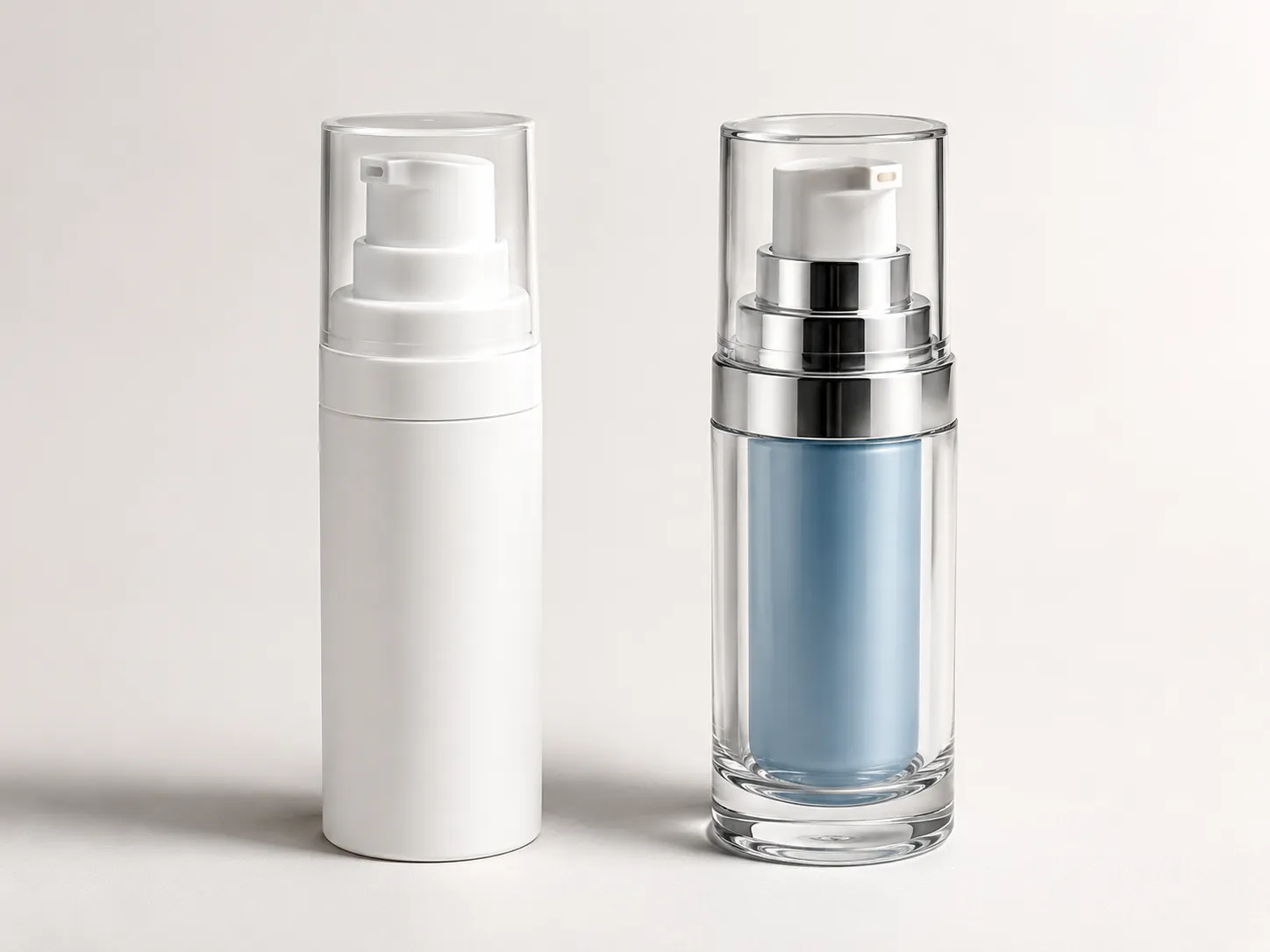
What Are PP and Acrylic Airless Bottles?
PP and acrylic airless bottles use similar dispensing principles but differ significantly in their outer structure, visual appearance, material composition, and typical market positioning.
In both cases, the airless system usually relies on a pump and a rising piston to dispense the formula without using a conventional dip tube. As the product is pumped out, the piston moves upward, helping reduce residual product and limiting repeated exposure to outside air.
The term “PP airless bottle” or “acrylic airless bottle” generally describes the primary visible material rather than every component within the complete packaging system. Pumps, pistons, inner bottles, seals, collars, and actuators may use different materials depending on the bottle design.
Buyers should therefore review the full material composition instead of judging the packaging only by its outer shell.

What Is a PP Airless Bottle?
A PP airless bottle primarily uses polypropylene, commonly abbreviated as PP, in its bottle body or major structural components. PP is widely used in cosmetic packaging because it is lightweight, impact-resistant, chemically stable, and suitable for injection molding in a broad range of shapes and colors.
PP airless bottles are often selected for skincare products that require practical, durable, and cost-controlled packaging. They can be used for facial serum, moisturizer, lotion, sunscreen, eye care products, and other personal care formulas.
Depending on the structure, PP packaging can support:
- Opaque or translucent colors
- Matte or glossy surfaces
- Custom Pantone color matching
- Silk-screen printing
- Hot stamping
- Labeling
- Surface coating
- Customized actuators and overcaps
One important advantage of PP is its potential for simplified material construction. Some airless packaging can be developed as all-PP or mono-material designs, although buyers should confirm whether the pump, spring, seals, and internal components also meet the intended material requirement.
A bottle described as PP is not automatically a completely single-material package.
For brands prioritizing low packaging weight, impact resistance, flexible color customization, and efficient bulk production, Oulete’s PP airless bottle packaging options provide a practical starting point for product selection.
What Is an Acrylic Airless Bottle?
An acrylic airless bottle usually features an outer shell made from polymethyl methacrylate, commonly known as PMMA or acrylic. Acrylic is valued for its high transparency, surface gloss, dimensional stability, and ability to create a thick-walled appearance similar to glass.
In many designs, the acrylic component functions mainly as a decorative outer shell. The inner bottle, piston, pump, actuator, and sealing components may still be made from PP, PE, or other plastics.
This multi-component construction allows the packaging to combine an airless dispensing system with a heavier and more premium visual presentation.
Acrylic airless bottles are commonly used for:
- Anti-aging serums
- Premium facial creams
- Eye treatments
- Luxury moisturizers
- High-value skincare concentrates
- Gift sets and prestige product lines
Transparent outer walls can be combined with colored inner bottles, metallic collars, gradient spraying, frosting, and other decorative effects to create a layered appearance.
Compared with PP, acrylic packaging is generally heavier and may require more protective handling during transportation. It is often better suited to skincare lines with a higher packaging budget and a stronger emphasis on luxury presentation rather than minimum weight or simplified material construction.
PP vs Acrylic Airless Bottles at a Glance
The following table summarizes the main differences between PP and acrylic airless bottles.
| Comparison Factor | PP Airless Bottle | Acrylic Airless Bottle |
|---|---|---|
| Packaging weight | Lightweight | Heavier |
| General appearance | Simple, clean, and flexible | Premium and glass-like |
| Transparency | Usually opaque or translucent | High transparency |
| Wall appearance | Thin to medium | Thick-wall appearance |
| Impact resistance | Generally strong | Moderate |
| Cost control | More suitable for cost-sensitive projects | Usually requires a higher budget |
| Color customization | Flexible | Flexible, especially for inner and outer color combinations |
| Decoration options | Printing, hot stamping, coating, labeling | Printing, spraying, frosting, hot stamping, metallization |
| Mono-material potential | Higher | Lower |
| Transportation practicality | Easier to manage due to lower weight | Requires more protective packaging |
| Typical positioning | Mass-market and mid-range skincare | Premium and luxury skincare |
| Common applications | Lotion, sunscreen, serum, moisturizer | Serum, eye care, anti-aging cream, luxury skincare |
These are general differences rather than absolute rules. Final performance depends on the complete bottle structure, pump system, decoration method, manufacturing quality, and compatibility with the intended skincare formula.
Appearance and Brand Positioning
Packaging appearance plays an important role in how consumers perceive a skincare product. PP and acrylic can both support attractive designs, but they create different visual and tactile impressions.
PP Offers Flexible but Simpler Visual Presentation
PP airless bottles usually have an opaque or semi-translucent appearance. They are well suited to minimalist, clinical, dermatological, natural, functional, or mass-market skincare concepts.
The material can be molded in a wide range of colors, allowing the bottle body, actuator, collar, and overcap to follow the brand’s visual identity.
Common PP design directions include:
- Matte white for clinical skincare
- Soft neutral colors for minimalist brands
- Bright custom colors for personal care products
- Solid black for men’s skincare
- Pastel colors for gentle or sensitive-skin products
- Metallic hot stamping for premium details
Although PP does not naturally provide the same glass-like transparency as acrylic, it should not automatically be considered a low-end packaging material.
Bottle proportions, surface quality, color consistency, actuator design, decoration accuracy, and overall structural integration can significantly influence the final appearance.
A well-designed matte PP bottle with clean printing and a coordinated pump can still support a professional or premium brand image.
Acrylic Provides a Thicker and More Premium Look
Acrylic is often selected when transparency, wall thickness, gloss, and visual depth are major design priorities.
A transparent acrylic outer shell can make the bottle appear more substantial, while a colored inner container creates a layered visual effect. This construction is commonly used for high-value serums, anti-aging treatments, and prestige creams.
Typical acrylic decoration options include:
- Transparent outer walls
- Colored internal bottles
- Frosted surfaces
- Gradient spraying
- Metallic collars
- Hot-stamped logos
- Vacuum metallization
- High-gloss finishes
- Decorative double-wall effects
Acrylic often delivers a stronger shelf presence and a heavier hand feel. These characteristics can support a higher perceived product value, particularly in department stores, beauty boutiques, gift sets, and premium e-commerce product presentations.
However, the more substantial appearance usually comes with higher material usage, more components, and increased packaging weight.
Weight, Durability, and Transportation
Packaging weight and durability influence not only the customer experience but also export handling, carton configuration, transportation costs, and damage risk.
PP Is Lightweight and Impact-Resistant
PP is widely used in packaging applications because it combines relatively low weight with good resistance to everyday impact.
For skincare brands, this can be particularly useful when products are distributed through:
- Cross-border e-commerce
- Online beauty retailers
- Subscription boxes
- Travel retail
- Pharmacies
- Supermarkets
- Large distributor networks
Lower bottle weight can help reduce the total weight of finished products and shipping cartons. It may also allow more units to be packed within a manageable carton weight, depending on the bottle dimensions and packaging method.
PP is also less likely to create the same brittle feel associated with some transparent rigid materials. This makes it practical for products that may experience repeated handling during filling, assembly, packing, transportation, and consumer use.
Acrylic Feels More Substantial but Requires More Protection
Acrylic bottles generally feel heavier and more solid. This can reinforce a premium brand impression, but it also creates additional transportation considerations.
Transparent or high-gloss acrylic surfaces may be more sensitive to:
- Scratches
- Surface marks
- Friction between bottles
- Edge damage
- Cracking after severe impact
- Decoration abrasion
Manufacturers may need to use protective bags, dividers, trays, or individual compartments to reduce contact between bottles during shipping.
Brands should therefore compare not only the unit price of the bottle but also the complete logistics requirements, including:
- Units per carton
- Carton weight
- Protective packaging
- Storage space
- Export transportation
- Damage replacement risk
For large-volume or long-distance export projects, PP may offer a more practical balance between appearance, weight, and transportation durability.
Cost and Bulk Production Considerations
The price difference between PP and acrylic packaging cannot be determined by material alone. Bottle structure, capacity, pump design, decoration, color, tooling, order quantity, and quality standards all affect the final quotation.
However, PP airless bottles are generally more suitable for projects where cost control and production efficiency are important.
Why PP Is Often More Cost-Efficient
PP airless packaging frequently uses a lighter and comparatively straightforward structure. Standard bottle molds can support a broad range of skincare projects without requiring completely new tooling.
PP may be more appropriate when the project involves:
- Large-volume production
- Multiple product variations
- Frequent repeat orders
- Cost-sensitive product lines
- Travel-size packaging
- Promotional skincare
- Mass-market distribution
- Private-label skincare programs
Standard PP bottles can still be customized through colors, printing, hot stamping, and surface treatments. This allows brands to create differentiated packaging without changing the complete bottle structure.
However, customization costs can increase when a project requires complex coatings, multiple printing passes, custom pump structures, unique molds, or special assembly processes.
Why Acrylic Airless Bottles Usually Cost More
Acrylic airless bottles often include a decorative external shell, a separate internal bottle, and several additional structural components.
The cost may also increase because of:
- Higher material weight
- Thick-wall construction
- More complex assembly
- Transparent surface quality requirements
- Gradient spraying
- Metallization
- Multiple decorative components
- Additional protective packaging
- Increased shipping weight
Acrylic is therefore more suitable when the product’s expected retail value can support a higher packaging budget.
For premium skincare, the additional cost may be justified by stronger shelf impact and perceived value. For lower-priced daily-use skincare, the same investment may not deliver a sufficient commercial return.
Customization and Decoration Options
Both PP and acrylic airless bottles can be customized, but their design strengths are different.
PP Airless Bottle Customization
PP is suitable for projects requiring consistent brand colors and practical decoration.
Available options may include:
- Custom color molding
- Pantone color matching
- Matte or glossy surface effects
- Silk-screen printing
- Hot stamping
- Label application
- UV coating
- Spray coating
- Customized actuator colors
- Customized collar colors
- Customized overcaps
- Standard or custom bottle shapes
- Refillable structure development
- Mono-material structure development
Color matching is an important consideration for PP packaging. Differences in resin batches, bottle wall thickness, surface texture, and lighting conditions can affect how a color appears.
Brands should confirm colors through physical samples rather than relying only on digital artwork.
Acrylic Airless Bottle Customization
Acrylic provides more opportunities for transparent, layered, and decorative visual effects.
Customization options may include:
- Clear outer shells
- Tinted transparent shells
- Colored inner bottles
- Frosted finishes
- Gradient spraying
- Full-surface coating
- Silk-screen printing
- Hot stamping
- Metallized collars
- Decorative rings
- Customized actuators
- Double-wall visual effects
- Custom external shapes
The combination of a transparent outer shell and colored inner bottle can create visual depth without requiring the formula itself to remain visible.
This is especially useful when the skincare formula may change color over time or when the brand wants to maintain a controlled external appearance.
Which Material Offers Better Brand Presentation?
Acrylic generally provides more options for thick-wall transparency and luxury visual effects. PP provides greater flexibility for lightweight, opaque, color-coordinated packaging.
The better option depends on the intended brand message.
Choose PP when the desired presentation is:
- Clean
- Practical
- Lightweight
- Clinical
- Minimalist
- Color-focused
- Cost-conscious
Choose acrylic when the desired presentation is:
- Transparent
- Substantial
- Decorative
- Luxury-oriented
- Gift-ready
- High-gloss
- Visually layered
Material is only one part of the design. Bottle shape, pump proportions, color combinations, decoration accuracy, and packaging consistency are equally important.
Sustainability and Material Structure
Sustainability claims require careful evaluation. A package should not be described as recyclable or environmentally friendly based only on the visible material.
Mono-Material Potential of PP Airless Bottles
PP has stronger potential for simplified or mono-material packaging because several bottle components can potentially be produced from the same polymer family.
An all-PP or mono-material airless bottle may reduce the number of different materials used in the complete packaging system.
However, buyers should still confirm:
- Whether the pump contains a metal spring
- Whether elastomer seals are used
- Whether all internal components are PP
- Whether decorative coatings affect recyclability
- Whether labels can be removed
- Whether the packaging can be separated after use
- Whether local recycling facilities accept the final structure
A PP outer bottle does not automatically mean that the complete package is mono-material.
Brands planning to make sustainability claims should request a full material composition list from the packaging supplier.
Recycling Challenges of Acrylic Airless Bottles
Acrylic airless bottles commonly use several materials in one package. The acrylic outer shell may be combined with PP, PE, metal, elastomers, coatings, or decorative components.
This creates a more complex packaging structure that may be difficult to separate after use.
Acrylic packaging can still be appropriate for brands focused on premium presentation, but sustainability claims should be based on the complete packaging system and the recycling infrastructure available in the target market.
Statements such as “fully recyclable,” “eco-friendly,” or “zero-waste” should not be used without appropriate structural and market verification.
Questions Buyers Should Ask Packaging Suppliers
Before selecting either PP or acrylic packaging, buyers should ask:
- What materials are used in each bottle component?
- Does the pump contain a metal spring?
- Can the components be separated after use?
- Is a mono-material version available?
- Can PCR material be incorporated?
- Will coatings or labels affect recycling?
- Can the supplier provide a material composition document?
- Has the final package been evaluated for the intended market?
These questions help brands avoid making decisions based only on the appearance of the outer bottle.
Formula Compatibility and Pump Performance
The outer bottle material is important, but it is only one part of the complete dispensing system.
An airless bottle also includes the inner product-contact components, pump chamber, piston, seals, actuator, and other structural parts. The formula may therefore have limited or no direct contact with the acrylic outer shell in some bottle designs.
This means buyers should not assume that PP and acrylic bottles will perform differently simply because their external materials are different.
Factors That Affect Packaging Compatibility
Airless bottle selection should consider:
- Formula viscosity
- Oil content
- Alcohol content
- Active ingredients
- Particle content
- Filling temperature
- Required pump output
- Priming performance
- Sealing performance
- Piston movement
- Product evacuation rate
- Storage conditions
- Expected shelf life
A lightweight serum may require a different pump dosage and sealing structure from a high-viscosity cream.
Similarly, sunscreen, oil-rich formulas, or products containing volatile ingredients may require additional compatibility evaluation.
Why Pump Output Matters
Pump output determines how much formula is dispensed during each actuation.
A low-output pump may be suitable for concentrated eye serum, while a larger output may be more practical for moisturizer, sunscreen, or body lotion.
The selected output should support:
- Accurate dosage
- Comfortable consumer use
- Consistent dispensing
- Suitable application frequency
- Reasonable product consumption
- Stable pumping throughout the bottle’s use
The pump should also work consistently as the piston rises and the amount of formula decreases.
Why Compatibility Testing Is Necessary
Visual inspection alone cannot confirm whether a bottle is suitable for a skincare formula.
Before bulk production, brands should evaluate samples with the intended formula and monitor:
- Leakage
- Pumping consistency
- Formula discoloration
- Odor changes
- Material swelling
- Component deformation
- Blocked dispensing
- Piston movement
- Product residue
- Decoration stability
The required testing period depends on the formula, packaging structure, storage conditions, and market requirements.
High-viscosity creams, oil-rich products, sunscreen formulas, and formulas containing alcohol or active ingredients may require particular attention.
Which Material Is Better for Different Skincare Products?
The following recommendations provide a practical starting point.
| Skincare Product | Suggested Starting Option | Main Reason |
|---|---|---|
| Facial serum | PP or acrylic | Depends on formula and brand positioning |
| Eye serum | PP | Lightweight and suitable for small capacities |
| Anti-aging serum | Acrylic | Supports a more premium visual presentation |
| Daily moisturizer | PP | Practical, durable, and cost-efficient |
| Premium face cream | Acrylic | Thick-wall appearance supports luxury positioning |
| Sunscreen | PP | Lightweight and impact-resistant |
| Travel skincare | PP | Easier to transport and carry |
| Luxury gift set | Acrylic | Stronger decorative and shelf impact |
| Sustainable skincare line | Mono-material PP | Greater potential for simplified material construction |
| E-commerce skincare | PP | Lower weight and practical transportation performance |
| Professional skincare | PP | Suitable for functional and clinical presentation |
| High-value treatment product | Acrylic | More substantial appearance and perceived value |
These recommendations are starting points rather than universal rules. The final choice should be confirmed through sample review, formula compatibility evaluation, decoration testing, and cost analysis.
PP or Acrylic: How Should Your Brand Decide?
The most suitable material depends on the commercial priorities of the skincare project.
Choose PP Airless Bottles When:
- Packaging weight needs to be controlled
- Impact resistance is important
- The product will be sold through e-commerce
- The project requires flexible molded colors
- The target market is mass-market or mid-range skincare
- The order volume requires stronger cost control
- The brand is exploring mono-material packaging
- The product includes multiple sizes or variations
- Transportation practicality is a major consideration
- The design direction is clean, clinical, or minimalist
Choose Acrylic Airless Bottles When:
- Premium shelf appearance is the main priority
- The design requires high transparency
- A thick-wall or glass-like effect is preferred
- The product has a higher retail price
- Packaging weight is less important
- The project requires double-wall visual effects
- The brand uses complex spraying or decorative finishes
- The packaging will be used in gift sets
- A substantial hand feel supports the product positioning
- The budget allows more complex packaging construction
Consider Both Materials When:
Some skincare brands do not need to choose only one material for the entire product range.
For example:
- A daily moisturizer can use PP packaging
- A premium anti-aging serum can use acrylic
- Travel sizes can use lightweight PP
- Hero products can use decorative acrylic
- Professional lines can use PP
- Gift sets can use acrylic
Using different materials across product tiers can help a brand balance packaging cost, product positioning, transportation requirements, and visual presentation.
Questions to Ask Before Requesting a Quote
A clear request for quotation helps the packaging manufacturer recommend a more suitable bottle and provide a more accurate price.
Buyers should prepare the following information:
| Requirement | Information to Provide |
|---|---|
| Formula type | Serum, lotion, cream, sunscreen, gel, or other formula |
| Formula characteristics | Viscosity, oil content, alcohol content, active ingredients |
| Bottle capacity | 15ml, 30ml, 50ml, 100ml, or custom |
| Preferred material | PP, acrylic, or undecided |
| Pump output | Required dosage per actuation |
| Pump structure | Standard, metal-free, lockable, or other structure |
| Bottle color | Standard color or Pantone reference |
| Decoration | Printing, hot stamping, coating, spraying, or labeling |
| Order quantity | Trial quantity and estimated annual demand |
| Target market | Country or sales region |
| Packaging objective | Cost control, premium appearance, lightweight design, or sustainability |
| Project schedule | Sample confirmation and expected delivery date |
Providing formula and project information at the beginning can reduce unnecessary sampling and help the supplier identify potential compatibility or structural issues earlier.
Working With an Airless Bottle Manufacturer
A suitable packaging supplier should do more than provide a bottle catalog. The supplier should help the buyer compare materials, select an appropriate pump structure, review decoration requirements, and prepare samples for evaluation.
Depending on the project, packaging development support may include:
- Standard bottle selection
- PP and acrylic material comparison
- Capacity recommendations
- Pump output selection
- Color matching
- Logo and artwork review
- Decoration sampling
- Formula compatibility evaluation
- Custom mold development
- Pre-production sample confirmation
- Bulk production inspection
- Export packaging
Oulete supplies standard and customized airless packaging for skincare and personal care projects. Brands can review available PP airless bottle packaging options and provide their formula type, target capacity, decoration requirements, and estimated order quantity for a packaging recommendation.
Frequently Asked Questions
Is PP or Acrylic Better for Airless Bottles?
Neither material is universally better.
PP is generally more suitable for lightweight packaging, impact resistance, cost control, flexible color molding, and mono-material development.
Acrylic is generally more suitable for high transparency, thick-wall appearance, heavier hand feel, and premium skincare positioning.
The best option depends on the formula, brand image, sales channel, order quantity, and packaging budget.
Are Acrylic Airless Bottles Made Entirely From Acrylic?
Usually not.
Acrylic is commonly used for the decorative outer shell. The inner bottle, piston, pump, actuator, and sealing components may use PP, PE, elastomers, metal, or other materials.
Buyers should request the complete material composition when recyclability or formula compatibility is important.
Are PP Airless Bottles Recyclable?
PP has recycling potential, but the recyclability of the complete package depends on its full structure.
A PP bottle may still contain a metal spring, seals, labels, coatings, or components made from other materials.
A mono-material or all-PP structure may simplify the material composition, but its suitability for recycling still depends on local collection and processing systems.
Which Material Is More Suitable for Premium Skincare?
Acrylic is commonly selected for premium skincare because of its transparency, thick-wall appearance, surface gloss, and substantial hand feel.
However, PP can also support premium designs through custom colors, matte finishes, high-quality printing, hot stamping, and well-integrated bottle structures.
The final result depends on the complete packaging design rather than the material alone.
Which Airless Bottle Is Better for E-Commerce Skincare Brands?
PP is often a practical choice for e-commerce because it is lightweight and generally resistant to everyday impact.
Its lower weight may simplify packing and transportation, while its durability can help reduce damage risk.
Acrylic can still be used for e-commerce products, but it may require more protective packaging.
Can Both PP and Acrylic Airless Bottles Be Customized?
Yes.
Both materials can support custom colors, logos, surface finishes, actuators, collars, overcaps, and decorative treatments.
PP is especially suitable for molded colors and coordinated opaque designs. Acrylic is especially suitable for transparent, frosted, gradient, and double-wall effects.
Do PP and Acrylic Bottles Work With the Same Skincare Formulas?
Not necessarily.
The external bottle material does not determine the complete formula compatibility. Buyers must also consider the inner bottle, pump, piston, seals, and other product-contact components.
Compatibility testing with the intended formula is recommended before bulk production.
Can High-Viscosity Cream Be Used in an Airless Bottle?
High-viscosity creams can be used in certain airless bottles, but the pump structure, output, inlet design, piston movement, and bottle dimensions must be suitable for the formula.
Samples should be tested with the actual cream before the packaging is confirmed.
Can Brands Order Samples Before Mass Production?
Sample evaluation is an important step in airless packaging development.
Brands should use samples to review bottle appearance, pump performance, color, printing, decoration, formula compatibility, and product evacuation before approving bulk production.
The exact sampling process depends on whether the project uses a standard bottle or requires custom development.
Conclusion
PP and acrylic airless bottles address different skincare packaging priorities.
PP is generally the stronger option when a project requires lightweight construction, impact resistance, flexible color customization, cost-efficient bulk production, or greater potential for mono-material packaging.
Acrylic is generally the stronger option when the brand prioritizes high transparency, thick-wall appearance, substantial hand feel, and premium shelf presentation.
However, the final decision should not be based only on appearance or material price. Brands should also evaluate the formula, pump output, product-contact components, decoration process, packaging weight, transportation requirements, order quantity, and target market.
For many projects, the best approach is to compare physical samples and test the complete bottle system with the intended skincare formula before mass production.
To receive a suitable packaging recommendation, provide Oulete with your formula type, required capacity, preferred appearance, decoration method, estimated order quantity, and target market.